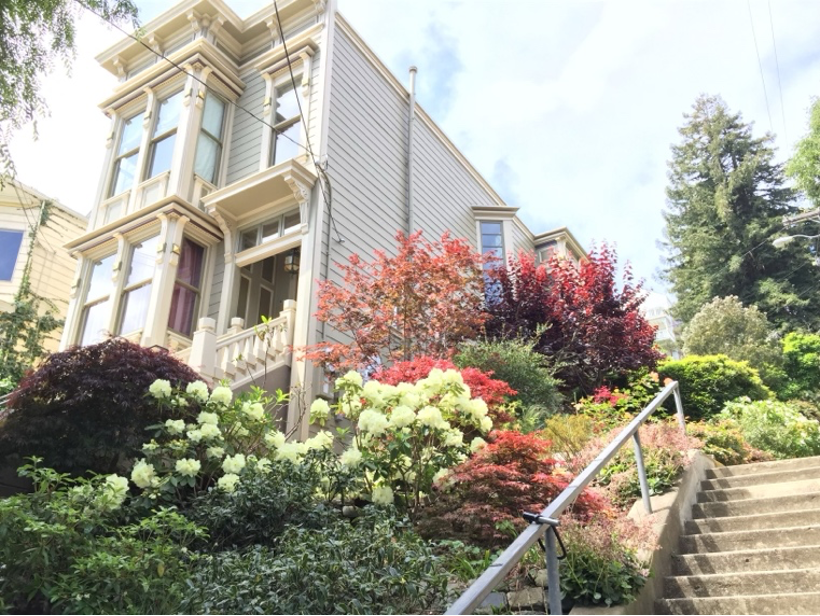
Vulcan Stairway, named for the Roman god of fire, is one of the nicest stairways in the city. The lower portion has terraced gardens and the upper portion is surrounded by charming Victorian
cottages and much greenery—209+/- stairs. Vulcan runs from Ord at the lower end to Levant at the upper.
The grading of Vulcan and the construction of the concrete stairway, landings, copings, a storm water inlet, and pipe railing, was approved by Resolution No. 78504 on August 16, 1923 (San Francisco Journal and Daily Journal of Commerce) as part of the Street Improvement Ordinance of 1918.
See Vulcan Stairway 1925.
And before it was Vulcan Stairway, it was Vulcan Street. One hundred and twenty five lots of Park
Lane Tract, map 5, were offered at auction by Adolph Sutro in September 1891. At auction the lots on Vulcan brought between $150 to $510 each, depending on the location, while those on Serpentine Place (now Saturn) brought $300 to $600. (San Francisco Chronicle, September 25, 1891).
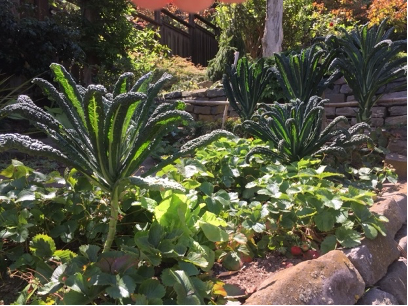
A Hundred Years Later: A Garden by Neighbors, for Neighbors “The house is slanted, full of rats, and haunted.” Those were words of warning to Pat Dowd and Rick Walsh before they bought 18 Ord Street in 1997. Plus, they couldn’t tour the inside of the home before making their offer. One city landmark was the selling point, though: “We bought this house for the Vulcan stairs.” Pat and
Rick spent years beautifying their home into the jewel it is today. A previous owner was a sun worshipper, and had cut “wacky windows” into the home to allow maximum sunlight to come in. Those had to be fixed. Then, they had to fend off the rats and keep a ghost at bay.
After years of renovation, they polished their home into something wonderful, but their passion lay with the garden, most of which abuts the Vulcan Stairway. They spent the weekends of their early days
ripping out ivy, blackberry, and acanthus. They had to jackhammer to extricate invasive plants.
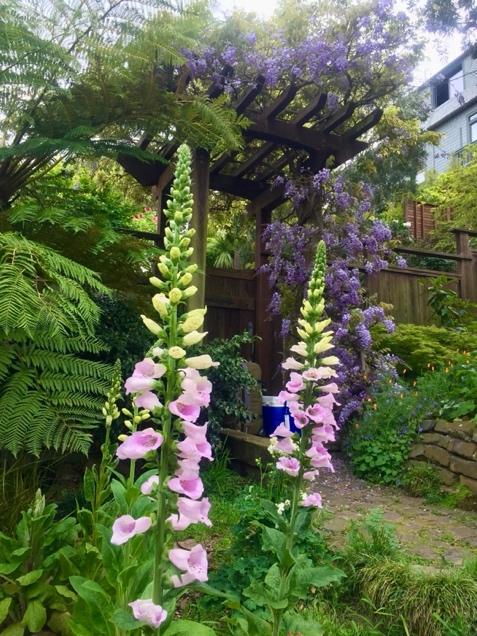
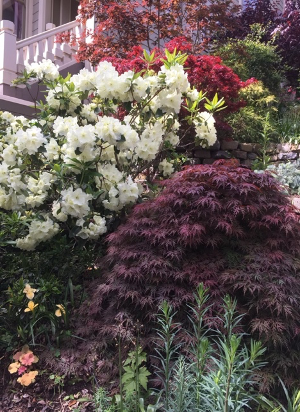
Today, it is a neighborhood icon. Pat and Rick water, plant, and maintain a variety of plants and trees that neighbors enjoy. “I have a spreadsheet of all the plants and trees we’ve ever planted,” Rick said. “There must be many hundreds,” said Pat. They both name their dwarf Japanese Maple trees as their favorite.
There are plenty of quirky touches. A sign warning that
the property is “Closed to Horses,” which was collected in Palm Springs. There is a hidden bamboo patio centered around a Chinese lantern. They once planted Dino kale, which was a big attraction for neighbors.
Cobblestones are a prominent feature. While some cobblestones were put in by a previous tenant, Pat and Rick added hundreds of their own. Some cobblestones were recovered during work on Ord Street, and some were salvaged during the construction of AT&T Park. Pat
constructed a small staircase to a much-loved lemon tree using those cobblestones.
They are quick to credit other neighbors with inspiring them. “Mike and Rick planted 3,000 bulbs last year on the other side of the staircase,” said Rick. Pat has a botany degree. But they credit their passion to a “genetic predisposition.” Both maintained vegetable gardens as kids.
Reflecting on nearly three decades on Ord maintaining their house and garden, Rick noted, “It’s an
entirely different neighborhood than when we bought it. This new community is our favorite thing about living here. The stairs create a sense of neighborliness. You’re always talking to people.” Pat added “We like how the garden makes other people happy. It’s an inexhaustible way to spend your time.
Early Owner of 18 Ord (34 Clara)
An early owner (if not the first) of 18 Ord (formerly 34 Clara Street), was William L. Meuser, a tinner and a sheet metal worker by trade, who in
1914 protested the city’s intention to the extension of Vulcan Street into Ord Street. He believed that the assessment would be more than his property could stand and when completed his property would be on a bluff. The city engineer testified that Mr. Meuser’s property would not be materially affected and that at present Vulcan Street ran into a cul-de-sac or pocket and residents had to climb up to get out and that the improvement was badly needed. The extension was
approved. Mr. Meuser shows up earlier in the news in 1911 complaining about the condition of the sidewalks at the southeast and northwest corners of 17th and Ord Streets. (He would have loved 311.) City directories show Meuser first living at 34 Clara (18 Ord) in 1891 and a John J. Farrell, a bricklayer, renting at 34 ½ Clara (18a Ord). (Mr. Farrell shows up at 42 Clara as early as 1884. Street numbers changed with the street name change (Clara to Ord)
in 1909. Was 42 Clara 34 1/2 ? If so, it would date the house to 1884.) Meuser died in 1917 and never got to the see the completion of the stairway. One of his two sons and his wife lived there until 1935.
Our Neighborhood’s Landmark Tree
Landmark trees are trees that have been designated by the Board of Supervisors as extra special. It may be due to the rareness of the species, their size or
age, or extraordinary structure, or ecological contribution. In addition, historical or cultural importance can qualify a tree for Landmark Status. Trees that are designated by the city for landmark status are protected from physical damage and removal. CHN nominated this Sequoiadendron giganteum in 2014 to the Urban Forestry Council and the Board of Supervisors for landmark status: Ordinance 205-14.
The giant sequoia can be found in the backyard of a house on the north side of the 3000 block of Market. The tree was brought back from the sierras by Sylvan (!) Adams, a graduate of the University of California, Berkeley, class of 1933 who worked the U.S. Forest Service and the Bureau of Entomology (1930-1967). He
gave the tree to his older sister who lived at Market Street property in the late 1940s or early 1950s. This is the only landmarked giant sequoia in San Francisco, and one of only 200 landmarked trees. The photo on the left was taken in 2010; on the right, 2014.
Bird Watch
Neighborhood birders are no doubt familiar with the wild
parrots that (loudly) fill the skies of Corbett Heights. Perhaps an equally stunning sight are the red-tailed hawks that live in our area. They can be spotted at Corona Heights Park, Buena Vista Park, the top of the Vulcan Stairway, and the Corona Heights Community Garden. They will soon become even more visible; mating season starts in March and is marked by elaborate aerial courtship rituals. Keep a keen eye!
The Market Street giant sequoia mentioned above has hosted
many birds, including the red-shouldered hawk, American robin, blue jay, snowy egret, Anna’s hummingbird, northern mockingbird, cardinal, European starling, raven, and mourning dove.
Traffic Calming/3000 Market Street
As a follow up to concerns expressed by the residents who live on the 3000 block of Market, the Board sent a letter to
Supervisor Mandelman and SFMTA requesting that SFMTA undertake a study to make this street safer for the residents. Supervisor Mandelman is setting up a meeting of concerned residents, SFPD, and SFMTA will be set up sometime in February.
Assembly Bill 413
The State of California has mandated
that there be no parking within 20 feet of every intersection.AB413 affects parking at all the intersections in our
neighborhood. This bill removes 5% or 13,775 parking spaces in the city.
Our interpretation of the above bill would issue warnings, not file/violations, prior to January 1, 2025 unless the area has been identified by a painted curb or signage. After January 1, 2025, ticketing begins whether marked or not. (SFMTA painted red zones at four of the eight corners at the corner of Ord and Corbett, which should cause some confusion.)
There is a Change.org
petition to repeal AB413. If you support that, here is the link: Petition
Meeting with Supervisor Mandelman and SFMTA
Board members met with Supervisor Mandelman and Joél Ramos, SFMTA Transportation Planner, Sustainable Streets Division, on January 25,
2024 to discuss the neighborhood concern over loss of parking on Corbett as red zones have been proposed for all bus flag stops. You may recall 83% of the membership was concerned about this loss of parking, which would cover the 14 flag stops on Corbett or about 280 feet of parking. This, is in addition to the loss of 41’ at Mars for a stop sign and 74’ at Ord and Corbett (AB413).
While the meeting of January 25, 2024 provided some indication from Mr. Ramos
that some flexibility might be considered, and we left hopeful that our concerns were heard, but today we received the following message, in part.
Staff also corrected me in estimating that we will be implementing changes along the 37 Corbett bus route by mid to late 2024 (which, admittedly, is much sooner than I had estimated). The project team’s preliminary review of all the Muni stops on Corbett Avenue indicates that there are 25 bus stops,
10 of which will likely require a parking space to be removed for improved access.
Additionally, as part of San Francisco’s compliance with a new state law AB413 that requires the approach to an intersection be clear of cars to improve safety, an additional four parking spaces at the approach to crosswalks will likely also be removed. This is a separate effort from the Flag Stops Program, but we wanted to be sure to mention it.
Staff estimate that there are about 350 on-street parking spaces on this segment of Corbett Avenue. Outreach for these changes will include posting notices near the Muni stops and as-needed canvassing to the immediate area at least one week in advance of the changes being implemented.
Again, I thank you for expressing your concerns to us on this matter, and we will be sure to
minimize the loss of parking on Corbett (including utilizing "daylighting" zones and driveways as clearance wherever possible) in our response to the BOS resolution.
Preservation Meeting January 31, 2024
On Wednesday, January 31, Kate Conner, Manager of Housing Implementation Programs for the San Francisco Planning Department, joined SF Heritage president & CEO Woody LaBounty in a discussion of state housing legislation and the potential impacts on historic buildings in San Francisco.
New laws streamlining approvals, offering density incentives, and removing local review took effect January 1, 2024. What do
they mean for the city's local landmarks, conservation districts, and significant but undesignated historic buildings and landscapes?
The Planning Department met on February 1, 2024 to discuss up-zoning. If you did not get a chance to attend, you can watch it here (item 13): Planning Department/Housing/Up-Zoning.
The Planning Department will have their next informational hearing on the proposed rezoning on February 22 at 12pm. You can watch virtually on SFGovTV or join in-person at City Hall, Room 400.
Here are the proposed rezoning changes that may come to
District 8. Note that 40 feet is roughly 4 stories, 50 feet is 5 stories, 65 feet is 6 stories, and 85 feet is 8 stories:
Market/Castro and Market/Church
Existing: 50 or 65 feet, 40 feet for surrounding blocks
Proposed: 85 feet, 65 feet for surrounding blocks
Glen Park BART Station
Existing: 40 feet
Proposed: 85 feet
Along the J-Church line
Existing: 40 feet
Proposed: 65 feet (north
of 21st St and south of Cesar Chavez) or 85 feet (between 21st St and Cesar Chavez)
Noe Valley
Existing: 40 feet
Proposed: 65 feet along 24th Street
85 feet along the N-Judah line
Existing: 40 feet
Proposed: 65 feet (Duboce Triangle) and 85 feet (Cole Valley)
Park Station Newsletter
Very recently, a house with scaffolding in the CHN neighborhood was targeted for a 0500 hour burglary. The intruder was scared off by the owner. Take extra precautions if you have scaffolding up on your house for painting or
repairs. To follow the news at Park Station, you can subscribe here: Park Station Subscribe Newsletter.
Al's Park Clean Up
Please join your neighbors on Saturday, February 17, at 11-1 PM at Al's Park for the monthly clean-up. We will remove lots of weeds.
General Meeting: Monday, March 18, 2024
Save the date for our CHN General Meeting on Zoom at 7 PM.
Speakers will be announced in the March newsletter.