September Neighborhood News
CHN General Membership Meeting
& Election of Board Members
General Membership Meeting, September 30, 2024, 7 PM at 501 Castro, 2ndFloor,
Community Room
CHN will hold its annual meeting on Monday, September 30, at 7 PM at the Castro Community Meeting Room at 501 Castro (second floor). A door-to-door flyer will announce the speakers. This is our first in person meeting since January 2020.
Election—Please Vote! (Paid Members Only)
September is CHN Board election month. Paid CHN members will receive an electronic ballot that can be used to
vote confidentially in the election for the board of directors for the forthcoming year. The ballot will be sent at least two weeks before September 30, 2024. Candidate names and a brief “candidate statement” will be on the ballot you will receive from Election Runner. Please vote no later than 6 PM September 30, the date of our annual meeting. Any member of CHN may nominate him/her self or any other member to become a board member by informing the secretary
([email protected]) a minimum of 30 days prior (September 1) to the annual member meeting. A meeting reminder will be sent September 27, 2024.
This year, there will be a “yes” or “no” vote requested on a change to our bylaws. We recommend you approve the changes to General Meetings dates.
Mayoral Candidate Mark Farrell Met with CHN Board
On August 15th, Mayoral Candidate
Mark Farrell joined the Corbett Heights Neighbors Board meeting to hear neighbors’ concerns. The Farrell campaign reached out to CHN this summer in an effort to understand the unique issues of our neighborhood. At the meeting, board members relayed the most-cited issues to Farrell. He spent over an hour meeting with CHN, and we thank him for his time.
Issue #1: Residents are deeply concerned about several interconnected issues impacting our city.
These include the proliferation of homeless encampments and their associated problems, such as garbage, graffiti, and vandalism. Many are frustrated with the lack of effective enforcement and the perceived inadequacies of the prosecution and court system.
Farrell’s Response: “I believe this mayor could have dealt with these issues before the Supreme Court ruling, just like I did when I was Mayor…it takes consistency and a backbone. The
Coalition for Homelessness was protesting in front of my house; criticism will come if you do it right.”
It takes time, he said. However, “by the 3rd or 4th time you take the tent encampment away, you made it ‘inconvenient for that lifestyle to exist.’ I don’t want to pretend I’m going to solve every individual’s underlying problem, but I will be an effective Mayor of San Francisco for our neighborhoods.”
A
board member then mentioned the number of agencies in the city, to which Farrell replied:
“We fund 248 non-profits for homeless services. We spend over a billion a year–between city and non-profits. How we’re spending our dollars is so ineffective and so inefficient as a city government. What I will do immediately in office next year is cut off everyone’s third party contracting authority. That’s within the Mayor’s
authority.”
Issue #2: The cycle of criminals being caught and then quickly released with minimal consequences. This situation not only creates a sense of insecurity but also undermines trust in our justice system and negatively impacts local businesses.
Farrell’s Response: “Public safety—along with homelessness—is the #1 issue in San Francisco. It was not that way a number of years ago. Twenty-five
percent of our police department is gone in the 6 years since I left.”
“That impacts everything we do in our city. My car was stolen in front of my house two months ago. That’s the state of affairs right now and it’s completely unacceptable. You need a Mayor who fully funds and commits to fully staffing the police department.”
“When you don’t have enough jail capacity, you put people out on the street with ankle monitors and diversion programs.
We have 800 people with ankle monitors, and only 2 staffed to monitor them. If you’re going to be honest and serious about public safety, you need to know all the details, and also address and fund it.”
“It’s not that I don’t think we have great men and women in our police department. It’s that we don’t have enough of them. Police staffing is a combination of money and being able to effectively recruit. This Mayor has done neither.”
“The
police commission is a major issue. They’re not accountable to anyone. The majority of the police commission has no law enforcement background. And they’re dictating policy to the police officers.”
“We also need a different type of police chief in there, to be a fighter and a leader.”
Issue #3: Many parents are concerned about the ability of public schools to provide a high-quality education for their children, leading
many to turn to private schools.
Farrell’s Response: “If you want San Francisco to be the iconic city that we believe it is, then we all want better public schools.”
“We need to elect people that are going to run the School Board better.”
“I want to be the most proactive mayor that we’ve ever had around public school families and public school children.”
While Farrell wouldn’t be able to directly dictate
the policy or budget decisions for the School Board, he mentioned three key areas in which he’d work with the Board:
1. Third grade reading is a key academic marker. He’d focus on that.
2. MTA. A lot of families use Muni to get to school. It’s imperative that the buses be on time so kids can get to school on time.
3. Public safety. He wants a priority 311 code. Any public safety issue within a block of the schools gets
dealt with within 24 hours.
Issue #4: Constant re-zoning by the City Planning Department makes it seem as if there is no consistent zoning policy, leading to uncertainty and frustration. Additionally, there are significant concerns about the poor handling of historic resource reviews and designations.
Farrell’s Response: “I was very opposed to the current plan our mayor came out with, a blanket
up-zoning plan. I thought that was just wrong. We need to build more housing, and I believe we can do it in every neighborhood. But not every neighborhood needs to look the same. I believe the greatest capacity for new units is in Soma and Mission Bay. We need to up-zone those neighborhoods because we need to revitalize those neighborhoods.”
“The next Mayor needs to build toward that state mandate, because if they don’t, the state will
come over our back and then there are really bad consequences.”
Issue #5: We have significant concerns around SFMTA’s operations, including its independence from resident input. The Zero Vision program appears ineffective despite substantial investment. Additionally, the MTA’s autocratic and unaccountable nature is troubling. Unreasonable fees for parking permits and citations, particularly affecting less affluent areas, are also a
concern.
Farrell’s Response: “We need a new head of the MTA. They’ve been operating on ideology instead of common sense for far too long.
“Transit First doesn’t bother me, but that doesn’t mean crushing people who use cars.”
“From an MTA perspective, they need to stop doing capital projects and start focusing on operations.”
Reminder:
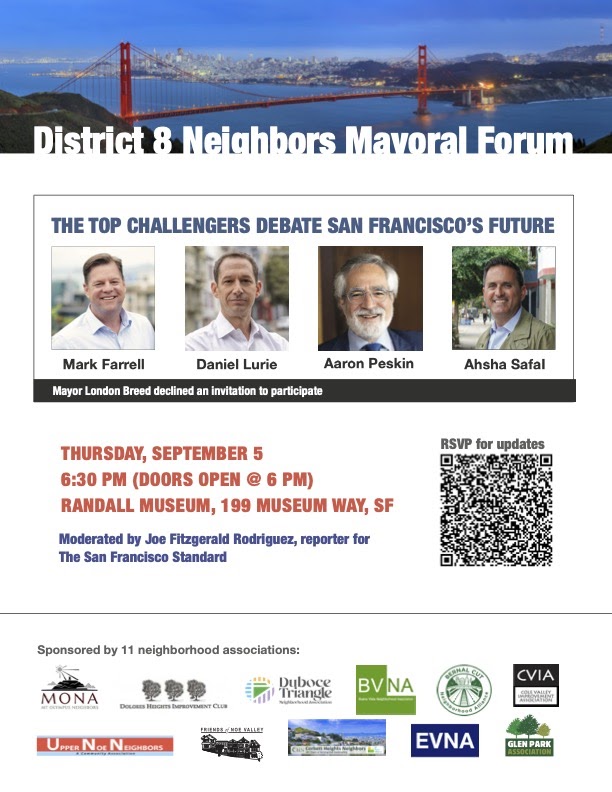
District 8 Neighbors Mayoral Debate
June V. Johnson (1922—2024)
June Johnson (11 days short of 102 years of age) of Ord Court died peacefully in her bed August 19.
She had been receiving hospice care for a few weeks at home. Perhaps you might have seen June over the years walking with headphones with antennas around the neighborhood.
She moved to Ord Court in 1924—a hundred years ago! Her parents paid $4,000 for her home and her taxes were $460 a year. "$4000 was a lot back then!" according to June. Her daughter lives nearby on 18th Street.

Joey Accordino
Leslie Koelsch
Newsletter Committee
August 29, 2024