What’s Happening with the Controversial Upzoning Proposed by Former Mayor Breed?
It’s not gone away, but changes are anticipated. Note the outreach period during May-July. CHN will alert our membership with
news.
Timeline for Mayor Lurie’s Upzoning Plan
January-March: Mayor Lurie and Planning Department Revising Upzoning
February 27: Tenant Displacement – Planning Commission Hearing
March 20: Upzoning Notification Legislation – Planning Commission
Mid-April:
Lurie’s Plan Published
May-July: Out-reach Lurie Plan – SF Planning Staff
Winter 2025: Approval of Lurie Plan – Board of Supervisors
January 2026: Mayor Lurie Submits Plan to the State of California
On March 20, a new upzoning Notification Ordinance was introduced by Supervisor Connie Chan, which seeks to require mailed notices to all property owners, residents, and business tenants in upzoned areas, and everyone within 300 feet of upzoned parcels.
It passed 5-2 (with modifications). Commissioners Campbell and McGarry voted no, expressing skepticism that the proposal would make a meaningful difference and raising concerns about the cost.
Yet, Planning’s own
presentation revealed the massive scale of the upzoning—affecting more than 400,000 residents out of the city’s 808,000. This includes those whose parcels are being upzoned, those living within 300 feet of these changes, and a broad swath of properties being shifted from single-family zoning to allow 4 and 6 plexes.
Planning also acknowledged that roughly 13,000 acres—nearly half of San Francisco’s total 30,000 acres—will be impacted, representing a dramatic
transformation of our city’s built environment.
The next step: Supervisor Chan is to schedule the proposed Ordinance with the Land Use and Transportation Committee.
More Upzoning by Scott Weiner
Senator Scott Wiener introduced Senate Bill (SB) 79, the Abundant & Affordable Homes Near Transit Act, SB 79, on March 14, 2025 that will
Establish state zoning standards around train stations and major bus stops
(bus rapid transit stops) to allow for multi-family homes up to seven stories near immediately surrounding major transit stops, with lower height standards extending up to half a mile away from such stops.
Streamline permitting for homes built within half a mile of major public transit stops.
Allow local transit agencies to develop at the same or greater density on land they own.
For the Birds
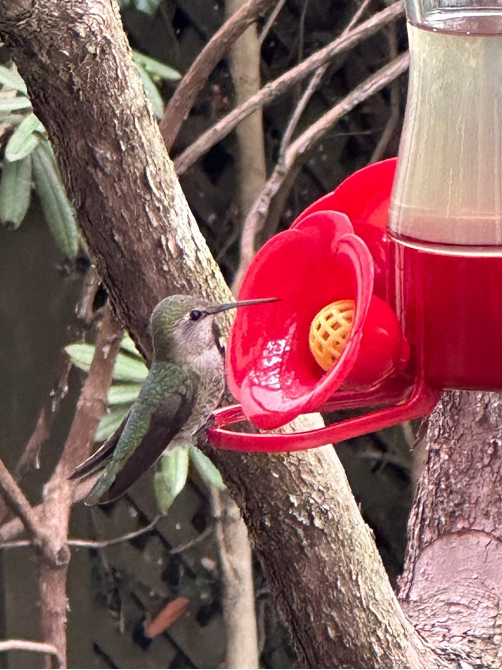
Our baby hummingbird
left the nest on March 8, 2024, and we are sorry we missed the event. But here is mom feeding a day before.
March 7, 2025 Credit: John
Koelsch
Did Wilt Chamberlain Live in the Neighborhood?
Did Basketball Hall of Famer Wilt (Wilton N.) Chamberlain (1936-1999) of the San Francisco Warriors own 310 Corbett Avenue? We set out to confirm this neighborhood folklore. The short answer is yes.
The house at 310 Corbett Avenue was designed in 1962 by architect Jonathan D. Buckley, 801 Kansas Street, for Ena and Michael Howell as
joint tenants. The house plans are dated April 20,1962. Buckley’s work is extensively documented by Amy O’Hair—
Buckley-Built Mid-Century Modern). The design of 310 Corbett is designed with irregular shapes and angles, avoiding squares and rectangles. Even the swimming pool in the garden in the
rear of the top floor is irregular.
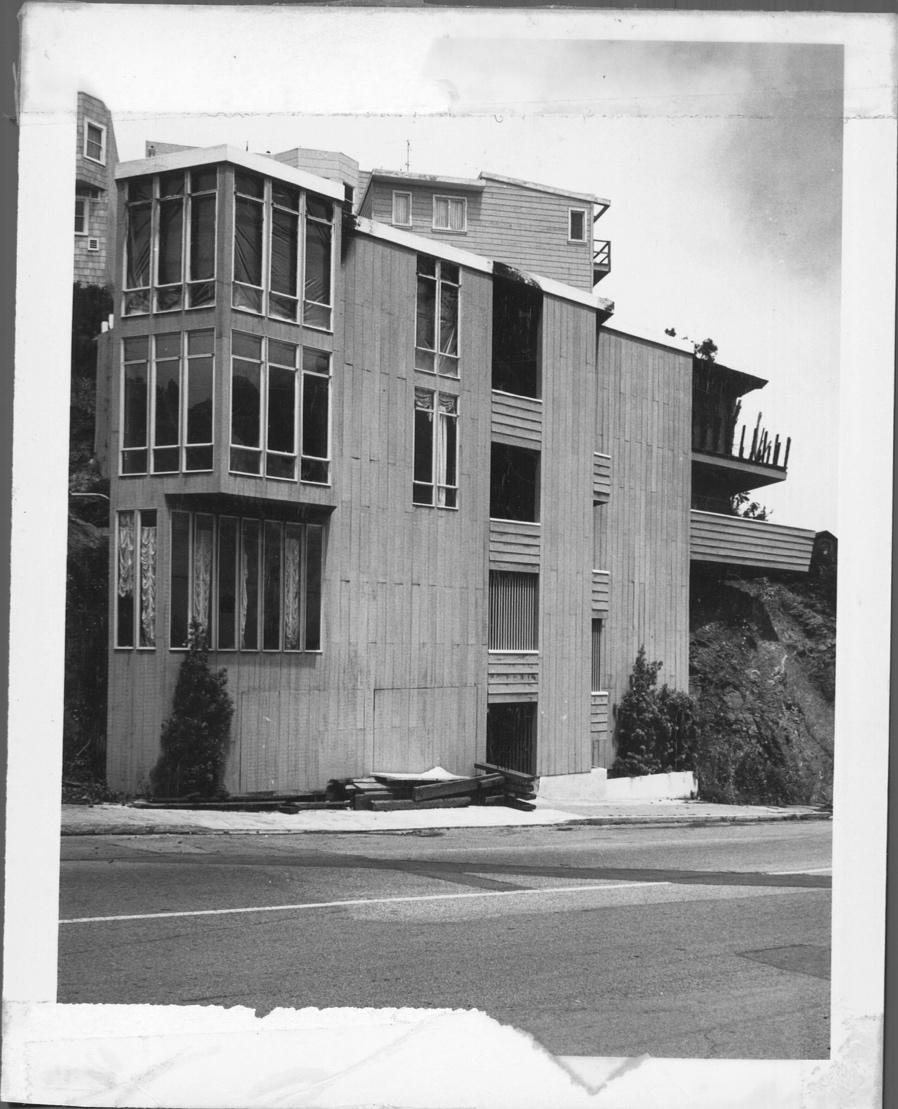
310 Corbett, June 1967, after a fire, before purchase and repair by Chamberlain Note: Shingles not part of the original
design.
Ena resided on Corbett from 1962 to 1965 when she died as the result of a street car accident, leaving her son, Michael, as the sole owner. In 1967 there was an extensive fire, leaving the building uninhabitable.
We were unable to find Chamberlain’s purchase agreement for 310 Corbett, but Chamberlain filed a permit for repairs dated February 16, 1967. On December 3, 1975, Chamberlain sold the building to Ron Bansemer
(d. 2012), of Herth Realty, who, in turn, sold it May 21, 1991. The current owner purchased 310 Corbett Avenue in 2002.
While we can establish that Wilt Chamberlain owned the building from 1967 to 1975, the city directories do not show him ever living there. Since there are two legal units, he most likely kept the top floor for himself as his career required frequent travel. He rented out the lower unit as indicated by different tenants during that eight year
period.
Chamberlain built his custom house in Bel-Air in 1972. Take a look at Chamberlain’s Bel Air hill top mansion, Ursa Major, described by Chamberlain himself in 1972, built on a former Nike Missile site.
David Tenneson Rich was the architect. Rich describes how he and Chamberlain came to design the house. No squares, circles, but triangles! Did 310 Corbett inspire the design for Bel Air house? (Crypto entrepreneur Erik Voorhees is the current owner of the former home. Voorhees purchased the home for just under $9.7 million in February 2024. The price was well below the
$19 million that the previous owner, Dmitri Novikov, had originally sought.)
Another basketball legend, Nate Thurmond (1941-2016), also has some connection to our neighborhood. If you lived here long enough, you would have seen him driving his Rolls Royce Silver Cloud III with the license plate, Nate 42, up and down Corbett when he lived at 5094 Diamond Heights Boulevard. Thurmond purchased the Silver Cloud from Glen Campbell in 1969 and owned it until
2009.
Watch a video at the Chase Center Art Center about Chamberlain and Thurmond here with former player and Warriors broadcaster, Jim Barnett, and current assistant coach, Ron
Adams.
Wilt Chamberlain “The Wilt to Win” by Samantha Wendell, 2018 Oil on Canvas Chase Art Center
Nate Thurmond 1965 Rolls Royce Silver Cloud III
The Missing Trash Can
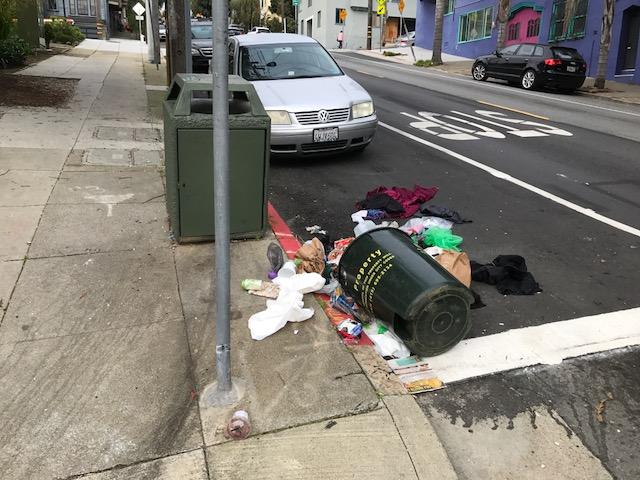
Wondering what happened to the second trash can at Ord Park? The Board voted to remove it. It
attracted a lot of dumping and rummaging—too much to clean up and too many 311 calls. It frequently looked like this.
Guess the Location and the
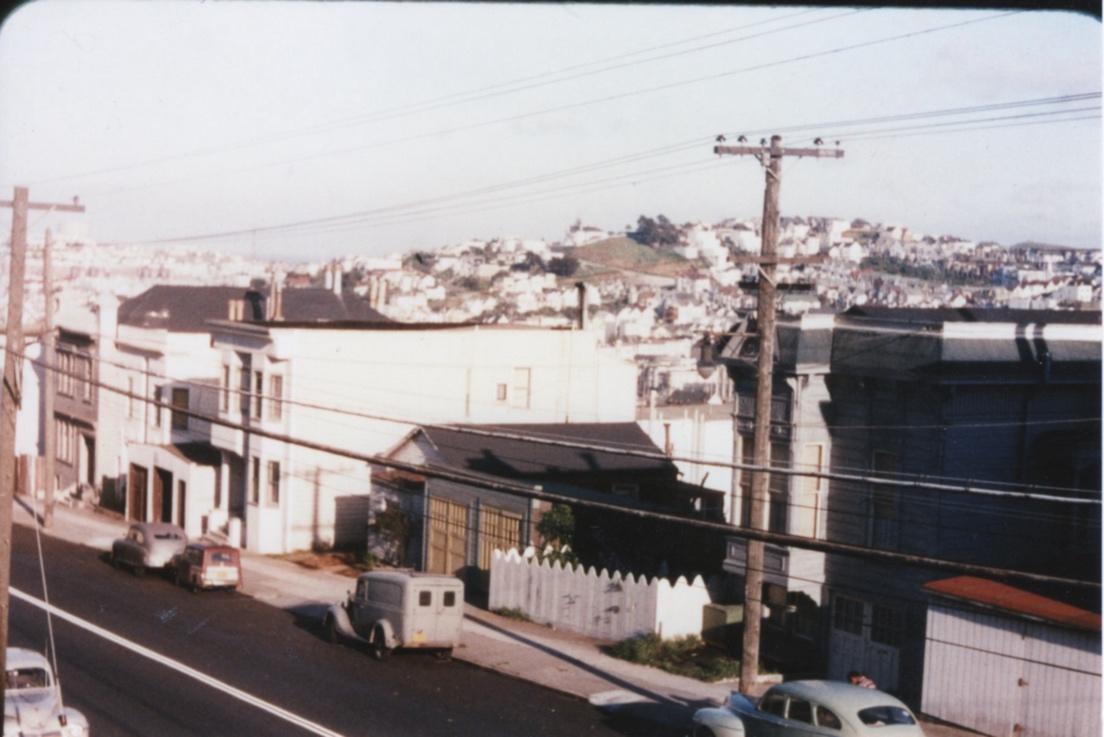
Date Answer at the bottom of the newsletter.
Collection of Ted Teipel
Richie’s April Pick
Richie Partington has recently
moved to Corbett Avenue. He taught children’s library services classes in the San Jose State MLIS program. Richie has served on numerous American Library Association award and selection committees, including the Caldecott Medal committee. Richie generously and willingly agreed to let us print this latest review.
GOLDEN GATE: BUILDING THE MIGHTY BRIDGE by Elizabeth Partridge and Ellen Heck, ill., Chronicle Books, October 2024, 60p., ISBN:
978-1-4521-3514-4
“Workers with steel and concrete are squaring off against fog and wind and pounding surf. They want to build the world’s longest suspension bridge.
People say it’s impossible. It's too far to span from land to land, across the wild, surging waters where the ocean meets the bay. The weather is wicked, with blinding, wet fogs and treacherous winds that will toss the workers into the water like paper dolls.
Maybe they’re right.
But…here come
the trucks!
Have you ever walked across the Golden Gate Bridge? I highly recommend experiencing it.
Yes, you may want to pick a day with good weather. Or maybe you’ll thrill on getting swallowed up in the cold, bracing fog. Either way, I’ve found it a blast to sashay those three or so miles–up so high above the water–as one completes the trek across the Bridge and back.
A decade ago, an excellent book about the Bridge was crafted by
Dave Eggers and cut-paper artist Tucker Nichols. THIS BRIDGE WILL NOT BE GRAY taught me all sorts of tidbits about the Golden Gate Bridge. For instance:
Did you know that the Golden Gate Bridge was built in thousands of sections that were shipped from the East Coast to California by boats that passed through the Panama Canal?
Did you know that the U.S. Navy thought the bridge should be painted with yellow and black stripes so as to be readily seen by planes and
ships?
Did you know that those thousands of sections of bridge that passed through the Panama Canal had been primed with an orange sealant paint?
Did you know that the Bridge employs the art deco architectural style? (Art deco is also the architectural style of the Empire State Building and the Chrysler Building in NYC)
Now, Berkeley native Elizabeth Partridge, who two years ago won the American Library Association’s award for young people’s nonfiction, and
illustrator Ellen Heck have created a picture book that will well-complement the Eggers book.
GOLDEN GATE: BUILDING THE MIGHTY BRIDGE is a lyrical, beautifully illustrated yarn about many of the steps involved in building the Bridge. It's told from the point of view of a youngster living nearby the Gate.
“Concrete trucks roll from the batching plant to the pier, sending their wet, heavy mix sluicing down the tube they call the ‘elephant’s
trunk.’
When the sun drops down into the Pacific Ocean, huge lights flood the pit so the work can go on. Night after night, the truck headlights sweep across your bedroom wall.
Hurry! the flickering lights seem to say.
Thousands of truckloads of concrete fill the hole, then the pier rises until it is 44 feet (13.4 meters) above the water.”
The story of the Bridge’s construction leads young readers to that thrilling day in May, 1937, when the
Golden Gate Bridge opened for the first time. The book depicts the crowds joyfully flocking to the Bridge in order to traverse the Gate before a night of celebrations brings fireworks and good cheer.
“You feel like you’re right in the middle of the whole wide world. The vast Pacific Ocean stretches out behind you. America is in front of you, with her high soaring mountains and plains and rivers. And high above, where seagulls circle, the towers touch the
sky”
ews
The story is topped off with a two-page, fact-filled Afterword. It made me shiver to read about how those workers “walking the iron” had to have nerves of steel in order to stay alive. The author notes how “Some men who bluffed their way onto the bridge quickly climbed down and quit.”