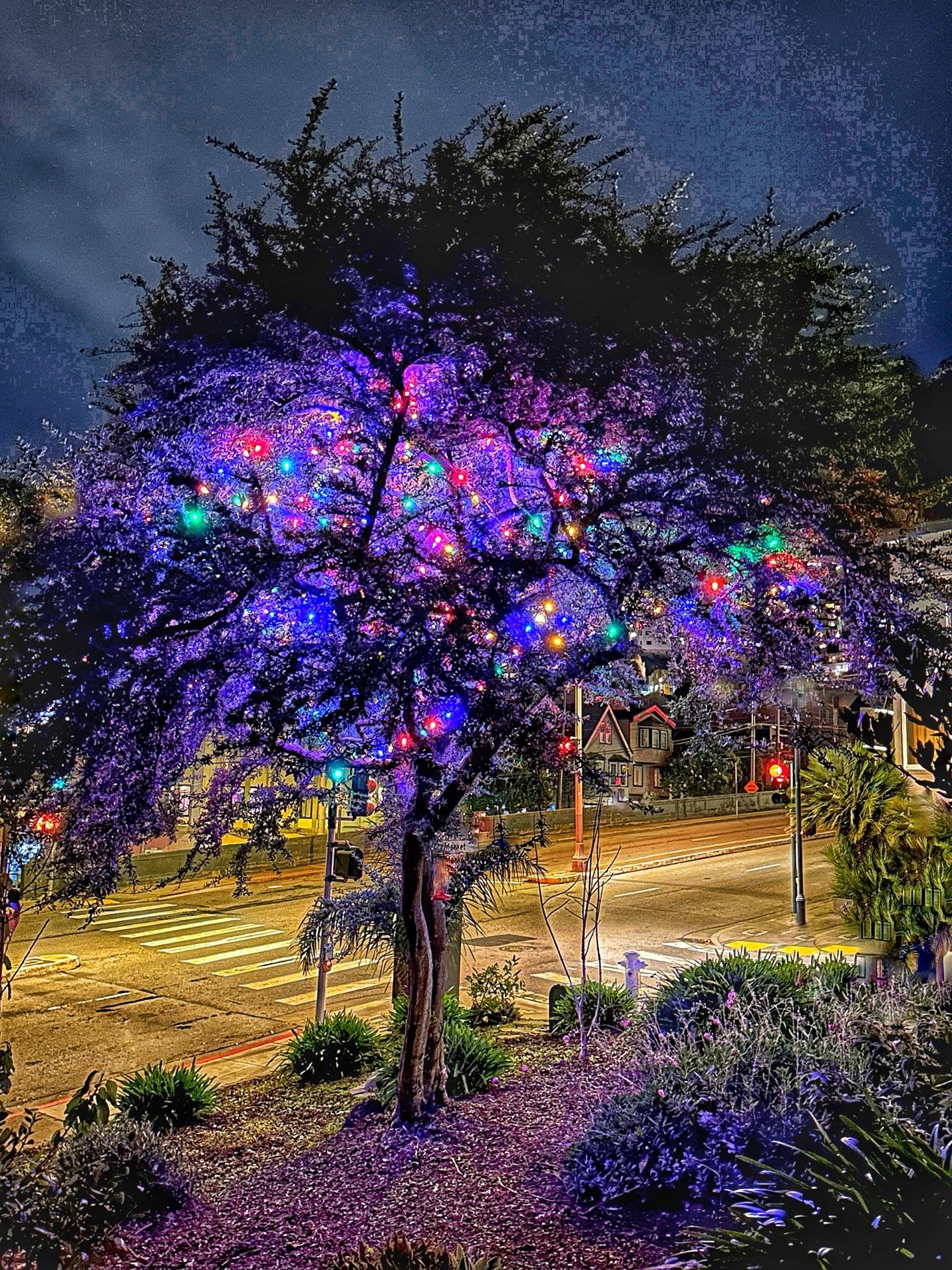
Corbett Heights Neighbor and Castro Merchant Andy Zivic is responsible for taking the lead and lighting the Cotoneaster (kəˌtoʊniˈæstər) tree at the park. We appreciate his initiative in this and hope this will be an annual event. Thanks to the Andrew and Lauren Beller for providing electrical access.
Photo Credit: John Koelsch
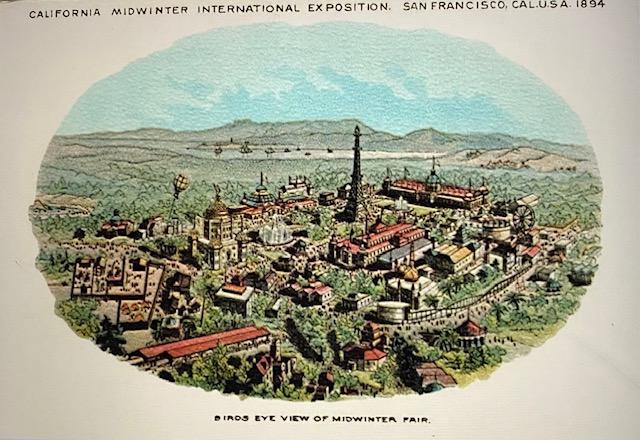
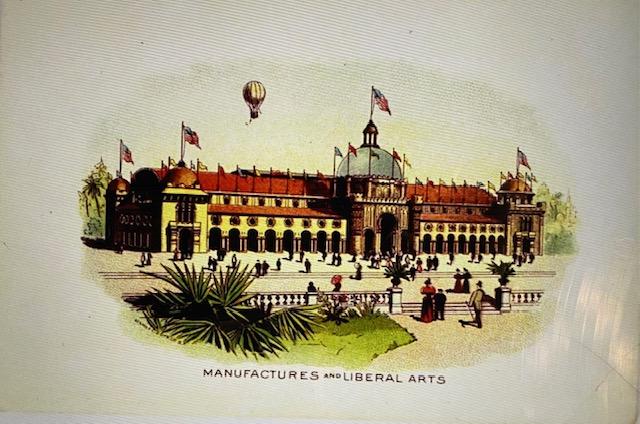
Corbett Heights Neighbors Battle Over Balloon That Escaped from the 1894 Mid-Winter International Exhibition, Golden Gate Park
One hundred and thirty one
years ago, Corbett Heights Neighbors Donnelly and Johnson were at war. It took 3 policemen to preserve peace over the ownership of a vagrant balloon that landed on the dividing fence between 2 and 4 Merritt Street (now 3000-2 and 3004 Market)(northwest corner of Market and Hattie Streets). The Official Guide Map of the Mid-winter International Exhibition describes the balloon as a “Captive Balloon.” This type of balloon remains tethered to the ground, allowing passengers
to experience a short aerial view, typically 65 to 130 feet in height.
The balloon with a special parachute escaped accidentally and soared above until it hovered over Corbett Road. It then descended rapidly toward Hattie Street. A reward of $10 (about $2,000 today) was to be paid to the finder.
Patrick Donnelly and his wife who resided at 4 Merritt Street and Peter Johnson and his wife, who dispensed liquid refreshment at the small
grocery store at 2 Merritt, were both hopeful of retrieving the balloon and collecting the reward. The balloon landed on the fence between the two properties. “Eager to earn the expected reward, the two families made for the prize. Mrs. Donnelly, who is more active than her rotund husband, arrived first and grabbed one of the ropes attached to the balloon. Her efforts to capture the bag and land it into her yard were quickly thwarted by Peter Johnson, the grocery
man…. Finding that the Johnsons were getting the better of his helpmeet, Donnelly whipped out his large revolver and threatened to blow the opposing forces into fragments.”
The arrival of the police prevented the tragedy. The police allowed the Johnsons to take the balloon as it rested mainly in their yard. The Donnellys were awarded the parachute. (San Francisco Chronicle, March 20, 1894, p. 7.) One wonders how these neighbors got
along after this incident.
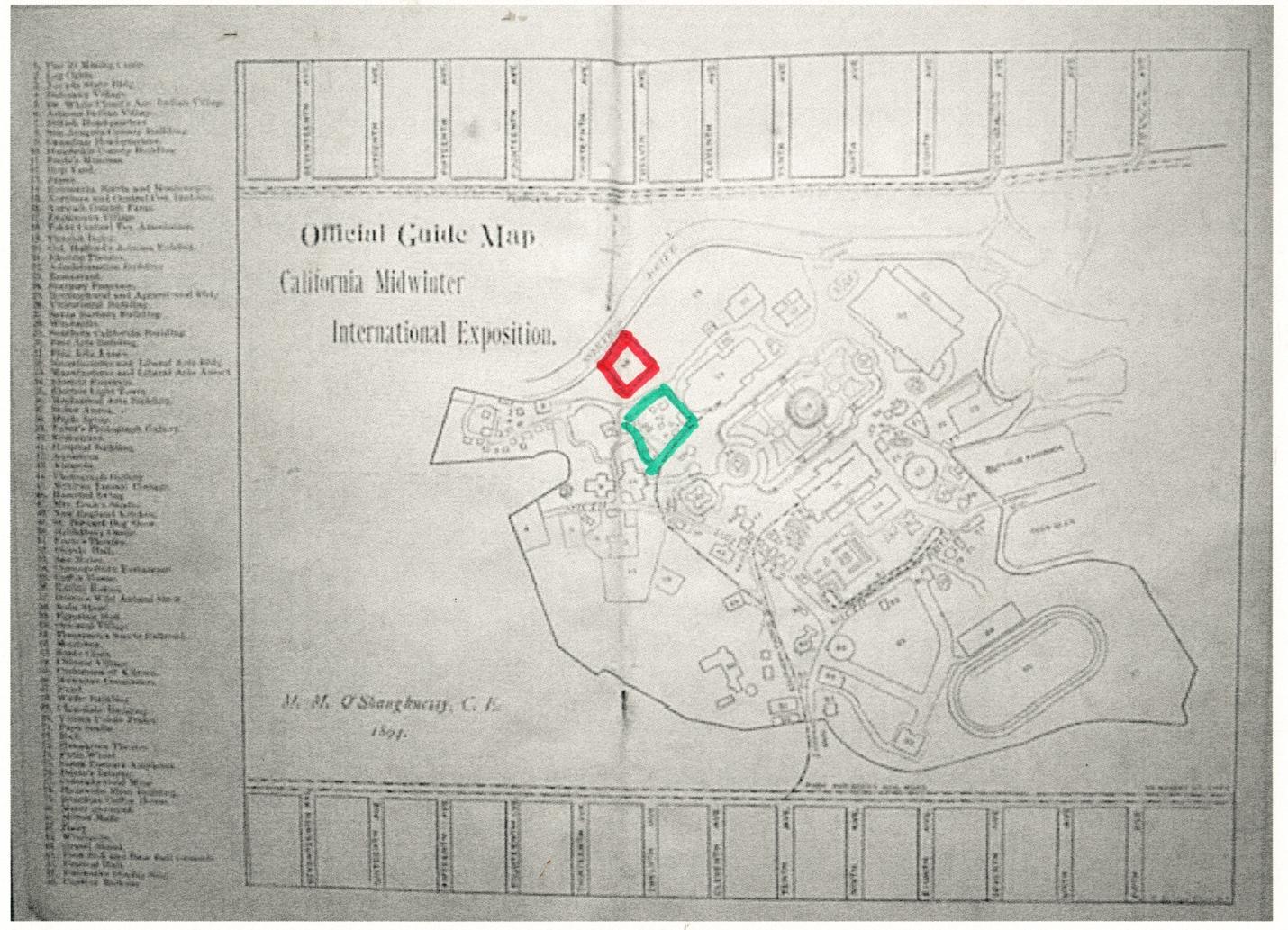
The Balloon Exhibit is outlined in red; the Japanese Tea Garden is a remaining
feature of the 1894 Exposition and is outlined in green.
More on the Donnelly Family
On February 14, 1892, Thomas Donnelly, son of Patrick Donnelly of Merritt Street (above), disturbed the peace of Miss Henshaw who lived on Hattie Street. Thomas Donnelly, a little fellow of 8 years of age, was arrested on a warrant charging him with disturbing the peace of Miss Nancy Henshaw living on Hattie Street. The
offense, on Valentine’s Day, consisted of affixing a caricature valentine of an old maid on the door of Miss Henshaw’s house and then ringing the doorbell. Thomas was not placed in the cells, but was to sit in the office until his guardian provided bail (San Francisco Chronicle, February 19, 1892, p.7.)
Miss Henshaw purchased Lot 12, Block A, Park Lane Tract (now 17 Hattie) in 1889 and sold it in 1892. In 1892, Miss Henshaw is identified as the wife of John
Henshaw, a laborer, who was reported missing for two months from his home at 4 Hattie (San Francisco Examiner, August 3, 1892).
Latest Neighborhood Data
CHN has 142 paid household memberships.
The newsletter is sent monthly to 316 households.
Approximately 80% of the 316 households read the newsletter.
If all who routinely read the newsletter were to join CHN as paid members then we would have 110
more household memberships—that’s our goal!
We live a few streets up the hill, but walk Corbett almost every day. We so appreciate the love and care that has gone into maintaining the magical community spaces of the neighborhood!
If Parkridge Drive neighbors are allowed, we would love to join, otherwise happy to just support/stay updated on news :)
January Book Review by Richie Partington
Richie Partington has recently moved to Corbett Avenue. He taught children’s library services classes in the San Jose State MLIS program. Richie has served on numerous American Library Association award and selection committees, including the Caldecott Medal
committee. Richie generously and willingly agreed to let us print this latest review.
FERRIS by Kate DiCamillo, Candlewick, 240p., ISBN: 978-1-5362-3105-2
"Light of the world, shine on me
Love is the answer (let it shine)
Shine on us all, set us free
Love is the answer”
– Todd Rundgren (1977)
Since garnering a Newbery Honor (runner up) for her well-known debut, BECAUSE OF WINN DIXIE, Kate DiCamillo has
won the Newbery Medal twice. FERRIS, released in 2024, is another of her sweet, must-reads for elementary audiences.
“Ferris thought that the world didn’t make much sense, no matter how many words you knew.”
‘It passeth understanding, thought Ferris. It passeth all understanding.”
“It was the summer before Emma Phineas Wilkey (who everyone called Ferris) went into the fifth grade. It was the summer that the ghost
appeared to Charisse, the summer that Ferris’s sister, Pinky Wilkey, devoted herself to becoming an outlaw, and the summer that Uncle Ted left Aunt Shirley and moved into the Wilkey basement to paint a history of the world.
It was the summer that Ferris’s best friend, Billy Jackson, played a song called ‘Mysterious Barricades’ over and over again on the piano.”
With the release of FERRIS, Kate DiCamillo once again rocks the children’s lit world with a moving,
mustn’t-miss-it yarn that features a colorful cast of interconnected characters. They include a dog named Boomer, as well as Pinky, a scene-stealing little sister who had me – the firstborn – rather curious to know about Kate’s own family history and sibling birth order:
“Pinky was six years old, and even though Ferris was her older sister, she did not understand Pinky on a cellular level.
Pinky was a fearsome mystery.
“Pinky laughed loudly… ‘I
think I’m going to rob a bank,’ she said. ‘That’s probably the quickest way to become an outlaw.’
It turned out Pinky was serious.
It turned out to be a serious time, in general, in Ferris’s world.”
FERRIS also features a grand 40-candle chandelier that has never been lit; comedic plagues of moths, bees, and raccoons; and periodic ghost sightings that have us fearing the worst about the future of Ferris’s beloved grandmother Charisse, who is at the hub of Ferris’s
zany three-generation household.
A particularly-intriguing character, whose reputation precedes her appearance, is Mrs. Mielk, the teacher who was responsible for Ferris and Billy Jackson’s rich stockpile of vocabulary words–a wealth of tasty terms that Ferris routinely defines for readers.
And then there is Billy, who is gifted and a total sweetie. We hear him playing that same tune over and over and over again on the pianos at his father’s steakhouse
and at Ferris’s house. But readers who are paying attention will note that Billy can and sometimes does actually pick up and play other tunes–by ear!
FERRIS features dramatic, emotional scenes that, together, merrily steer readers to a climax in which this idiosyncratic cast comes together in a grand spectacle that had me recalling the stateroom scene in the Marx Brothers’ “Night at the Opera.”
Ferris had me both rolling in the aisle, and sometimes sobbing.
I can’t wait to gather up my grandkid audience and read this one again.