Join us for a special General Membership Meeting on Monday, May 12, 2025 at 7 PM, 501 Castro Street. The topic is upzoning, now referred to as Family Zoning. We will have three speakers: Rachael Tanner, Director of SF City Wide Planning, and Joshua Switzky, Deputy Director of City Wide Planning; Bridget Maley will represent Neighborhoods United San Francisco
(NUSF).
Update on Upzoning Notification
The April issue of the Newsletter reported that on March 20, a new upzoning Notification Ordinance was introduced by Supervisor Connie Chan. This legislation requires direct notice to residents and businesses when their property, or one within 300 feet, is proposed for upzoning, specifically increases in height and/or density.
The Ordinance with modifications was sent to the Board of Supervisors for consideration at their April 22, 2025 meeting. It passed 8-3 on first reading by the following vote: Ayes: Chan,
Chen, Engardio, Fielder, Mandelman, Sauter, Sherrill, Walton. Noes: Dorsey, Mahmood, Melgar.
San Francisco Police Commission
After twenty-three months of effort by a Corbett Heights resident and former Board of Directors member, Paul Allen, the Police Commission’s Statement of Purpose was approved by the Board of Supervisors and is now posted on the Commission’s website. The Commission never had such a statement of goals and
principles even though the City’s legal Charter required it. Allen submitted a draft that the Commission slightly modified before adoption. Advancing public safety is now goal number 1.
Statement of Purpose
The San Francisco Police Commission (Commission) is a seven-member volunteer citizen agency tasked with overseeing the San Francisco Police Department (SFPD) and the Department of Police Accountability (DPA). As to SFPD, the Commission has three main
powers. The first is to promulgate regulations, known as Department General Orders (DGOs), that set forth policies governing the conduct of officers in the field as well as SFPD’s institutional obligations. Second, it adjudicates cases of officer discipline. Third, it assesses the performance of the Chief of Police. As to this last power, the Commission may remove the Chief by majority vote (the Mayor, acting unilaterally, may also remove the Chief). In the case of a Chief of Police vacancy, the
Commission proposes three potential candidates from which the Mayor may select a nominee for the job. The Commission does not have power over hiring decisions, officer deployment, or other day-to-day departmental operations. Those powers reside with the Chief of Police.
Four of the Commission’s seven members are nominated by the Mayor, subject to confirmation by the Board of Supervisors, while three are selected by the Board of Supervisors. Commission meetings are open to the public and
are generally held the first three Wednesdays of the month at City Hall.
Goals and Principles
1. To enhance the quality of life and level of public safety in San Francisco. 2. To enact policies that reflect evidence-based best practices as well as input from the community at large and the officers who will be tasked with carrying out the policy in question. 3. To promote
accountability and transparency at SFPD, including by holding hearings on matters of public interest, and by requesting and reviewing documents and data from SFPD and DPA. 4. To ensure that DPA has access to the documents and data necessary to provide policy recommendations and to conduct audits of SFPD. 5. To educate the public about matters of public safety and police oversight, and to solicit public feedback and
criticism. 6. To interpret the meaning of any DGO in the event that there is a need for clarity. 7. To serve the public interest with integrity, transparency, and independence. 8. To understand and balance the purported benefits of rules and policies against the cost of implementation.
Mail Carrier Robbery
On Thursday, April 10, one of our neighborhood mail
carriers was robbed of his keys. One individual pulled the keys off the carrier’s belt while a partner in crime waited in a white car. If you have mail delivered to a box that the mail carrier uses to deliver mail, you might want to consider an alternative.
Update on CHN Neighbors’ Survey Requests for Street Safety
A red zone was painted on the 3000 block of Market Street at Merritt, west bound. This was
recommended as it is very difficult to see west bound traffic when exiting Merritt with parked vehicles. This request was filed January 31 and completed April 5. All the others requests are pending.
District 8 Individual Landmarks
On April 2, Supervisor Mandelman and San Francisco Planning held a community forum about potential individual landmark designations in District 8. San Francisco planning staff discussed the
landmark designation process, associated preservation incentives, responsibilities, and opportunities for public participation.
CHN intends to inquire and follow up on potential landmark buildings within our boundaries.
Acacia at Ord and Corbett Park
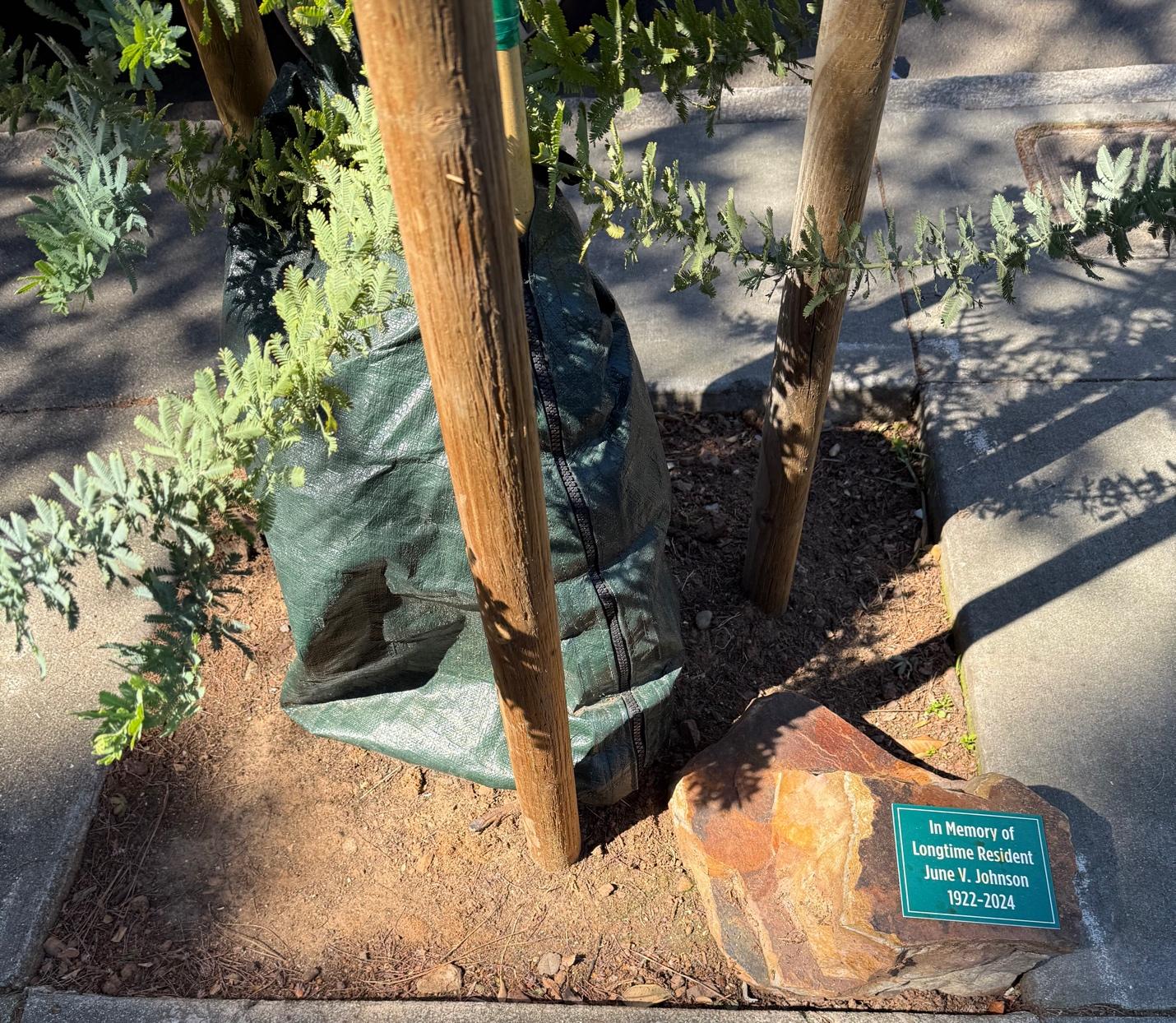
A plaque has been placed in memory of longtime resident, June V. Johnson of Ord Court, who died last year at the age of 101, 11 ½ months.
A Corbett Heights Native Comments on Chamberlain and Thurmond
Ron Kremling, a Corbett Heights native and a Warriors fan, confirms that Wilt Chamberlain and Nate Thurmond both lived on Corbett. Ron grew up just up the street from Wilt and would see him walking his two black
Great Danes. “Being only about 8 years old at the time and only 4’ 2", he was very imposing....but nice. The same goes for Nate, it was great for me as a Warrior fan to have them living nearby.” Thurmond lived at 655 Corbett, apartment 503, in 1966.
Matching Funds—Did You Know?
Matching gifts are corporate programs where employers match employee donations to eligible nonprofits, often doubling the contribution. We have updated our donation page at SF Parks Alliance to allow matching funds. One company, in addition to doubling the contribution, amplifies the impact of employees' donations to the causes they care about the most, the Levi Strauss Foundation provides employees with up to $2,000 a year in matching funds for donations and volunteer time. Please check with your employer to learn about their matching funds program.
Al’s Park
Looking Very Good
Charles Liao has been taking great care of Al’s. Here’s a photo.
Photo Credit: Charles Liao
Richie’s
Picks: REBELLION 1776 by Laurie Halse Anderson, Simon & Schuster/Atheneum/Caitlyn Dlouhy, April 2025, 416p., ISBN: 978-1-4169-6826-9
Richie Partington has recently moved to Corbett Avenue. He taught children’s library services classes in the San Jose State MLIS program. Richie has served on numerous American Library Association award and selection committees, including the Caldecott Medal committee. Richie generously and willingly agreed to let us print
this latest review.
“Inoculation is the act of implanting a pathogen or microbe into a person or other recipient; vaccination is the act of implanting or giving someone a vaccine specifically.”
— Wikipedia
“A steadfast figure in the anti-vaccine movement who has helped shape Health Secretary Robert F. Kennedy Jr.’s thinking on a possible link
to autism has joined his department to work on a study examining the long-debunked theory, according to people familiar with the matter.
The new analyst, David Geier, has published numerous articles in the medical literature attempting to tie mercury in vaccines to autism. In 2012, state authorities in Maryland found that he had been practicing medicine without a license alongside his father, Mark Geier, who was a doctor at the
time.
Maryland authorities also suspended Mark Geier’s medical license following claims that he endangered children with autism and exploited their parents, according to state records.”
– NYT (3/27/25)
“The Food and Drug Administration's top vaccine regulator was forced out of the agency Friday and sharply criticized Robert F. Kennedy Jr., his boss at the
Department of Health and Human Services.
‘It has become clear that truth and transparency are not desired by the secretary, but rather he wishes subservient confirmation of his misinformation and lies,’ Dr. Peter Marks wrote in his letter of resignation”
– NPR (3/28/25)
In Laurie Halse Anderson’s latest, REBELLION 1776, we meet characters who, as was
the practice back then, are inoculated with a knife scratch and some pus from a smallpox patient’s pox. The inoculated children and adults subsequently endure aches, pains, and pox. But this controlled, limited, and planned viral infection yielded a less-dangerous case of the disease. It’s a matter of serious discomfort rather than death. Smallpox inoculation provided colonial-era Americans lifelong immunity against suffering from the disease in its full-blown, deadly
form.
Inoculation was a potentially dangerous practice, in large part because any failure to adequately separate inoculated and symptomatic people from uninoculated people could lead to uninoculated people becoming accidentally infected and possibly facing deadly, full-blown cases of the virus.
The author’s graphic account of a character’s developing such a full-blown case of
smallpox in this manner is one of several situations that are described so well that readers can see, smell, and feel the discomfort and agony.
(Thankfully, while stockpiles of smallpox vaccine still exist, the disease has now been eradicated worldwide, and so it has been a long time since those vaccinations were routinely performed.
“I’d hoped to find Pappa sound asleep, but his
bedchamber at the top of the stairs was empty. More than empty; no blankets lay on his bed, no clothes hung on the pegs. His books and tools were missing too. He must have stowed his gear aboard ship before he came for me. But how could he find work without his tools? Regret began gnawing my insides; I’d never thought about that when I made my plan to hide.
‘Help.’ The hoarse whisper came from the other bedchamber. ‘Please. Help me.’
I froze. It didn’t sound like Pappa, but clearly someone was in distress. Crossing the hall, I opened the door to the other bedchamber, and gasped. The small, dim room reeked of urine, puke, and disease. One bed held a man curled on his side, facing the wall. The fellow in the other bed, lying on his back, croaked, ‘Water.’
I took a breath and gagged. ‘Twas not the smell of ordinary sickness; ‘twas smallpox.
The stench unlocked my worst memories: Momma, my brothers, and my wee baby sister…their room smelled like this. Stop! Don’t think of them! I fled. Halfway down the stairs, my knees buckled, forcing me to sit. I buried my face in my hands, rocking back and forth, trying not to see them again, trying to forget my helplessness, the horrid sounds of their moans and the unbearable silence that followed. ‘I beg you.’ The man’s voice had grown louder
with desperation. ‘Please, miss!’ Stop it, stop it!I covered my ears and rocked faster. ‘Twas not my place to care for strangers. Then, an unbidden thought pierced my heart. Momma would help him.
She’d caught smallpox by helping a neighbor who had a
terrible fever and aches in her bones. By the time the pox appeared on the sick woman, days later, Momma was already infected. She’d grown sick first, then Jacob and Toby, and baby Keziah. I tried to be a good nurse to them, but then the pox came for me, leaving me bedridden and helpless as the speckled monster took them. one by one. Pappa, who’d had the pox as a boy, built their coffins. I rocked harder still, tears washing down my face. My heart shattered all over again. ‘Just water,
miss,’ called the man. ‘I beg you. Smallpox patients crave water to soothe their parched throats and chapped mouths. How long had it been since anyone had brought drink or food to those two? Where was Missus Stone?”
Oh, yeah. The man facing away on the other bed, across from the parched, pleading guy? He’s already dead from the virus.
With the COVID pandemic still raw and smarting in our
minds, Laurie Halse Anderson has crafted a powerful, impeccably-researched, colonial-era America tale plagued by the overhanging threat of smallpox.
Set in Boston in the year that independence was declared, REBELLION 1776 begins as British soldiers and Loyalists are about to be forced to leave town, thanks to George Washington’s successful strategy of besieging the city with Patriot cannons. Washington has successfully turned the Brits and
Co. into sitting ducks.
Twelve-year-old Elsbeth Culpepper has been serving curmudgeonly old British Judge Bellingham (Judge Corkbrain, as she refers to him) in exchange for food and a place to sleep. This while her father resides at Missus Stone’s boarding house and engages in sail making. The pain is still raw for father and daughter, having left those wooden coffins with mother and siblings buried back in
Philadelphia.
In light of Washington’s tactical success, Pappa’s latest plan involves their sailing back across the Atlantic in order to deliver Elsbeth to her late mom’s people in Scotland. Elsbeth, who opposes that plan, immediately devises her own counter-plan: Hide when Pappa sets his plan in motion. The unintended consequences of Elsbeth’s apparently successful ruse is that she now has not the vaguest idea whether or not Pappa actually
made it over to Judge Corkbrain’s otherwise-abandoned house to collect her; whether Pappa has since sailed without her; or whether or not he’s even still alive.
Meanwhile, at the judge’s house, Mister Pike has taken up residence. He has just completed a prison term for spying on the Royalists on behalf of the Patriots. His wife and kids soon join him there. Under the care of the Pikes is teenaged, orphaned, Miss Hannah Sparhawk, who soon
becomes a combination of Elbeth’s employer, friend and co-conspirator.
“What was the point of ever dreaming of a joyful future when pestilence and war took such delight in killing thousands with a single breath? What was the point of living at all if it was doomed to end in pain and sorrow?”
REBELLION 1776 is the story of Elsbeth and Hannah living amidst family, the American
Revolution and War, soldiers, scoundrels, and the smallpox epidemic. It is powerful, gritty, filled with colorful colonial language, and unquestionably award-worthy.