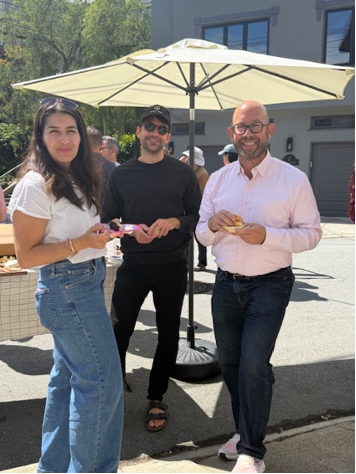
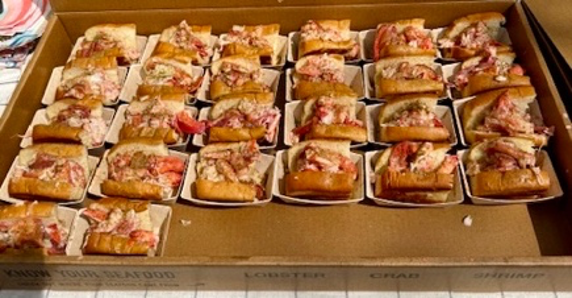
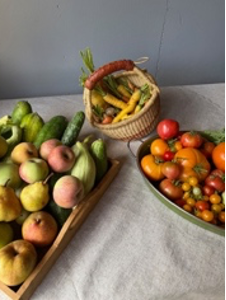
Another very successful block party organized by Becca and Warren McCann was held on Saturday, September 13. The food, music, and the crowd were absolutely amazing. We were pleased to see Supervisor Mandelman as well.
Lobster Rolls and Organic Produce from Napa
Save the
Date
Our General Membership meeting at the Castro Community Meeting Room is scheduled for Wednesday, November 12. More information to follow next month.
Please contact us by October 13 at [email protected] if you are interested in becoming a CHN Board Member. In order to be a board member you must have a paid membership and reside or own property
within the boundaries.
Reminder:
A special thanks to those of you who have paid your membership dues! We still await some renewals for the period December 2024 to the present.
The San Francisco Neighborhoods and Parks Fund was created as a temporary vehicle to raise and distribute philanthropic donations to help groups go back to work in their communities. It was created by the Community Partner Network (former partners associated with the San Francisco Parks Alliance), Mayor Daniel Lurie, Third Plateau, a social impact consulting firm, and Contina Impact, a 501(c)(3) fiscal sponsor to house and distribute the fund
(and eventually our prorata portion to CHN’s fiscal sponsor, IAM, on CHN’s behalf).
When the Parks Alliance collapsed, community groups united to save volunteer-led beautification, activation, and stewardship of parks and open spaces that a vibrant part of the city.
We are incredibly grateful to the Mayor’s office and Third Plateau for leading this new fund. It’s a magical solution that seemed impossible a few months ago.
We
especially thank the philanthropic community that has stepped up to replace funds so that community groups can go back to their missions and good work in the neighborhoods across the city.
Response from SFMTA
Early this year, CHN surveyed neighbors. One request was for a stop sign at Castro and States. We now have a response:
Thank you for your request to install additional STOP signs at the
intersection of Castro Street and States Street. We apologize for the delay in our response.
We share your concern about pedestrian and traffic safety and have conducted an investigation into the possibility of making improvements at this intersection. Based on our investigation, we do not recommend installing STOP signs to stop Castro Street at this time. STOP signs are primarily used to designate the right-of-way at intersections where it may
be unclear. The right-of-way at this intersection is clearly defined, as vehicles on States Street must stop and yield to vehicles on Castro Street as it is the major vehicular approach. Our observations indicate that the vast majority of drivers comply with the right-of-way rules and maneuver this intersection without incident. These observations are further substantiated by the overall safety record of this intersection over the last five years, according to San Francisco
Police Department reports.
A factor influencing our recommendation is the routing of the 24-Divisadero bus line on Castro Street. While the effect of one additional STOP sign may have only a small impact on delays, the cumulative effect of additional STOP signs at other intersections can degrade MUNI service. The City’s Transit First policy requires that we pay particular attention to MUNI’s service requirements, especially when an intersection
operates relatively safely.
However, based on our review, we found that the existing KEEP CLEAR pavement messages within the intersection are faded. Therefore, we have sent a maintenance request to our Paint Shop to restore the messages…. Eddie Tsui, Senior Engineer Streets Division – Transportation Engineering (September 16, 2025)
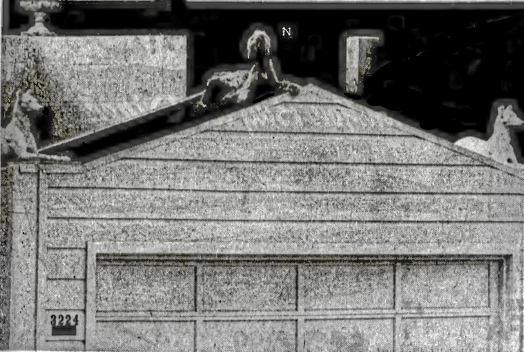
The “Mistress of Twin Peaks”
Four-year Afghan hound Sasha, the
“Mistress of Twin Peaks,” belonging to the Mosby’s of 3224 Market Street (Miller-Joost house) watched traffic in 1965 on Market Street. Two stone whippets watch with Sasha (and they are still watching).
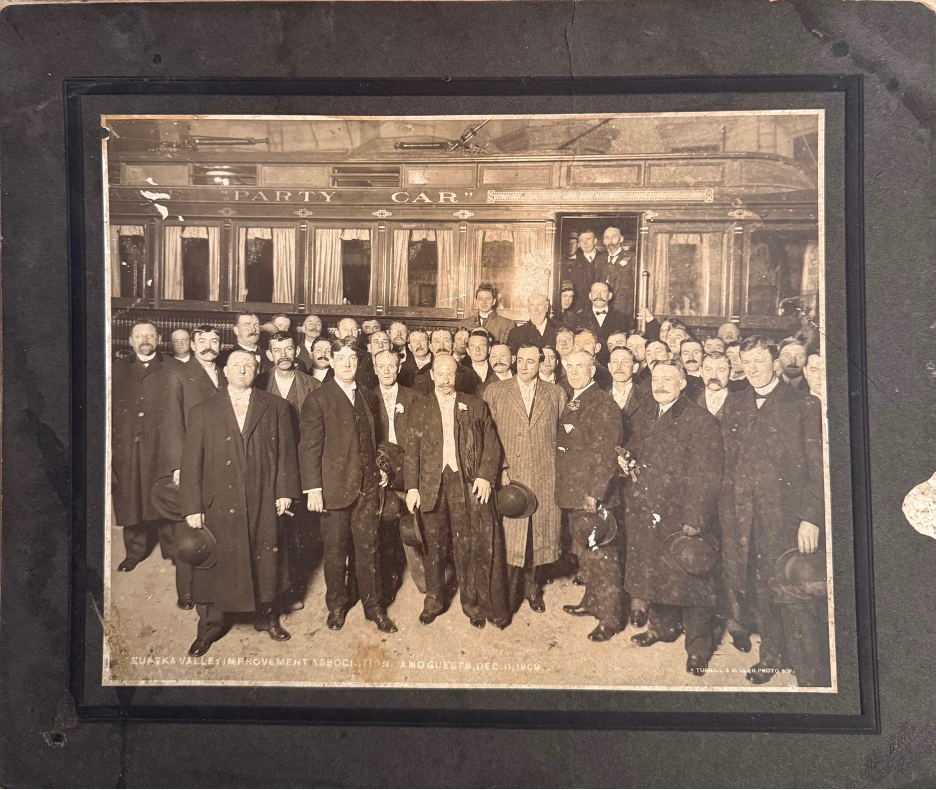
The photo below shows members of guests of the Eureka Valley Promotion Association dressed for an important
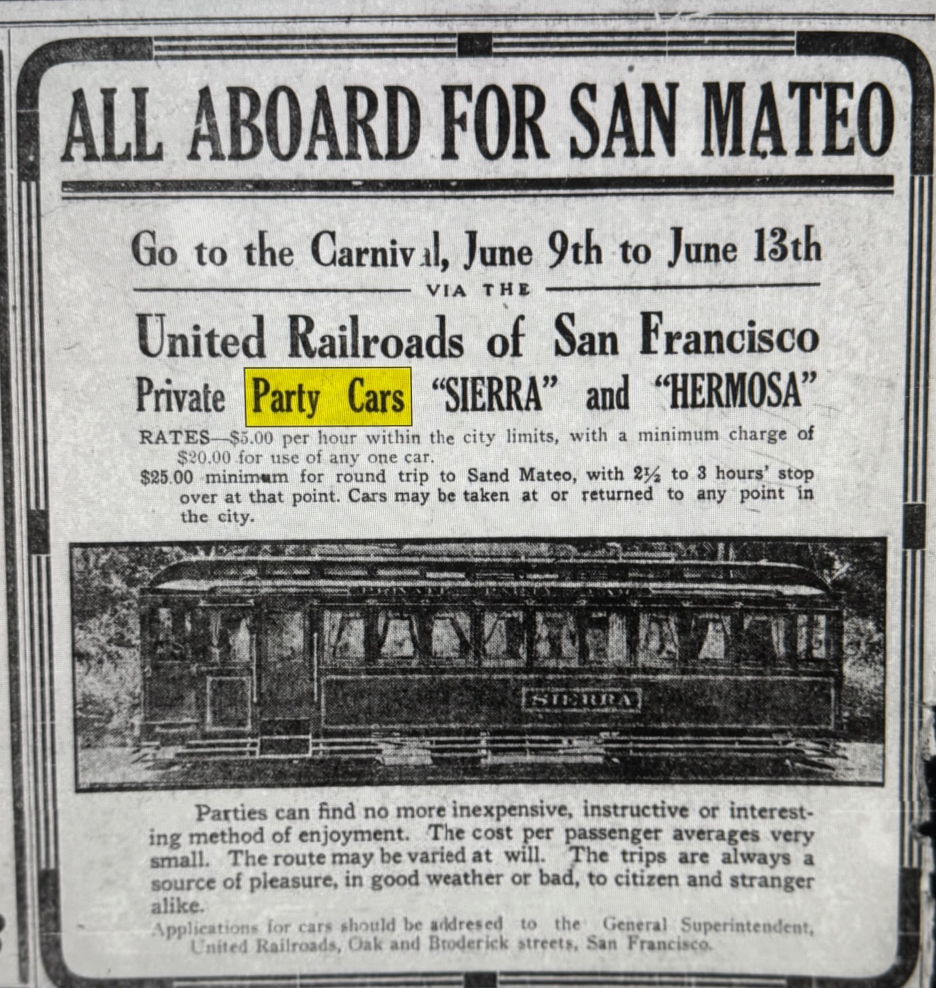
event. Behind the group, is the Sierra, the Private Party Car, which was advertised for rent in 1909.
The Eureka Valley Improvement Association, which was comprised to property-owners and business men of Eureka Valley, entertained the mayor-elect and supervisors-elect at a banquet at the Cliff House on Saturday, December 11, 1909. The special car (Private Party Car Sierra) left 18th and Castro Streets at 7:30. Guests included
Mayor-elect P. H. “Pinhead” McCarthy and Supervisors-elect Matt Harris, Oscar Hocks, John R. Knowles, and P. O. Dowd. Mayor-elect McCarthy is standing on the party car stairs (see red mark). One hundred and fifty attendees were present and Mayor-elect McCarthy “aroused much enthusiasm by his assurance that he would do everything possible to advance the interests of the outlying districts.” (San Francisco Examiner, December 13, 1909, page 3.)
Credit: Estate of Judith HoyemThe Examiner, June 9, 1909
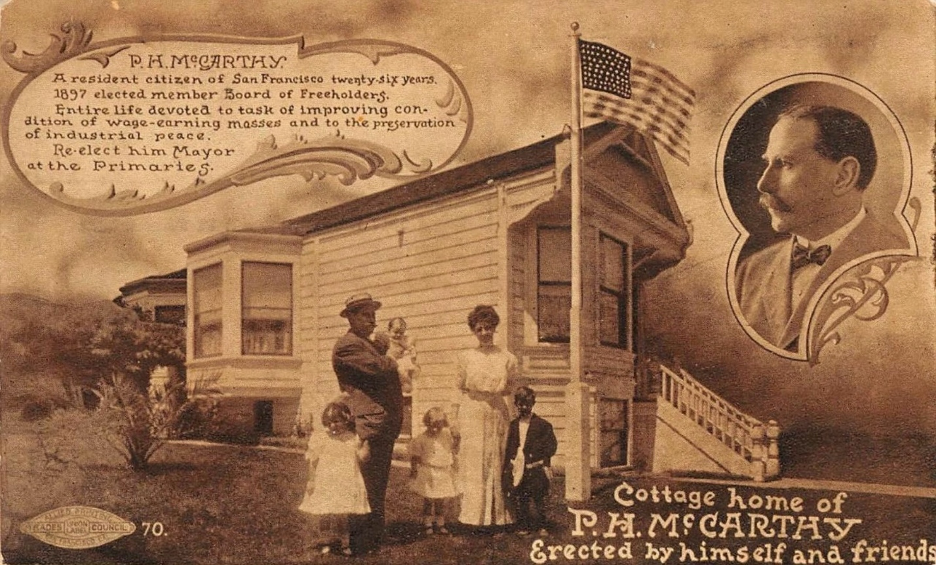
Mayor-elect McCarthy helped form the United Brotherhood of Carpenters and Joiners of America. He launched the SF Building Trades Council in 1894. Here is with four of his children (three more to follow) at a house he built. He lived on Collingwood from 1903 to 1915. In 1915, he moved to 153 Upper Terrace.
The Creation of the Pink Triangle Park
By Judith Hoyem (1936-2025), 2017
Forty-six years ago in October 1971, my family and I moved into our house on 17th Street between Castro and
Diamond, facing what is now the Pink Triangle Park.
At the time 17th Street was a two-way street from Castro to Roosevelt. But due to the 1970s construction of the tunnel under Market Street for the Muni Metro, the street soon became one-way west (and no parking) from Castro to Eureka in order to accommodate a diversion of Market Street traffic. Everywhere there was dust, traffic congestion, and construction noise for the next ten years. A park was
unimaginable!
However, an unused extension of Collingwood Street running across Market to 17th Street had been closed off permanently by the configuration of the new street design. And thus was born a triangular piece of land that was destined to become the Pink Triangle Park. But not right away. It remained neglected by its owners, the San Francisco Department of Public Works. Although a few people realized that this small plot of undeveloped
public land was valuable, other important history was being made in the neighborhood, as the Castro became the locus for the Gay Liberation movement. On the sorrowful side, the Aids epidemic was also underway. So it is no wonder that it took twenty years before the beautiful garden and memorial of Pink Triangle Park emerged from a vacant lot overgrown with ivy.
Once the subway construction ended, the Eureka Valley Promotion Association (EVPA), which is the Eureka
Valley Neighborhood Association (EVNA), had arranged for the planting of three Monterey Pines in the vacant lot, which helped to beautify the lot and dampen the noise and air pollution generated by Market Street. Unfortunately, these trees gradually succumbed to pitch canker disease, which ravaged all Monterey Pines throughout their habitat.
It wasn’t until the year 1999 that plans were consolidated for a memorial park in the vacant lot. The theme was to be the Pink
Triangle that gay victims of the Nazi holocaust were forced to wear. In August 2300, EVPA became a co-sponsor of the project, along with the Department of Public Works and the Mayor’s Neighborhood Beautification Fund. Numerous volunteers and businesses contributed. A committee of five or six members of EVPA was formed, including Pauline Shaver, who was an art consultant and curator, who provide focus, and Joe Foster, later President of EVPA, who had a concept of what the park could
become and started preparing the neglected lot himself. A call went out for designs. A wonderful design by the arts Robert Bruce and Susan Martin was selected that would incorporate 15 granite and marble pylons, pink quartz, a rose garden, and the remaining Monterey Pines.
Excitement began to build and on Saturday, October 21, 2000, over 20 neighbors gathered, and with help from a sheriff’s work crew, DPW and Re and Park, they planted 40 donated rose bushes and 30
rosemary plants in this first phase. Pink Triangle Park was blooming! Over the following year, the pink quartz path was laid the pink quartz triangle in the center was formed, and the memorial pylons were fabricated.
On December 10, 2001, San Francisco city officials honored the 53rd Anniversary of the United Nations Declaration of Human Rights by proclaiming Pink Triangle Park Day. A ceremony at the park site that day was the official
ground-breaking of the park and its memorial of triangular pylons commemorating gay and lesbian victims of the Nazi regime. Governor Gray David issued a proclamation honoring the day and the work of neighborhood volunteers. Later a plaque was set in place commemorating the completion of this great neighborhood project.
From a personal perspective as one who had the enormous pleasure of enjoying this beautiful small park for the past 16 years, I have found it to be
a calm and quiet oasis in the midst of a busy city, a place not only sad contemplation of the suffering mankind can engender on each other but also of the compassion and kindness and beauty we can produce in harmony with each other.
The design and the installation involved the volunteer work of many people and was the key to its success. Once the project was completed, EVPA continued to oversee the park. Fortunately, its heart and spirit was maintained and
cultivated by a dedicated volunteer gardener, Justin Del Versano, with the assistance of his friend, Ed Scruggs. Justin’s partner, Jack Keating, a member of EVPA, provide help in decision-making and liaison with EVPA, as well as many hours of assistance with all the tasks of the garden. The team not only worked weekly in the garden—nay, daily when it was needed—for about 16 years, rain or shine, they also brought their own tools and lawn mowers and contributed plants, even a locust
tree, to keep the garden beautiful. I am especially appreciative of the fact that as the garden bloomed, it remained a simple but beautiful presence in keeping with the theme of mourning, remembrance, and inspiration. Indeed, it has become a destination for people from around the world. There is only other Pink Triangle memorial in the world, I am told, and it is in Amsterdam.
This month EVPA honors Justin, Ed, and Jack and expresses its gratitude for their
countless hours of work over the past 16 years and their selfness dedication to the park. Another neighbor who must be mentioned as a volunteer over the years is Diane Nutting who also contributed many hours and much effort toward the beautification of the park, as well as numerous fund-raising efforts.
As the care of the par is handed over to new gardeners, changes will occur, but I trust that the simplicity, beauty, and spirit of Pink Triangle Park will continue
on and on as the years go by.
A Neighbor’s Opinion:
Make Public Power in San Francisco a Reality: Let’s join 50 million Americans!
By Olga Mandrussow
Los Angeles, Sacramento, Palo Alto, Alameda, and dozens of other jurisdictions in California own their electricity grids and operate their own public power today. Public power utilities are community-owned, not-for-profit electric
utilities. They are operated by local governments and are directly accountable to the public they serve. There are over 2,000 public power utilities across the country, serving 50 million Americans. It is time for San Francisco to take this non-partisan, cost-saving step.
The San Francisco Public Utility Commission (SFPUC) is a City department that has provided clean, safe, and reliable electricity (Hetch Hetchy Power) for over 100 years to the airport, public
schools, public libraries, public hospitals, etc. The SFPUC has been trying––for years––to purchase the grid from PG&E, but PG&E has consistently obstructed and delayed progress.
It’s time for full public power in San Francisco. Without PG&E in the middle, San Francisco can deliver more affordable and reliable public power. There are several benefits of public power for San Francisco:
• More Affordable: As a not-for-
profit public utility, San Francisco does not pay shareholder dividends, nor million-dollar bonuses to corporate executives. Additionally, governments pay no income taxes and get better interest rates from financial institutions. • More Reliable: We can explore investing in renewables, battery storage, and undergrounding to build more climate- resilient power infrastructure. • More Accountable: We answer to the community and have more
transparency and local oversight.
When San Francisco finally buys the grid from PG&E, it will be a blow to PG&E’s bottom line, as the compactness of San Francisco offers PG&E a large profit.
Join the Movement for Public Power: Here are five actions you can take today to support public power in San Francisco: Take Action — Our City. Our Power.: 1. Sign up for updates on our
website 2. Endorse our campaign as an individual or an organization 3. Invite us to present to your community or neighborhood group 4. Contact your elected officials to let them know you support public power
Together, we have the power to shape our energy future. Publicpowersf.org Follow SFPUC on social media––@publicpowersf
Richie’s Picks: DEATH IN THE
JUNGLE: MURDER, BETRAYAL, AND THE LOST DREAM OF JONESTOWN by Candace Fleming, Penguin Random House/Anne Schwartz Books, April 2025, 368p., ISBN: 978-0-593-48006-9
Richie Partington, a Corbett Avenue resident, taught
children’s library services classes in the San Jose State MLIS
program. Richie has served on numerous American Library Association
award and selection committees, including the Caldecott Medal committee.
Richie
generously and willingly agreed to let us print this latest review.
“Just say a word and the boys will be right there With claws at your back to send a chill through the night air Is it so frightening to have me at your shoulder? Thunder and lightning couldn't be bolder I'll write on your tombstone, I thank you for dinner This
game that we animals play is a winner” – Jethro Tull, “Bungle in the Jungle” (1974)
“Temple membership spread through the families living in Redwood Valley and beyond. By the end of 1968–a little more than three years after the original group had moved west–close to two hundred
people called themselves members. As in Indianapolis, the majority of Temple members (75 percent) were poor and disenfranchised African Americans–a reflection of the alienation they felt within U.S. society. In the wake of Dr. Martin Luther King Jr.’s assassination,as well as those of Medgar Evers, Malcolm X, and Robert F. Kennedy, they found themselves wondering how to live Dr. King’s
dream. Would they ever be judged solely by their character instead of their skin color? Peoples Temple seemed to offer a solution. Another group began joining the Temple around this time, too: people in their twenties and thirties, some white, some Black, some college-educated, some dropouts. Many sprang from California’s counterculture. In the summer of 1967, tens of thousands of young
adults had headed to San Francisco with a shared desire for peace and freedom. The American dream cherished by their parents was no longer a goal for them. They rejected consumerism, advocated peace, and demanded social reform. Some protested the Vietnam War. Others fought for civil rights and women’s rights. Most were searching for meaning, purpose, and a sense of community. Once, they would have joined organized religion as their parents had, but conventional faith no longer satisfied. They
were interested in the metaphysical, the spiritual. Some studied Eastern religions. ‘We had a saying,’ recalled one activist who joined Peoples Temple. ‘One person can only whisper. You need to be in a group to stand strong.’ Many others who joined the church were going through life transitions–moving to a new town, returning from military service, losing a job, getting a divorce, battling
addiction, and so on. They were searching for security, stability, and a helping hand. The Temple offered all this and more. Jones understood these varied reasons, and like a chameleon, he ‘appealed to anyone on any level at any time,’ recalled one former member. To some, like Hyacinth Thrash, he spoke the language of a Pentecostal preacher. To others, like the Laytons, he references
political theory and metaphysics. ‘His vocabulary could change quickly from…backwood and homey to being quite intellectual,’ recalled another former member. He drew on these people’s deep yearning for some kind of alternative life…and exploited it.”
In DEATH IN THE JUNGLE, much-awarded young people’s nonfiction writer Candace Fleming probes the life and death of Jim Jones. In
1978, Jones instigated and oversaw the suicide/murder of 918 people, mostly Peoples Temple members who had followed him from California to a settlement in the jungles in Guyana.
“But it was the preacher who transfixed Jimmy–his shiny satin robe, his booming voice and fiery words.”
Beginning with his early childhood of neglect, as he wandered his Indiana hometown unsupervised, dirty, and unfed, we learn how he was entranced by the ability of preachers (and Adolf Hitler) to hold a crowd’s attention. We see how he had a knack for memorizing names, situations, and extensive passages of scripture. He was wowed by the Pentecostal demonstrations of devotion “in which people leaped spontaneously to their feet, burst into song, danced ecstatically, or
fell shaking to the floor.”
Jim Jones, who eventually came to embrace his mother’s long-held atheism, and to tout himself as a god seems, on some level, to have been supportive of great stuff like civil rights and socialism, peace and love. But the guy was a nut job–a deadly nut job who progressively went further and further off the rails—and DEATH IN THE JUNGLE is an
important–life-and-death cautionary tale for tweens and teens about cults and cult leaders.
“Without warning, four aides would appear at a member’s home or workplace and cheerfully inform the person that it was time to go. Immediately. That day. That minute. While one aide helped the member pack, a second watched the phone to prevent them from making any calls, and a third aide
comforted those being left behind. The fourth aide was there to deal with anyone who didn’t want to go. Some members were eager to move to Guyana. But many balked at going–they didn’t want to move away forever. Aides told them they could just go for a visit. Stay a few weeks, they said. If you don’t like it, you can come back. This was a lie, of course. No one would be allowed to
return.”
Author Candace Fleming immersed herself in a virtual mountain of primary source materials relating to Jones and Peoples Temple. (The backmatter includes details on accessing these materials.) She also interviewed Jones’ only biological son. (He survived.) What makes DEATH IN THE JUNGLE shine so brightly is Fleming’s keen ability to process this wealth of information and craft
a factual, repeatedly jaw-dropping, intense, (and, undoubtedly, soon-to-be-award-winning) nonfiction tale that’ll grab young readers and never ever lets up.
Gruesome, intense, horrifying, and eye-opening, exposure to DEATH IN THE JUNGLE will undoubtedly save the life of some middle schooler or high schooler who might otherwise get suckered into following a latter-day Jim Jones. Do not
miss it.