Join Our Neighbors for a Congressional Forum, May 6
With Congresswoman Nancy Pelosi's retirement, the June 2, 2026 election is a once-in-a-generation opportunity to shape who represents us in District 8.
We are co-sponsors of a forum with the four leading candidates vying for San Francisco’s U.S. House seat, featuring Saikat Chakrabarti, San Francisco Supervisor Connie Chan, Marie Hurabiell, and State Senator Scott
Wiener.
Eleven neighborhood groups across District 8 are hosting the forum to address issues that matter to neighbors and households across the Castro, Noe Valley, Glen Park, Duboce Triangle, and Cole Valley.
San Francisco Standard reporter Joe Fitzgerald Rodriguez will moderate the forum, which will feature questions submitted by the neighborhood groups. With mail-in ballots arriving the same week, the forum is the perfect time to make your final choice for the June 2 primary in this once-in-a-generation race.
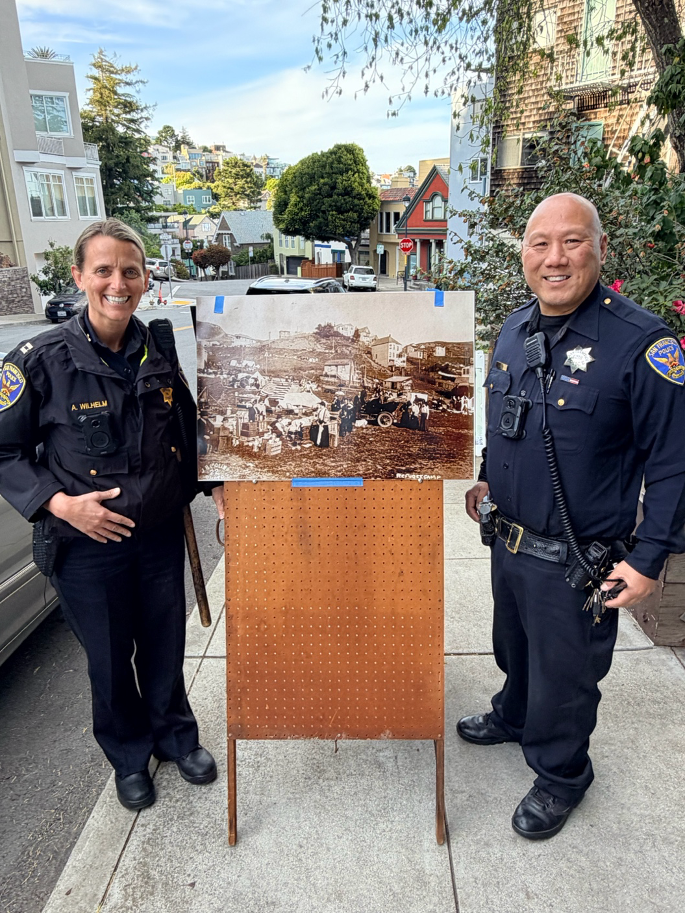
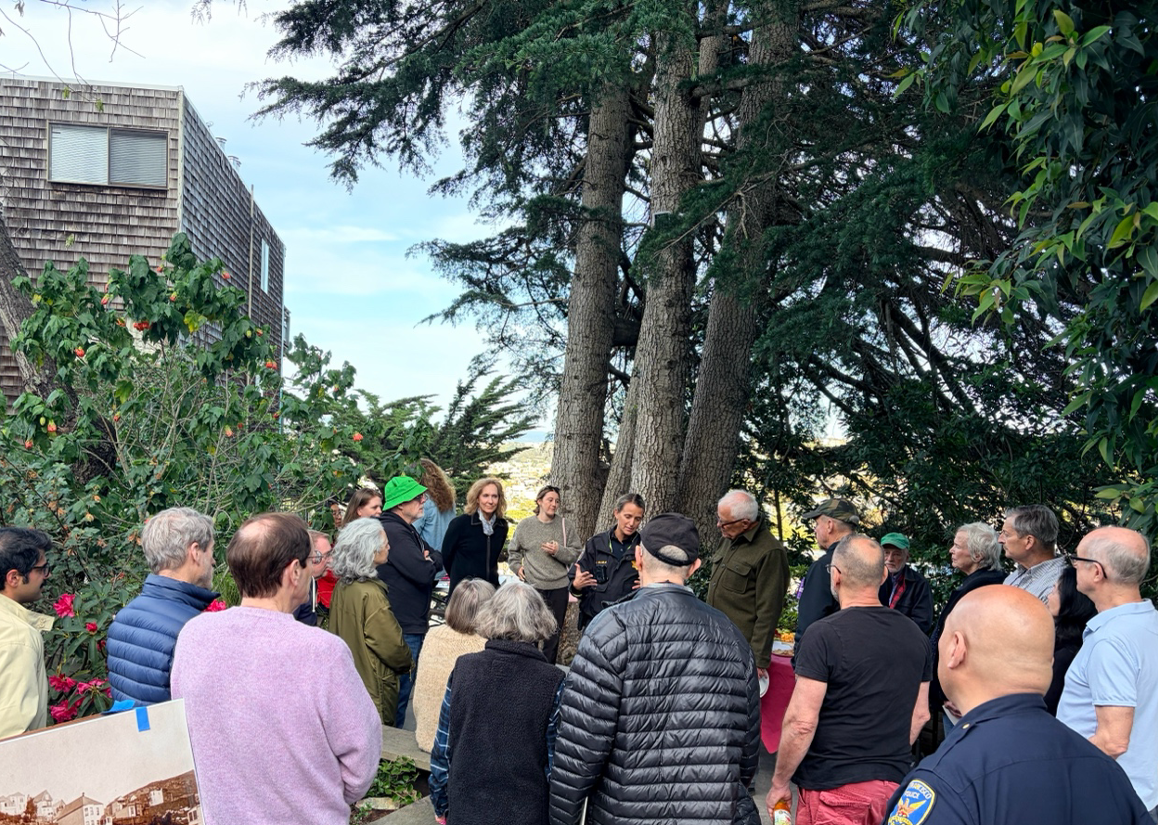
On Friday, April 17th, Corbett Heights Neighbors hosted a successful neighborhood gathering with dozens of attendees. Special guests included Park Station Police Captain Angela Wilhelm and District 8
Supervisor Candidate Manny Yekutiel. The event commemorated the 120th anniversary of the 1906 earthquake, and the refugee camp that existed at that location. Photos of the 1906 camp were distributed to attendees, and guests enjoyed refreshments. Thanks to all who attended, and we look forward to having you at our next park get-together! We would also like to thank Mollie Stone’s for providing refreshments.
SF Park Police Captain Wilhelm and Officer Sung
Earth Day 2026
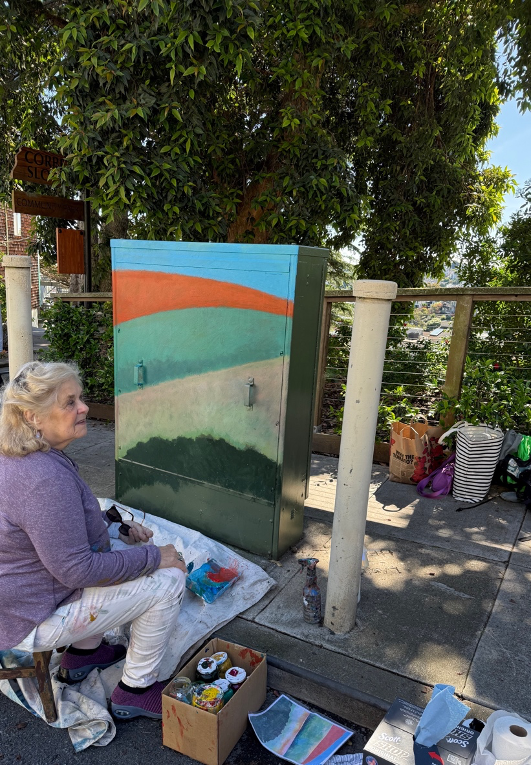
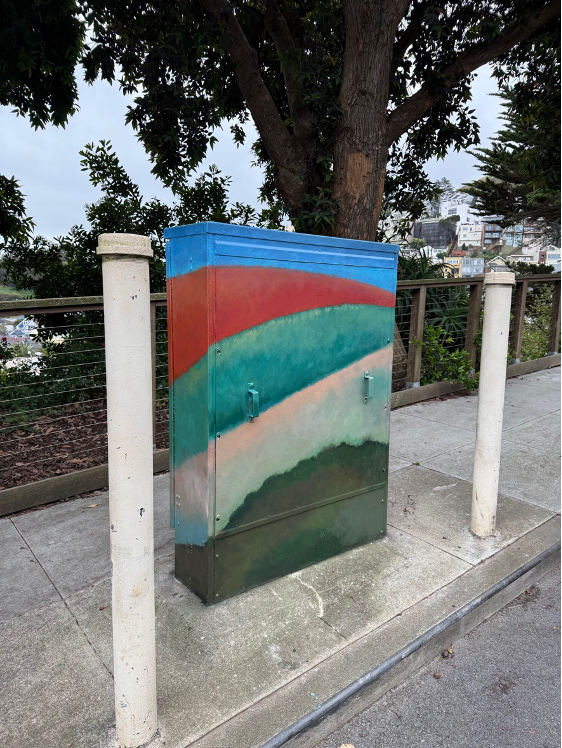
Muralist, Betsie Miller-Kusz, has painted a portion of our Market Street mural, The Voice of the Earth, the Chart of the Land, on the AT&T box at the SLOPE to reflect her work on Market Street. The first Earth Day was celebrated April 22, 1970. It is an annual global event held to demonstrate support for environmental protection and raise awareness about the
importance of safeguarding the
planet.
Betsie with Work in Progress
Completed Project
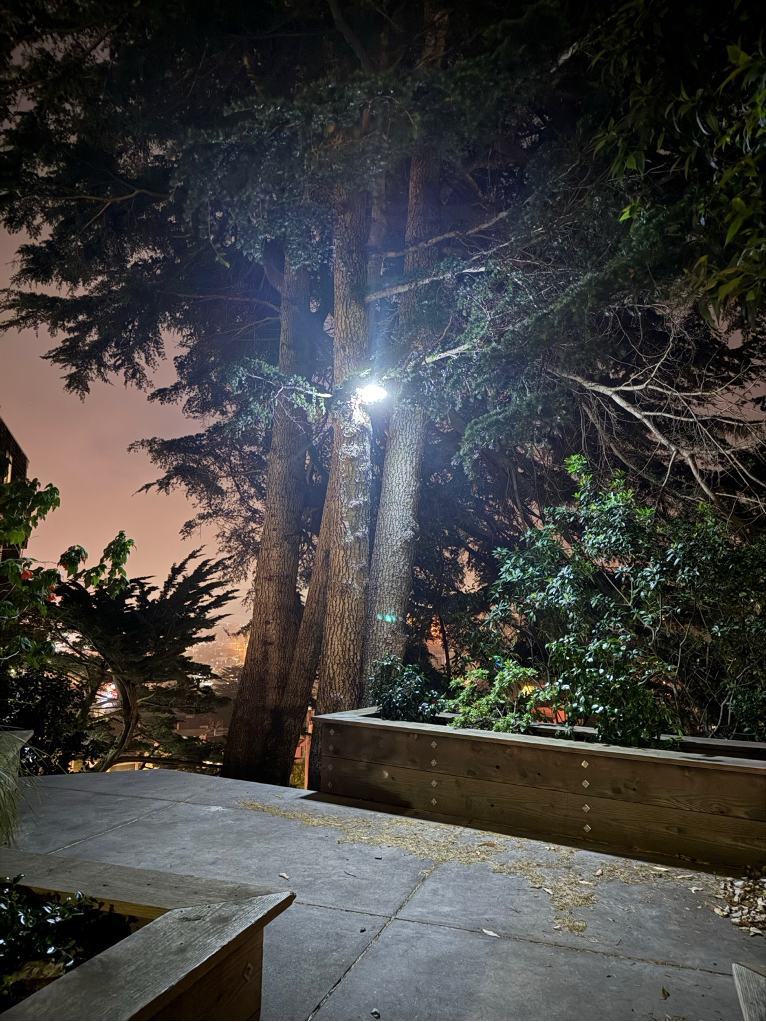
Let There Be Light!
We have installed a motion detector solar light at the Slope, hoping this will illuminate and inhibit those who are intent on destructive acts, such as burning one of the planters. We still await some word from DPW about the repair. The light was installed and the drip system repaired by John Koelsch.
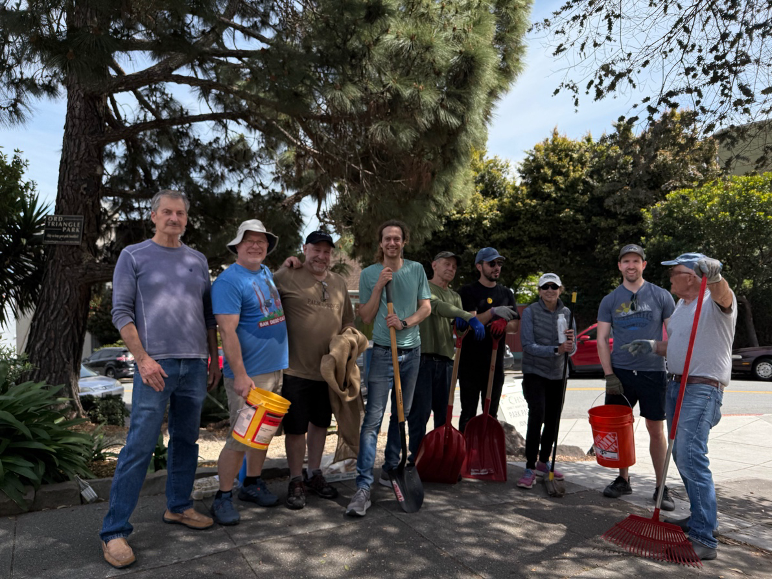
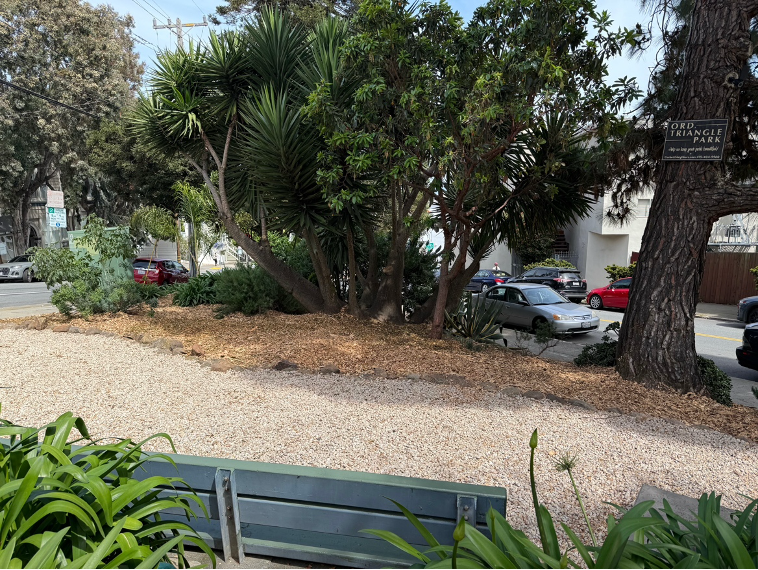
Bark Spreaders at Ord, April 18, 2026
Thanks to a big group of neighborhood volunteers, Ord/Corbett Park has a beautiful new layer of bark and mulch. Enjoy!
Mark, Casey, Greg, Stan, Bill, Joey, Maryann, Tommy, John (Leslie taking the photo)
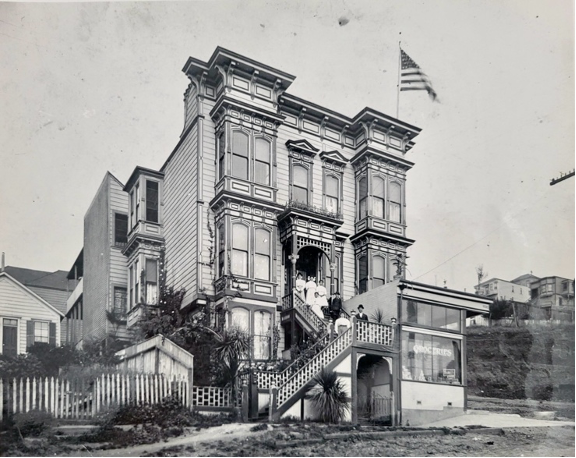
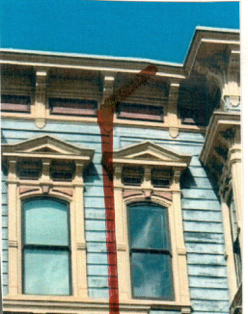
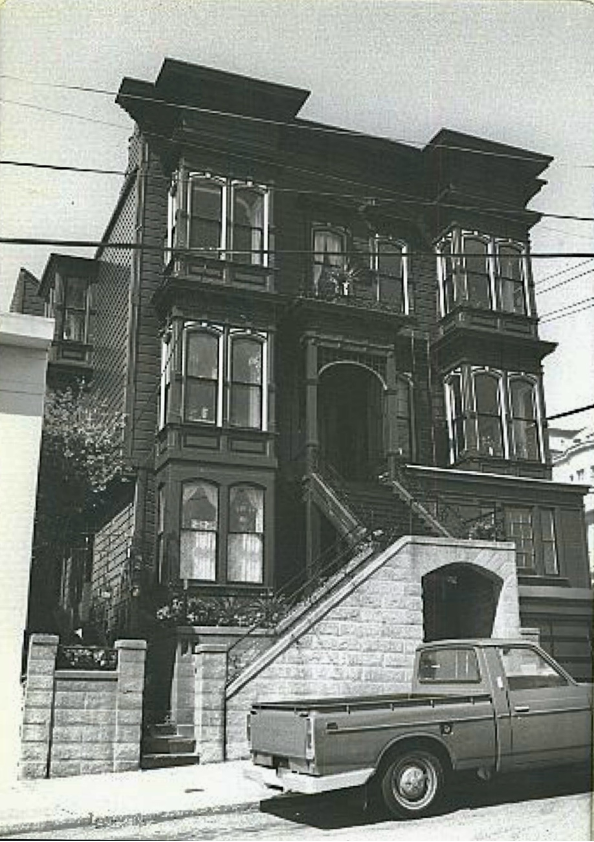
An Imposing Victorian (Clara/Ord & 17th) and A Modest Cottage (Clara/Ord & Corbett)
Location: William McGee Subdivision
West of Horner’s Addition (1853-4), is the McKee Subdivision of 1864, which predates the first development in Corbett Heights (Park Lane Tract lots were first sold in 1885). The McKee Subdivision consisted of ten (10) acres of Rancho San Miguel, a two block area, bound by the north by the Rancho San
Miguel boundary line (now Ord Court?), on the east by Douglass, the south by 18th Street, and the west by properties facing Clara Avenue. William McGee (1828-1876) came to California from West Virginia with his father, Redrick McGee, an Indian Agent, in 1850-1851 to negotiate treaties with California Indians. William McGee was an investor in mining stock and later, real estate. In 1863 he married Clara French. He purchased land from Pioche & Robinson, and filed
the McKee Subdivision with the county recorder. Its central street, Clara, was named after his wife, and Hattie Street was named after his daughter. The McKee Subdivision had forty numbered lots; it was a suburban subdivision “intended primarily for tradespeople who depended on proximity to the city to sell goods and services, but who also benefitted from cheap land where there was ample room for crops, animals, and equipment. Such lots were rarely platted in urban settings.”
(Michael Corbett, Corbett Heights: San Francisco, An Historic Context Statement, 2017, p. 33).
The Victorian house at Clara (Ord) and 17th Street (lot 30 of the McKee Subdivision) is now 104-106-108 Ord and 4301-4303-4305 17th Street; the other property, the modest cottage, was at the northwest corner of Corbett and Clara, known after 1909 at 110 Ord Street.
Early Owners
The
Cottage
The owner of the modest cottage, as seen in the 1880 and 1910 photographs at the corner of Corbett and Clara, was Peter Cassin (1825-1912), an 1843 immigrant from Ireland, living with his wife, Sarah Ryan Cassin 1830-1905), a son and two daughters. Peter appears in the San Francisco directories as early as 1875 living at Clara and 17th, later described as the northwest corner of Clara and Corbett Road, then 110 Clara. A Real Estate Transaction
notice in The San Francisco Call Bulletin of April 25, 1874 refers to a deed and the lot 56 feet by 137 ½ feet on the west line of Clara Avenue, 448 feet north of 18th, which was as sold for $500. The Recorder (February 18, 1911, p. 15) refers to a deed dated May 19, 1884 (Liber 1116 in Deeds, page 341—original not available) that transferred title from Peter Cassin and his wife, Sarah Cassin, to their son, Cornelius Cassin. Cornelius, at this time, would
have been 22 years old.
To support the fact that the Cassins lived at Clara and Corbett as early as 1875 are two newspapers mentions: In 1894 when residents were in dispute with Behrend Joost over the erection of a fence on Corbett between Clara and Hattie, Peter Cassin, is reported as being “decidedly indignant at the action of Joost” having lived on Clara for twenty (20) years (The San Francisco Chronicle, June 22, 1894, p. 2). Another item that
supports the early residency is the unfortunate incident when one the daughters, aged 10, found a neatly tied up paper box at the intersection of Clara and 17th in 1877, which she carried home to her mother. Upon opening the box, they discovered that it contained a dead infant (The San Francisco Chronicle, March 16, 1877, p. 3). The cottage can be seen in the photographs of 1880 and 1910, to the left of to the three-story Victorian.
Peter
Cassin was a shoe and bootmaker who died at the age of 87 in 1912. Two daughters Ellen (Nellie)(1863-1951) and Sarah M.(1867-1949), seamstresses, owners of the property since 1911, continued to live at the house at 110 Ord after the death of their parents. In 1930 they moved around the corner, purchasing 104 Corbett Avenue (1930 Federal census). On February 18, 1911, Sarah (aged 44) and Ellen (Nettie) (aged 48) filed a Summons to Establish Title for the property (lot 30, McKee
Subdivision). The most likely reason for Ellen and Sarah for filing a Summons was that the brother, Cornelius, the owner of the house, was an “inmate” at Agnews State Hospital at the time. He most certainly did not respond to the Summons. In 1904, Cornelius (1862-1943) escaped from Agnews, having walked a distance of forty-five miles to return home to Clara Avenue (The San Francisco Chronicle, August 11, 1904, p. 11). He died at Napa State Hospital. The
entire family, however, is buried together at Holy Cross Catholic Cemetery, Colma. See a portion of a 1928 panorama photograph below showing the south side of 104-106-108 Ord Street and the now demolished 104 Corbett. The house on Corbett was replaced with the current building in 1961. The Cassins had a presence in the neighborhood for 77 years.
The Imposing Victorian
The three story Victorian at 104-106-108 Ord Street across from the
park was most likely was built in the mid-1880s on the same lot first owned by the Cassins. At least half of it—the other half was built in 1908.
Joseph “John” Esse is recorded as residing at the house at Clara and 17th at early as April 10, 1885 (San Francisco Water Tap Records). Joseph Esse was a wheelwright and builder, born in Alsace-Loraine, France in 1837. He died at 49 years of age; a funeral was held at the Clara Avenue house on
October 28, 1886. His wife, Matilda Helbach (1847-1906), a native of Milwaukee, Wisconsin, remarried (Walter de Langton, a master mariner) and remained at the house with her six children. In 1895, they were still residing on Clara, as The San Francisco Chronicle of November 1895, reported that an issue arose with a loan association attempting to foreclose on the property. The mortgage at the time was $5000. When her first husband died, she mortgaged the
property, which was in her name. During foreclosure, she was informed she had no right to mortgage the property as she only had a half interest (her children, the other half). The youngest child was born at the Clara property in 1886 just a couple of months before Joseph’s death and the oldest of the six children was twenty years old in1886. Subsequently, she took out Letters of Administration, and the property was set aside for the minor children and a homestead. The children then
claimed the loan association could not foreclose. Matilda Esse’s attorney at the time was a brilliant recent law graduate, Louis Titus (1872-1946). Because of his assistance, the family remained at 106 Clara until 1899 when they moved to 4595 18th Street at Clover. However, in 1899 Louis Titus purchased the property from Matilda Esse de Langton and subsequently sold it to the River Brothers on July 1, 1899 (San Francisco Chronicle, p. 11).
The
San Francisco Chronicle reported that the Rivers Brothers sold to George Austin the three flats at 104-106-108 Clara on December 31, 1899 for $4750; the was deed recorded on March 9, 1900 (San Francisco Register of Deeds for the Year 1900, Book 1859, p. 121) between grantor, the Rivers Brothers (Thomas W. (1856-1933) and his wife, Katherine A. Rivers and Christopher C., and his wife, Lily A. Rivers) and George Austin, grantee. The Rivers Brothers ran a grocery and liquor store in Hayes
Valley. In 1896, Thomas W. entered the race for San Francisco Supervisor, becoming a supervisor-elect. In 1900, after Thomas W. served as a San Francisco Supervisor, the Rivers Brothers were no longer the grocery business, but they had established a real estate and insurance business with an address on Montgomery Street. Thomas eventually moved to a residence in Piedmont, Alameda County (1930).
In November 1900, Mary A. Staples (b. 1837), a
clairvoyant, and wife of George F. Staples, deceased, mother-in law of George Austin who purchased the property from the River Brothers, died at 108 Clara (The San Francisco Examiner, Nov. 25, 1900, p.6). She had three children: Lyman D., Mrs. J. M. Frederick, and Alice or Mrs. George Austin.
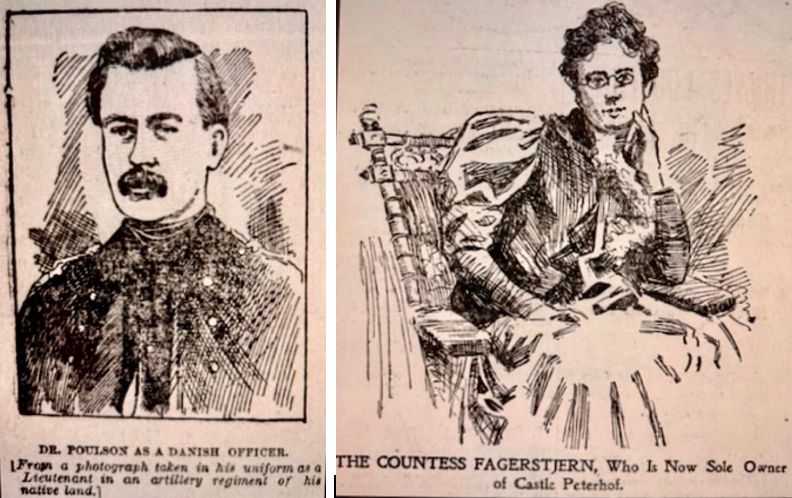
Count Peter William Poulson (1831-1894), divorced from his wife, became interested in Alice Staples. Count Poulson appeared before his devotees as Count Peter Poulsen
of Castle Peterhof, founder and high priest of the Brotherhood of the Black Cross, a band of religious devotees who had united to uplift their spiritual condition. He decided that he had been commanded by voices from the unseen world to wed Alice. “And in due time there was a spirit wedding.” Alice moved into the castle with Count Poulson who died in 1894, leaving her the castle and other properties. Count and Countess Alice Poulson-Fagerstjerna had a daughter, Deborah
Fagerstjerna. The castle was rambling structure that stood at 150 yards east of Fruitvale Avenue, Oakland, opposite East 27th Street. Alice Staples Poulson remarried, and became the wife of George Austin, then residing at 108 Clara. On November 30, 1901 (The San Francisco Call Bulletin, Nov. 30, 1901, p. 11) reported that the Castle Peterhof, with “it’s strange memories of mysticism and magic, is no more,” having burned to the
ground.
George Austin, a candy dealer and musician, owner and resident of 108 Clara Avenue from 1900 to 1905, sold the lot described as the west line of Clara, 478 feet of 18th Street, measuring 26 feet north by 136 feet west to George Tooker (The San Francisco Chronicle of November 1, 1905). Nine days, later, George Tooker sold 108 Clara Avenue to a E. H. Musin (The San Francisco Call, November 10, 1905). The description of this property is 478
feet north while the Cassin property is 448 feet north of 18th Street, a difference of 30 feet. In 1901, the lot is 26 feet wide; with the addition of the 16 feet on the right, the lot was increased to 42 feet, which occurred between 1901 and 1908. (See the 1901 and 1909 Horner’s Subdivision maps.)
In August 1905, the house (only half as wide as it is now) was offered for sale at $6,000, described as 3 large, imposing, well-built flats of 6, 6, and 7
rooms and bath, thoroughly modern, lot 25 x 137.6; rented very low at $55 per month and to apply at 108 Clara near 17th Street (The San Francisco Examiner, April 27, 1905, p. 17.). (Note that the lot at this time is only 25 feet wide. In September 1905, the flats were still on the market: “$6000, absolutely must be sold…building alone cost $7000” (The San Francisco Examiner, Sept. 24, 1905, p. 17).
A permit was applied for by Mary
Bates of 435 Douglass Street on December 1, 1906 on the 16 foot wide side lot, to build a single family dwelling measuring 16 feet by 36 feet and 25 feet high (96 feet from Clara). (The 16’ wide lot resulted from cutting through the Clara block to extend 17th Street, leaving 16 feet of lot 31. See McKee map). She withdrew her application on April 11, 1907. On August 28, 1907, she applied for another permit. In this permit she proposed to build a two story dwelling for two
families, measuring 16 feet by 136 feet with a height of 30 feet. She was required to provide an elevation drawing as the cost would exceed $1000. This was not built, and most likely she sold the lot.
The next early owner and resident was Ephraim Chaim (E. H.) Musin (1866-1927), an 1888 immigrant from Kiev, Russia. The family moved to San Francisco from Chicago in 1904 and E. H. Musin purchased the house on November 10, 1905. He was a tailor, jeweler, and
pawnbroker, the few trades allowed a Jew in Russia; in America, he also bought real estate and became a wealthy man. He was married three times; the first wife died young (one daughter) and the second wife died in 1918 of the flu. They had four daughters and a son.
On August 1, 1908, E. H. Musin applied for a permit (Lattig Construction Company) to add an addition to the house at Clara Avenue and 17th Street at the cost of $3900. The permit is
described as addition to a 3-story frame building (2 flats and store)(TheRecorder, Aug. 4, 1908, p. 8.) The permit shows a sketch on the 16 feet side lot, extending 84 feet with a height of 43 feet. This permit was approved with some modifications and requirements. The address of the store was 100 Ord Street. After the addition, the street numbers 104, 106, and 108 (as well as 4301-4303-4305 17th Street) appear. A recently discovered photograph taken
of the Musin family on the stairs of the house was taken in 1910. This photograph shows the grocery store. The wooden staircase and railings were eventually replaced for what is seen today.
The 1919 Sanborn Fire Map below shows the addition (double bay window design and store). This may explain why the bay windows on the 17th Street side (north side) appear to be later in design than those on the south side, an 1880s design. The façade also tells
the same story—look at the 1970s photograph below. It is not entirely symmetrical as would be expected at this time; the two windows above the entrance are not on center and the right side has a window that does not appear on the left. The architect and contractor, N. W. Mohr, matched the 1880 façade window trim in 1908.
1885 Left Side; 1908 Right Side
On June 25, 1912, E. H. Musin filed a Summons to Establish Title. On April 20, 1920, E. H. Musin applied for a permit to alter the present grocery store at 100 Ord to a three room and bath apartment and a garage in the basement with a separate entrance on Ord (this became 104 Ord) at the cost of $750. This was to make
three stories of living space on the right side of the building. On December 15, 1921, E. H. Musin reapplied for a permit to rearrange storerooms for a two room apartment and a garage at Ord and 17th with N. W. Mohr, architect, and W. F. Lovell, contractor at the cost of $1450. (The Recorder, Dec., 13, 1921, p. 6.) The main difference between these two permits was that there were to be two rooms instead of three and 120 yards of earth were to be removed for the garage. The
grocery store shown in the 1908 and 1910 photographs was short lived. E. H. Musin married a third time in 1920.
In 1928, he died as a result of a gunshot to his head, a suicide. He was at the time living at 365 Arguello Street, having last lived on Ord in 1923. The newspapers noted that he was despondent over the death of his wife, eight years earlier. Yet, descendants report (ancestry.com) that he had contracted syphilis from his third wife, Ida. The property on
Clara was left to his three surviving daughters, a son, and an orphaned granddaughter (1/5 each). He left some funds for his sister in Russia. His wife, Ida, was only to receive one-half of his home at 365 Arguello, provided that she cooperate with his children in assisting with collecting proceeds of his life insurance policies. E. H. Musin lived on Ord from 1905 to 1923 before moving to Arguello. The appraised value of all of his property at his death (1928) was $32,375
($600,000 in today’s dollars). The house on Ord was appraised at $10,000. It was eventually was ordered to be sold to settle the estate in 1940.
In 1940, descendants who inherited the building from E. H. Musin, applied for permits to repair posts, piers and stairways. In 1946, the Clara and 17th Street house was still owned by Musin descendants. In 1953, lot 1 was owned by Robert and Anna Bruckman. The Bruckmans lived at 106 Ord from
1948-1949 to 1959 (San Francisco Directories). Robert Bruckman was engaged in fine book binding; the name of his business was Anabob Crafts. In 1953, lot 2, owned by the Cassin sisters (both deceased by 1951), is subdivided, creating a lot where 100 Corbett was built; 104 Corbett was demolished for the present day 104 Corbett. The current owners’ grandmother purchased the building on June 12, 1959, probably from the Bruckmans.
Not to be missed
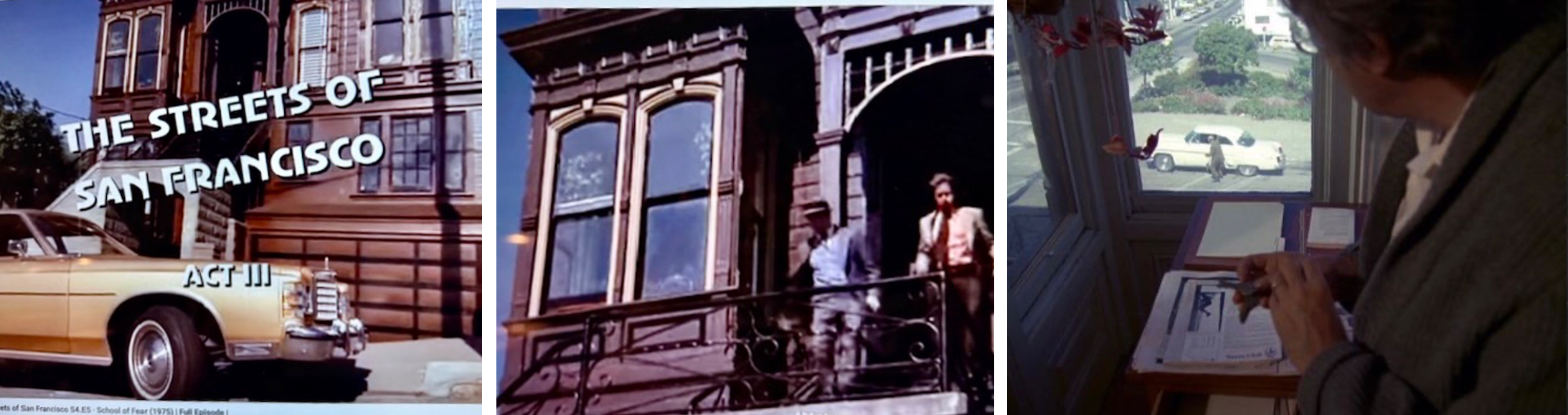
The Streets of San Francisco, Season 4, Episode 5, 1975 . This episode features the house, including some interior shots, the neighborhood and even the Ord/Corbett Park from the street and the interior of 4301 17th Street. If you don’t want to watch the entire episode, the house is shown starting around 8 minutes; followed by
several neighborhood photos at approximately 27 minutes.
Other filming locations: A teacher is shot at George Washington High School (“Manual High School”); the interior of the Columbarium; the retired teacher kidnaps students at 200 Clayton and at the Eddy and Divisadero; “Thomas Paine Academy” where the kidnapped students are held is an abandoned orphanage, Homewood Terrace, a 13-acre facility operated by the Pacific Hebrew Orphan Asylum, which opened in 1921 and
closed in 1965, located on Ocean Avenue between Ingleside Terrace and Westwood Park (El Rey Theater is in the background). (The orphanage was demolished soon after the filming and became a condominium project); a meeting with a witness at the corner of Scott and Ellis; the teacher pulls into a parking lot near 1900 Ellis; old St. Patrick’s Church at 1822 Eddy Street (now Macang Monastery); a woman questioned at 1207 Scott Street. There are numerous views of Fillmore District Victorian houses
that were demolished in the early 1970s for redevelopment.
The American Dream
The Cassins and the Musins, families of differing backgrounds, came to America to escape a difficult life—for one,
it was the potato famine of 1845-1852 and, for another, it was persecution for religious beliefs in 19th century Russia. They worked hard and fared well to achieve the American Dream.
…that dream of a land in which life should be better and richer and fuller for everyone with opportunity for each according to ability or achievement. […]It is not a dream of motor cars and high wages merely, but a dream of social order in which each man and each woman shall
be able to attain to the fullest stature of which they are innately capable, and be recognized by others for what they are, regardless of the fortuitous circumstances of birth of position. James Thuslow Adams, 1931
Architectural Rating
The building at 104-106-108 Ord Street has an A rating as a Historic Resource by the San Francisco Planning Department. It is recognized the 1976 San Francisco Architectural Survey with the following ratings
on a scale of -2 to +5; relationship with surrounding building (3); importance as contribution to a cluster/streetscape (3); façade proportions (3); richness/excellence of detailing/decoration (3); unique visual feature of interest (3); example of a rate or unusual style or design (3); overall architectural quality (3); façade condition (3); paint/material color (3); and appropriateness of improvements (1).
The Planning Department deemed the house as being
constructed in 1885, but did not make note of the two part construction identified here. The field note mentions decorative iron rails (replacement for wood structure shown in 1910 and therefore, not original) and “dark color paint give this building an assertive dignity.” It is also mentioned in the Here Today appendix of 1968.
Maps
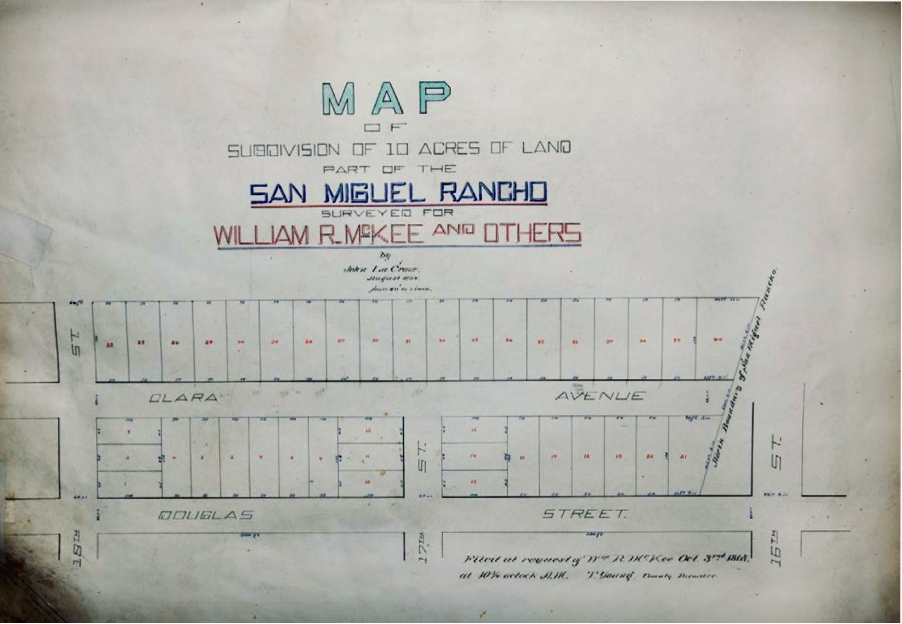
The first map below shows Clara Avenue as described above—the McKee Subdivision surveyed
in 1867. See lot 30 (9th lot from 18th Street).
Surveyed for William McKee Subdivision, by John La Croze, 1864 (#30 is 9 from the left of the numbered
lots)
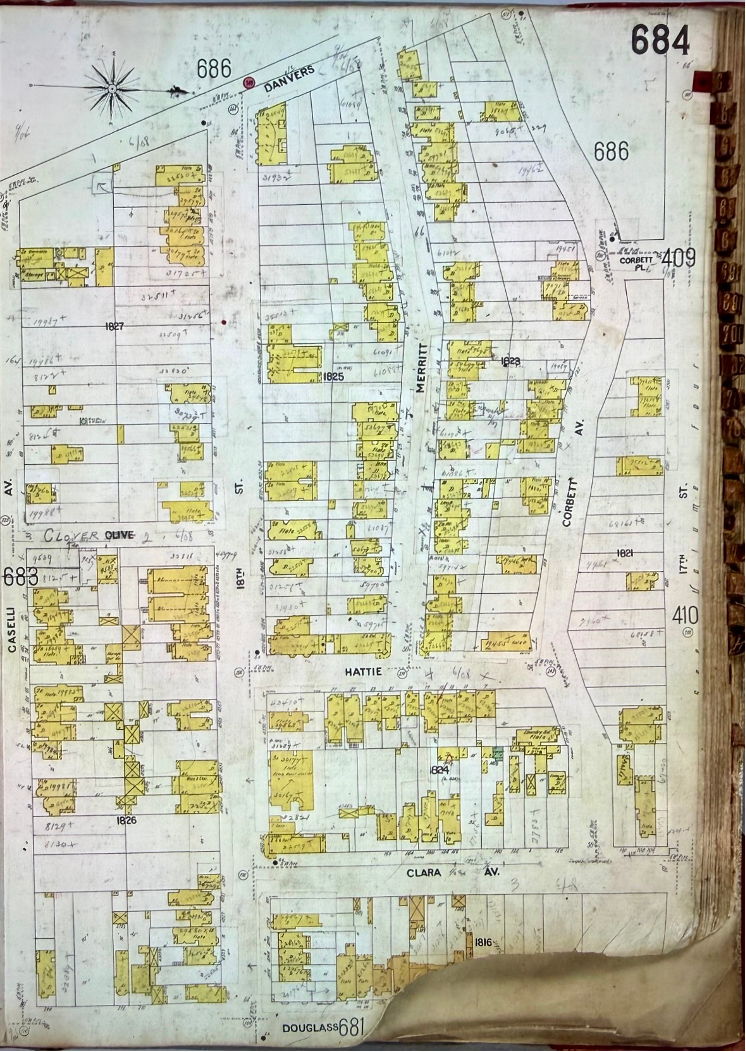
The next map is the 1905 Sanborn Fire map. Note that the parcel does not extend to the sidewalk on the right or north side and appears to have one bay window. The left half of the building is earlier than the right side!
Sanborn Fire Map, 1905 Vol. 6, p. 684 This is before the 104-106-108 expanded. The 16’ strip has permit codes in pencil indicating potential development.
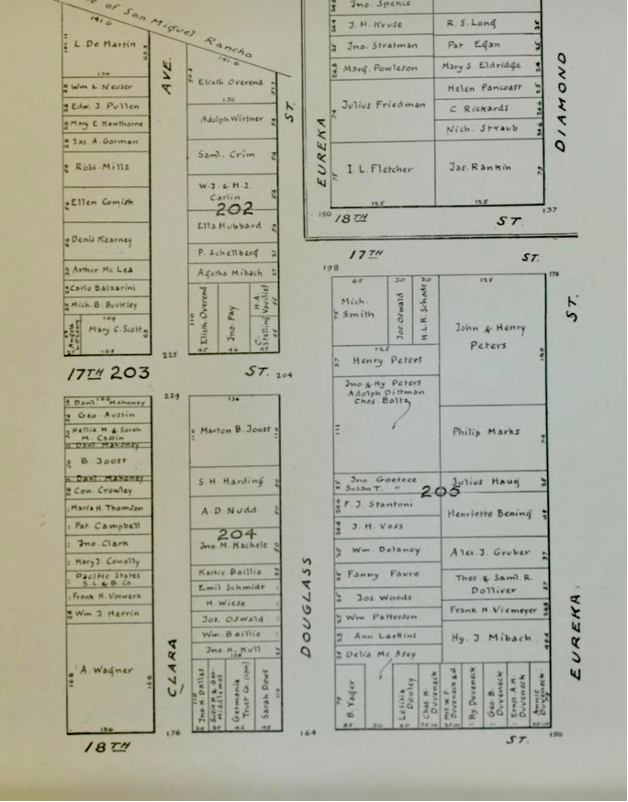
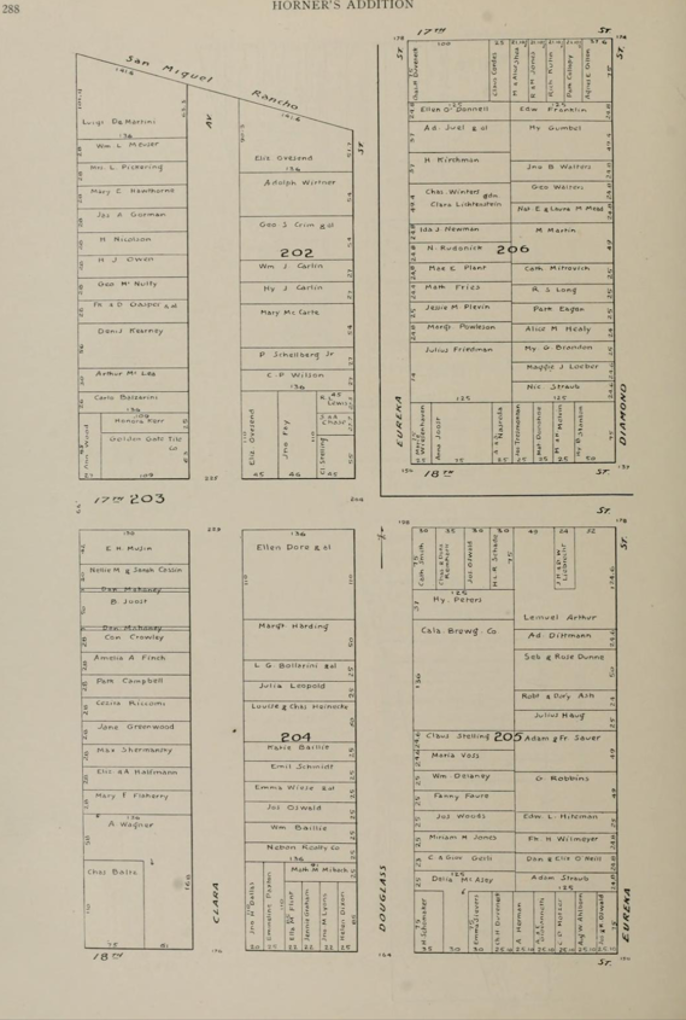
The next two maps are the Horner’s Additions, block 203, 1901 and 1909. Note the change in ownership.
Horner’s Addition 1901 Note Block 203. Daniel Mahoney owns the 16’ that later came part of 104-106-108 Ord. Austin is shown owning the house in 1901; Sarah and Ellen Cassin own 110 Ord. B. Joost’s property is now Corbett Avenue. Marten Joost’s
property is now part of the Ord/Corbett park.
Horner’s Addition, 1909 Musin now owns the 16’ Mahoney lot and 104-106-108 Ord. (House enlarged in 1908.) The narrow strip of 3’ owned by Mahoney eventually is
owned by Cassin.
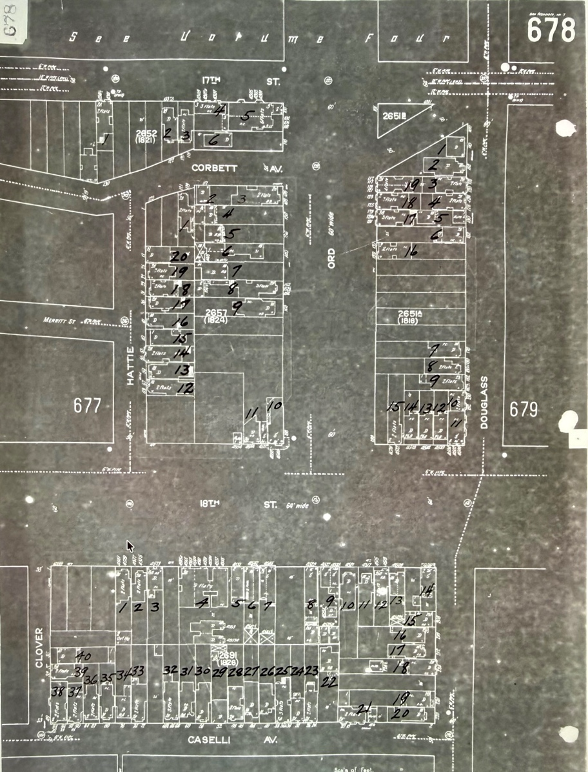
The 1919 Sanborn Fire map shows the completed construction of 1908. The map is marked “S” for store. It is now twice as wide. The building is now six flats, with the completion of the 1908 addition by Musin.
Sanborn Fire Map, Vol. 4., p. 678, 1919
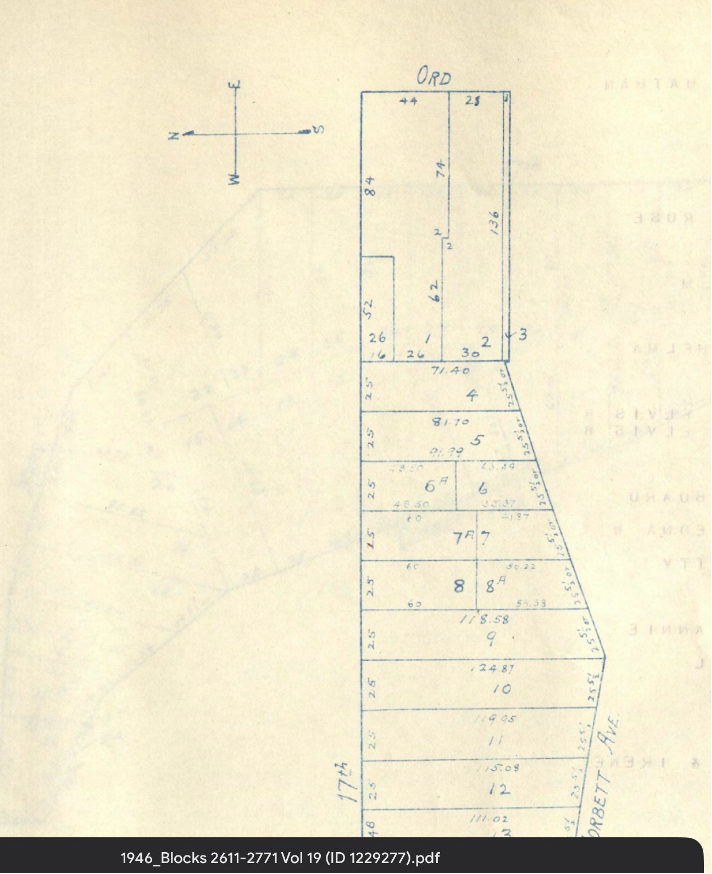
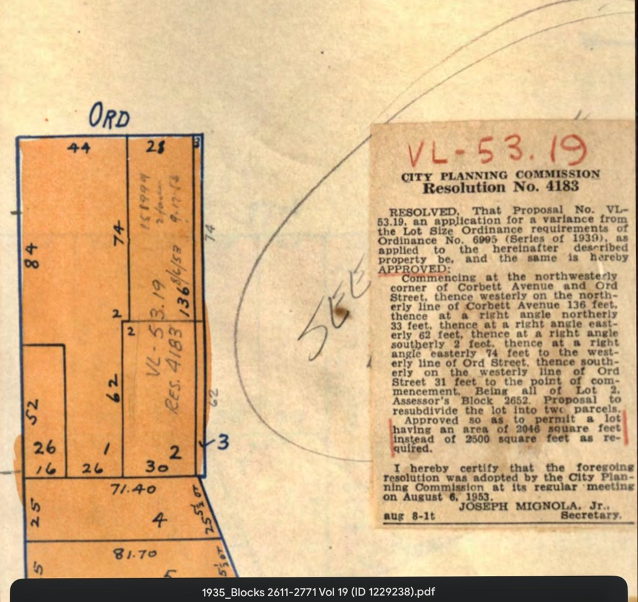
The final two maps are the 1946 and 1953 Block Maps.
1946 Block Map: Note lots 1 and 2 Lot 1 Belonged to Musin
Descendants Lots 2 and 3 Belonged to Ellen (Nellie) and Sarah Cassin (now living at 104 Corbett) The frontage between 17th and Corbett totals 72’.
1953 Subdivision of Lot 2 to create a new lot (100
Corbett) Ellen Cassin d. 1951 Lot 1 owned by Robert and Anna Bruckman, 1953
Photographs
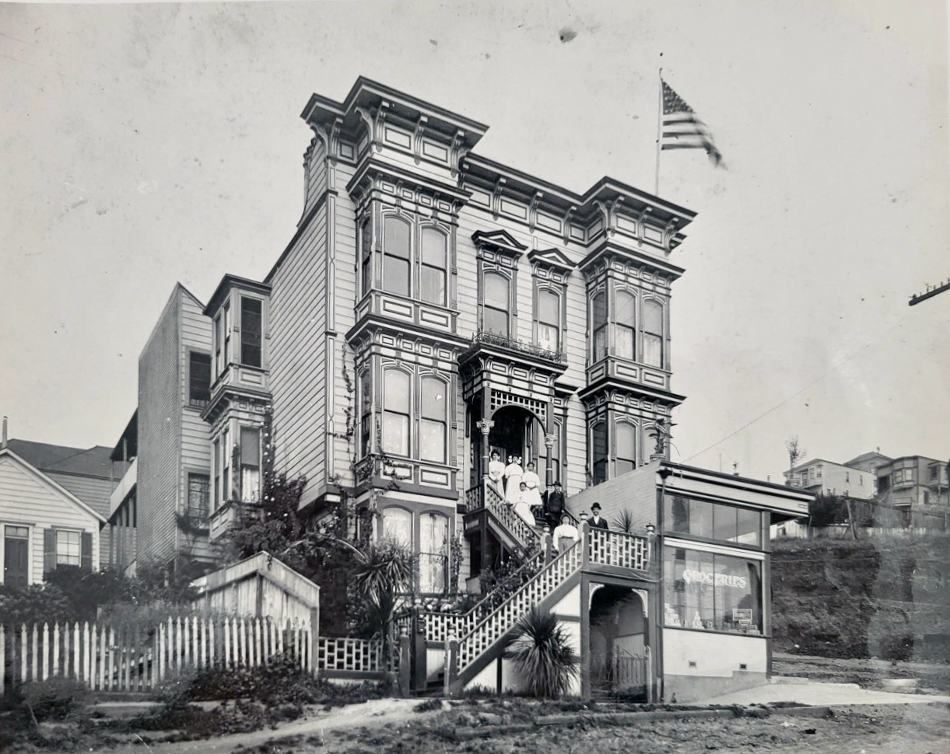
The first photograph shows the completion of the addition and grocery store circa 1910. The Musin family is on the stairs—Ephraim H. Musin (1866-1927) and his second wife, Sarah Rose Stein (1869-1918) and their five children: Milcah 1891-1975 (daughter of f E. H. and his first wife), Bertha (1894-1919); Leah (1895-1985), Bernice
(1897-1997), and Morris (1898-1964). The cottage of the Cassin family is on the left.
Musin Family on Stairs, 100-104-106-108 Clara, 1910 110 Clara, Cassin Residence, 1910 Credit: Alex
Clever
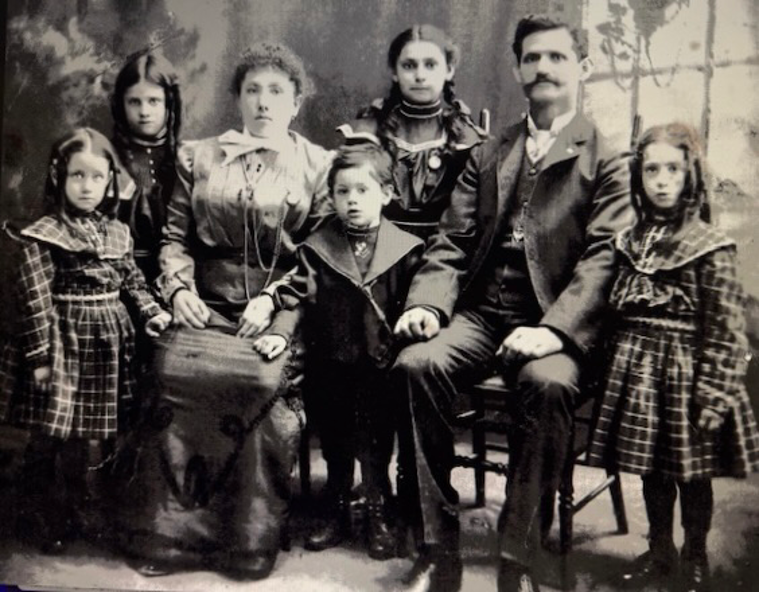
A family photograph of the E. H. Musin, wife, and children, circa 1904, a year or so before they moved to Clara Avenue.
E. H. Musin Family 1904
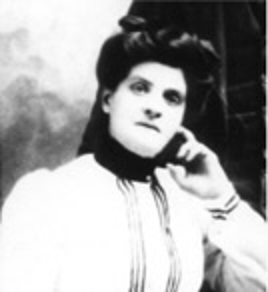
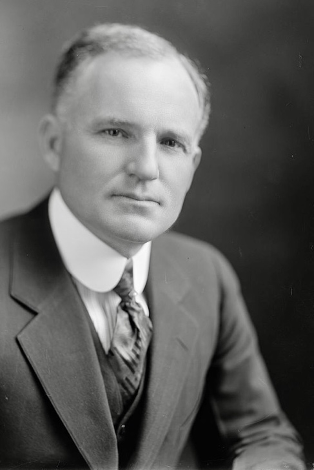
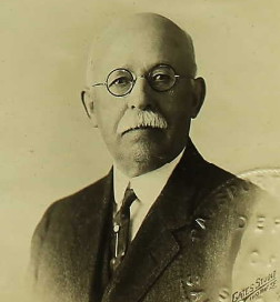
Other owners
of 104-106-108 Ord: Matilda Helbach Esse de Langton, Louis Titus, Thomas W. Rivers, George Austin, and Countess Poulson.
Matilda Helbach Esse de Langton
Louis Titus
Thomas W. Rivers
George Austin
Count and Countess Poulson
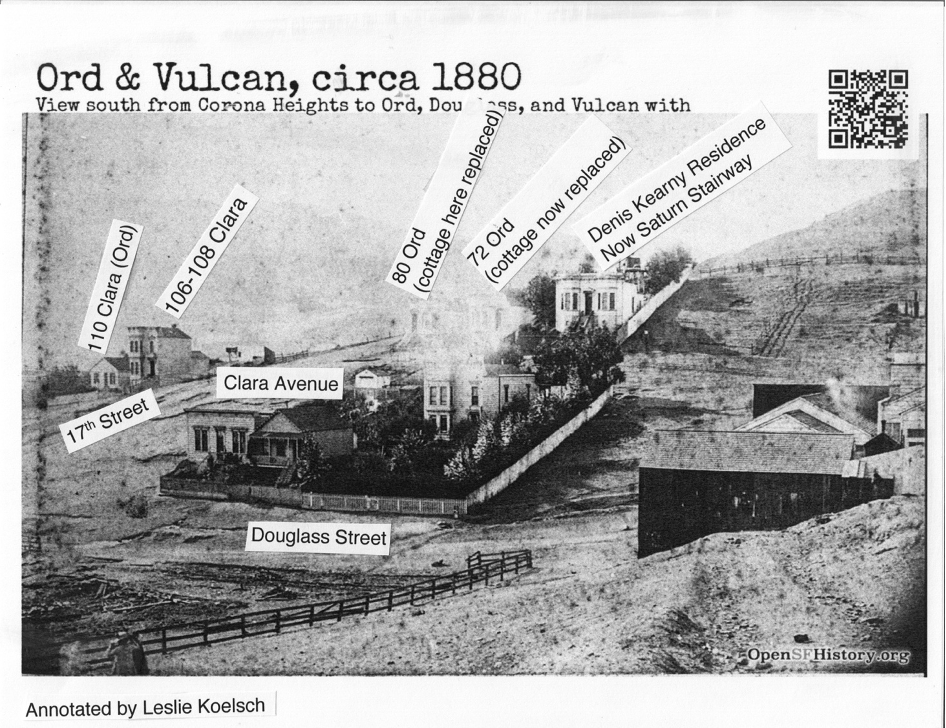
The earliest photograph of the house is circa 1880. This is the only photograph showing the house before its addition of 1908. See the annotated photograph. (See the March and April 2024 Neighborhood News that features 80 and 82 Ord and the Saturn Stairway.)
OpenSFHistory wnp33.00787
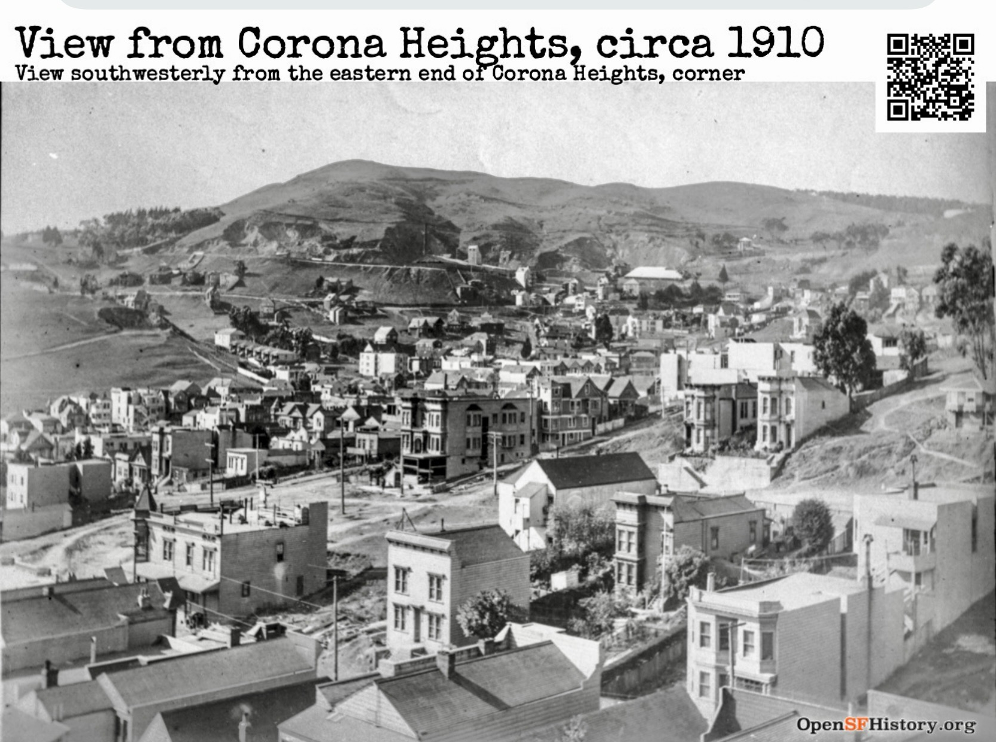
The next early photograph of the house is from 1908 (circa 1910). In this photo, the right side of the building is complete and the store at 100 Ord is under construction.
OpenSFHistory, 1908 Expansion of House Completed; Store under construction
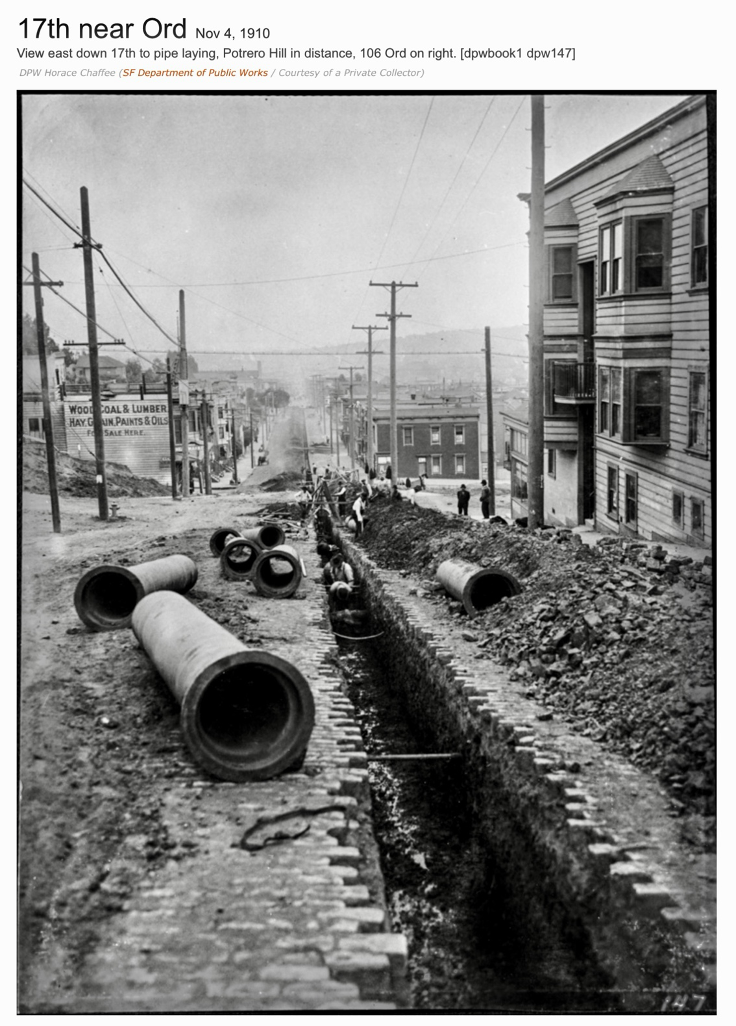
A 1910 photograph looking down 17th Street shows the completed store and addition on the right side.
Dpwbook 1 dpw 147
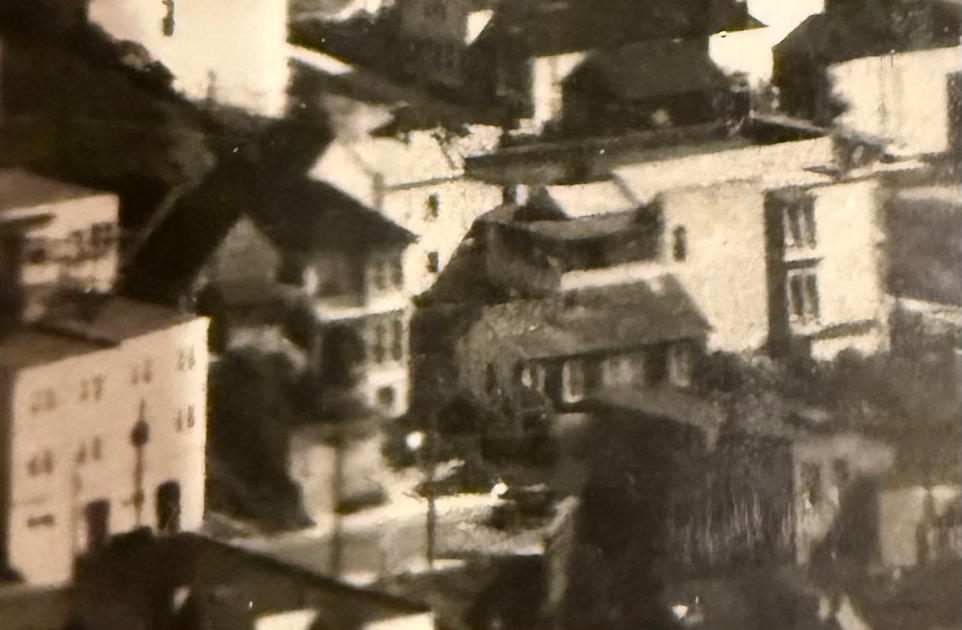
This photograph shows a portion of a large panorama photograph, 1928. The Ord Street house (bay window on the side, light color paint) and the cottage at 104 Corbett (home of Ellen and Sarah Musin from 1930
to 1951). 108-110 Corbett extant, but unrecognizable.
1928-1930 104 Corbett (demolished and replaced) 104-6-8 Ord from the south side 108-110 Corbett extant, but
unrecognizable
San Francisco Planning, 1976
Pet of the Month
Meet Mylo posing at the Corona Heights Park. Keep those pet photos coming….
Blooming Now
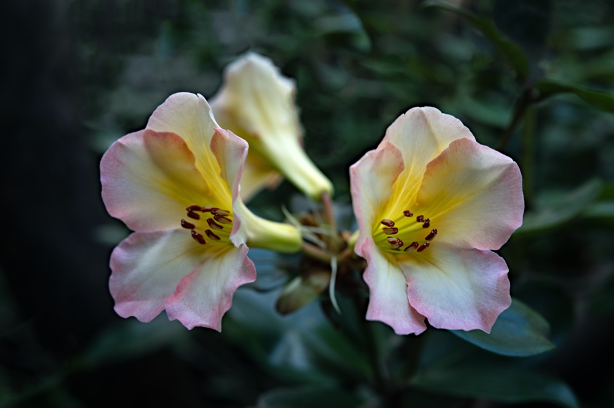
Vireya Rhododendron—R. Cara Mia. (Rhododendron armitii) features trusses of cream to ivory colored trumpet shaped flowers rimmed with a clear pink
edge.
Richie’s Picks: THE DREAM & THE HOPE: THE HISTORIC RISE OF KETANJI BROWN JACKSON TO THE NATION’S HIGHEST COURT by Garen Thomas and Lori Rozsa, HarperCollins/Harper,
January 2026, 336p., ISBN: 978-0-06-331144-2
“And there were bloody footprints
Where mercy should have stood
And two dead, left to die on snow-filled streets
Alex Pretti and Renée Good”
– Bruce Springsteen (2026)
“When President Joe Biden nominated Judge Jackson to be on the US Supreme Court, her friends and family and most people in the legal world were thrilled but not surprised.
The president said he wanted somebody truly
special for the important job.
‘Somebody extremely qualified, with a brilliant legal mind, with the utmost character and integrity, which are equally as important,’ Biden said. ‘Someone with extraordinary character, who will bring to the Supreme Court an independent mind, uncompromising integrity, and with a strong moral compass and the courage to stand up for what she thinks is right.’”
From cover to cover, THE DREAM & THE HOPE: THE HISTORIC RISE OF KETANJI BROWN
JACKSON TO THE NATION’S HIGHEST COURT demonstrates over and over and over again why President Biden’s elevation of Ketanji Brown Jackson to the US Supreme Court was a no-brainer: Ketanji exceeded Biden’s desired qualifications in every aspect of her resume and her life.
Justice Jackson, who was a precocious reader at age two, and was citing history to adults by age four, was the daughter of a teacher mother and a teacher-turned-attorney father. She fell in love with the
law, thanks to her dad, and actually imagined, as an adolescent, one day fulfilling her fantasy of “becoming the first Black, female Supreme Court to appear on a Broadway stage.”
From grade school to high school, to college and law school, Ketanji kept her eyes on the prize, working overtime to consistently be the best student, the best student leader, and the best person she could be. This engaging biography walks us through the challenges and successes from her
childhood in Florida onward to the Supreme Court.
“Ketanji developed a very useful habit during her debate competition years. Every time she walked into a new classroom throughout her storied speech and debate career, she’d enter with her customary resolute step, exuding confidence and a big smile with her head held high and her back straight. She was just over five feet tall, but she seemed taller to her friends because of the way she carried herself.
Ketanji knew
that a confident posture helped to convince the judges watching from the front row that she knew what she was talking about. She was always prepared, well-rested, and ready to win.
But she knew she had another obstacle to overcome that had nothing to do with her confidence, or with how brilliant her public speaking was, or how sharp and on point her speeches and comebacks or rejoinders were. She was Black, and the judges and competitors were almost always white. Therefore, she walked with
purpose to the chalkboard at the front of the room, and with a smile, briefly turned her back to the judges and wrote on the board:
K-e-t-a-n-j-i
She’d put the chalk down and then turn back to face the judges, still smiling. She’d spell her name out loud, and then pronounce it, clear as a bell.
‘She would always just articulate it really clearly,’ said Stephen, who was also on the team, and had watched her introduce herself like that dozens of times. ‘It was a
simple, “Hello, my name is Ketanji Brown, K-e-t-a-n-j-i.”’ He noted that she was dark-complexioned ‘Black young woman, a teenager. And she had an unusual name. And so she had to immediately convey to the person who’s going to be literally judging her who she is right off the bat.’”
“Ketanji recalled many years later, ‘Whether it was running for class president, or becoming a champion orator, or even applying to Harvard after my public high school guidance counselor “helpfully”
suggested that I not set my sights so high, I recall distinctly not being fazed by the slings and arrows of implicit, or even explicit bias, and making the conscious decision to push forward nonetheless.’
We repeatedly see Ketanji’s compassionate side, and how her time spent as a public defender–a rare experience amongst Supreme Court justices–has enriched her ability to really grasp what people who come before the Court–or any court–might be dealing with.
But
THE DREAM & THE HOPE is far more than a biography. This is a serious must-have for Black History Month. It is packed with fascinating details about American Black history, including discussions of pivotal decisions made by the Founders and by the US Supreme Court that have positively and negatively impacted the paths trod by Ketanji Brown Jackson and generations of other Americans of color who have fought for the same rights accorded, so routinely and consistently, to white men. In this age
of Trump’s anti-DEI crusade, there is an excellent discussion of affirmative action.
At a time when a lot is wrong in America, having Ketanji Brown Jackson on the Supreme Court is one of the things that, as an American, I am so proud of. This book is guaranteed to inspire some kids, somewhere in America, to work hard, to become lawyers or jurists, and work to change our representative democracy so that we make America everything it can be.