A congressional candidates forum is being sponsored by ten local neighborhood organizations, including CHN. Save Wednesday May 6. The doors open at the Randall Museum at 6:30 and the forum is 7:00PM to 8:15PM. Joe Fitzgerald
Rodriguez, a reporter of The Standard, will be the moderator.
CHN will also sponsor a similar forum for San Francisco Supervisor District 8 with other neighborhood organizations. The date is to be determined.
Save Another Date—April 17th at the Slope!
We are set for a special event commemorating the Great Earthquake on Friday, April 17 from 6 to 8 PM. Please meet at the Slope Community
Garden at Corbett & Mars. We will have “photogifts” of Corbett Heights’s own earthquake camp and bread line. (First 25 get the photos). Our guest speaker will tell us about the earthquake and its effects in Corbett Heights. You will receive a reminder in the April 1 newsletter.
Results of the Annual January Survey
Three hundred and five (305) questionnaires were sent twice via the newsletter. Two hundred and forty-five
(245) or 80.3% of the newsletter survey were opened the email and 11% responded. Of those who responded 63% have attended more than one general membership meeting; 76% attended because of general interest in the neighborhood, followed by 62% having a specific interest in a speaker, and 57% wanting to engage with neighbors. Fifty percent (50%) have not attended due to either location, parking, and time and date issues. An overwhelming number of responders said they would attend
neighborhood social events: 83% to be held at Ord and Corbett; 11% at the Slope, and 6% at Merritt and Danvers parks. Seventy-eight percent would attend if the meetings were virtual versus 22% if in person. CHN will consider these results when planning events.
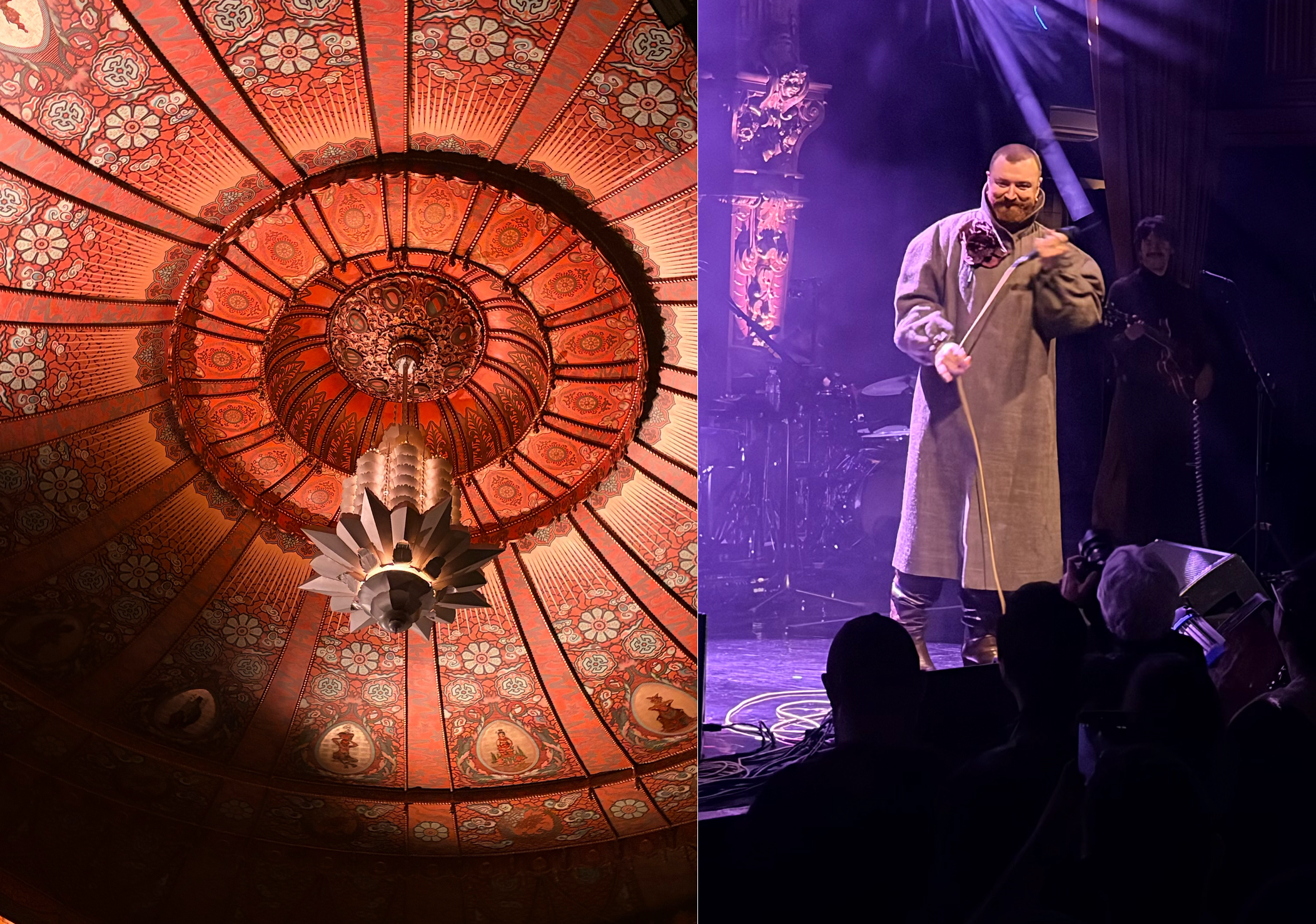
Sam Smith Headlines Castro Theatre Reopening
The Castro Theatre officially opened to the public on February 6, 2026, with a fundraiser and film screening of The Adventures of
Priscilla, Queen of the Desert. The venue will host a mix of live music, film screenings, and community events. The sold-out program with Sam Smith was attended by one our board members who reports here.
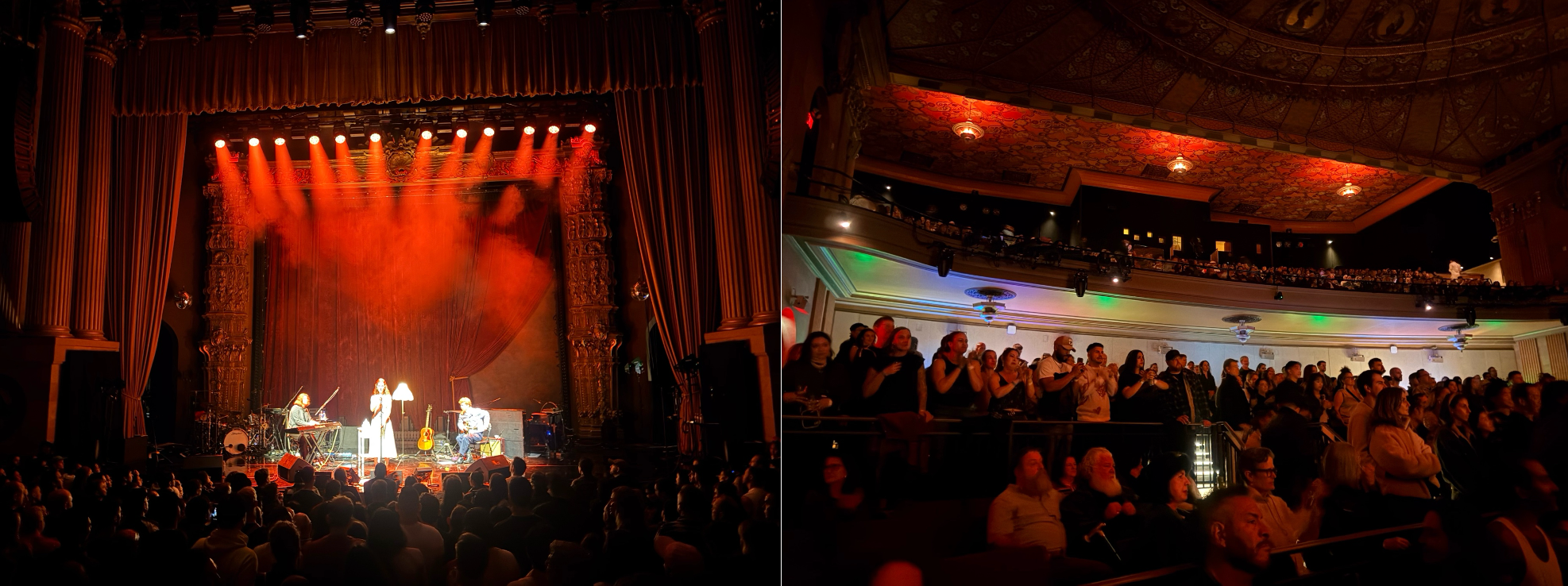
After a two year closure and $41 million renovation by Another Planet Entertainment (APE), the Castro Theatre has reopened in style. Five-time Grammy Winner Sam Smith is in the middle of a twenty-night residency through March 14th, performing some of his #1
singles, including "Stay With Me."
The opening act is Isabel Dumaa, a singer/songwriter and Cole Valley native. Both Smith and Dumaa expressed pride in performing at the Castro Theatre. Smith professed, "The Castro is one of the first places ever in my life that when I came here I felt I had come home....getting to be here in this theatre on this street in this tremendous occasion for the Castro is one of the greatest honors of my life."
While
Smith has clearly been the main draw for the sold-out crowds, the Castro Theatre is his co-star. APE's renovation, at times controversial, restored some of the theatre's historic elements, and installed removable seating to cater to concerts like Smith's. The result is a beautiful, intimate, and historic experience, with the potential to inject new life into the Castro.
General Manager of the Castro
Garrett Blanchard is the designated community liaison for the theatre – located at 429 Castro St. San Francisco, CA, 94114. Should you have any questions, he can be reached at 415-864-0815.
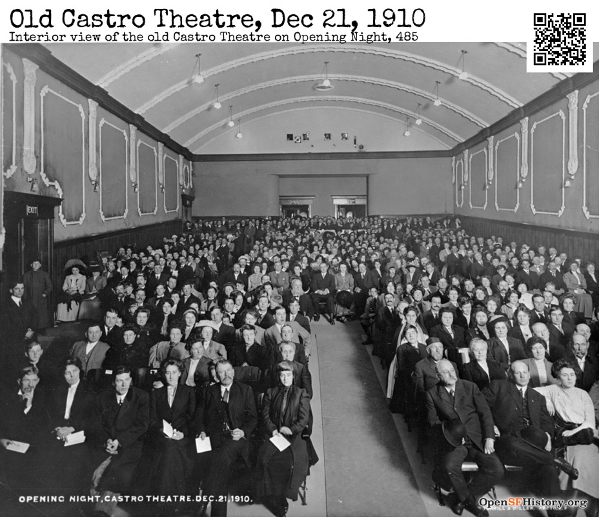
Before the Castro Theatre at 429 Castro
Before the new Castro Theatre, the old Castro
Theatre operated at 485 Castro (now Cliff’s Hardware at 479 Castro). Its opening night was December 21, 1910.
Credit: OpenSFHistory, wnp67.0033
The "New" Castro
Theatre
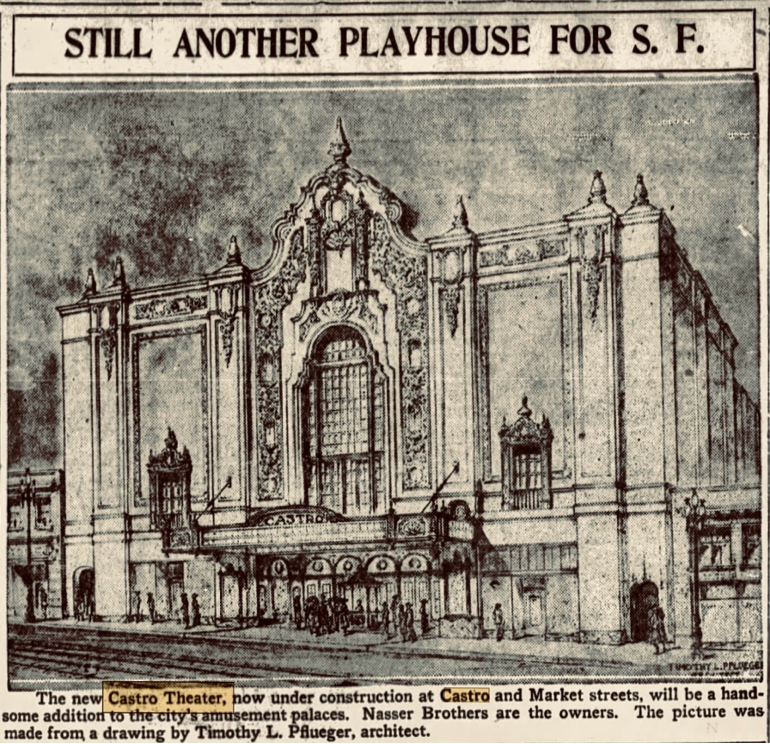
The new Castro Theatre opened on June 22, 1922 and seated 2,000. The cost to build the theatre was $300,000. Timothy L. Pflueger, was the architect. The interior decoration was done by Faggioni Studios. The orchestral organ, a Robert Morton.
San Francisco Examiner, May 28, 1922, p. 10.
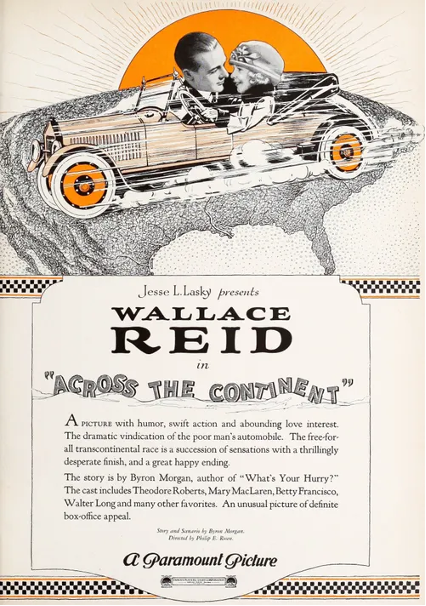
The First Movie at the Castro Theatre of 1922
“Across the Continent,” a silent film featuring Jimmy Dent, son of an automobile manufacturer, who defies his father by purchasing a low priced car from a rival firm of his father’s. He drives cross country to defy his father and prove the reliability of a low priced car. It was the opening film at the
Castro Theatre on June 22, 1922. The film is lost and there are no surviving copies.
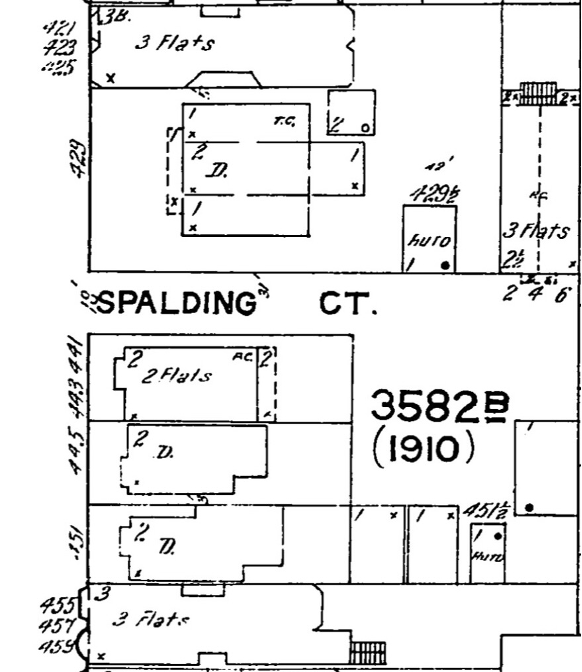
What Building(s) did the new Castro Theatre Replace?
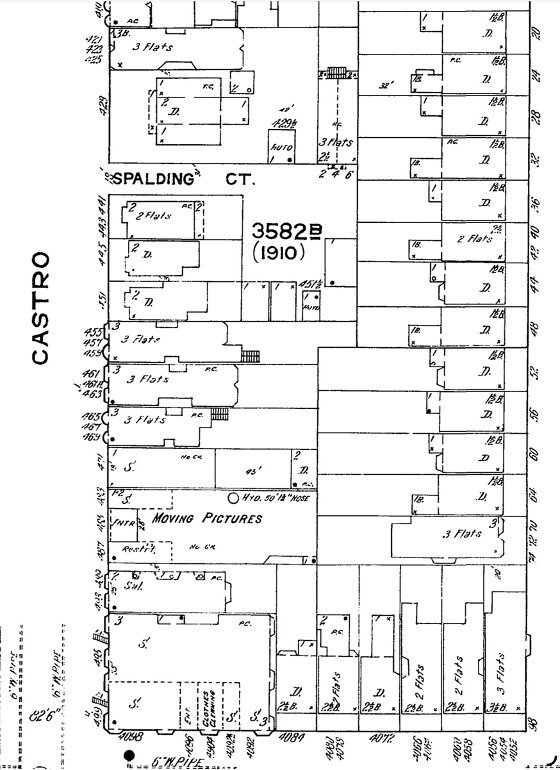
There was a large apartment building on the site of the
new Castro Theatre. The Sanborn Fire Map below shows a couple of apartment buildings and a garage at 429 Castro; the old Castro Theatre “Moving Pictures” is at the Cliff’s Hardware location.
Cities Within a
City and The Castro Opens 1922
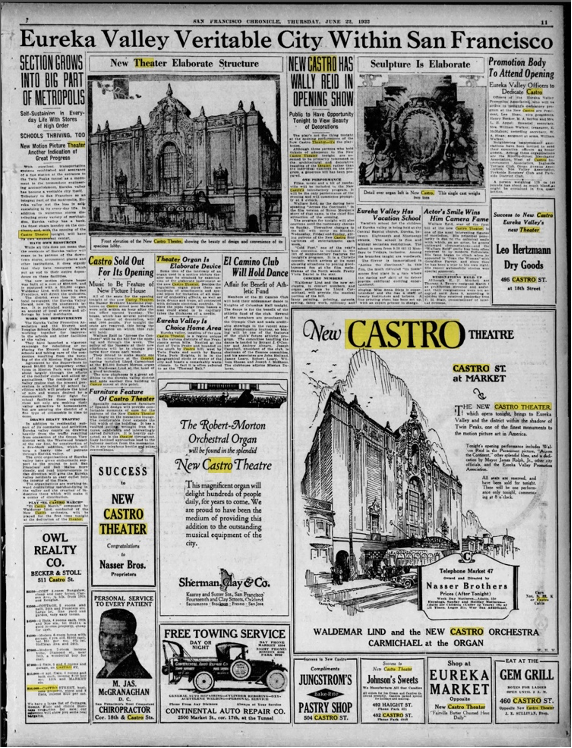
Between August to November, 1924, Anita Day Hubbard (1889-1965) published columns in the San Francisco Bulletin. Twenty-two pages about Eureka Valley can be found on pages 88-109 here. The article highlights the new (i.e., 1922) Castro
Theatre.
There is such an air of well-established maturity in the Eureka Valley that it is hard to realize that the territory, like all of western San Francisco, only yesterday as devoted to the pursuits of agriculture—cow ranches, vegetable gardens and brickyards (p.88).
San Francisco Chronicle, June 22, 1922
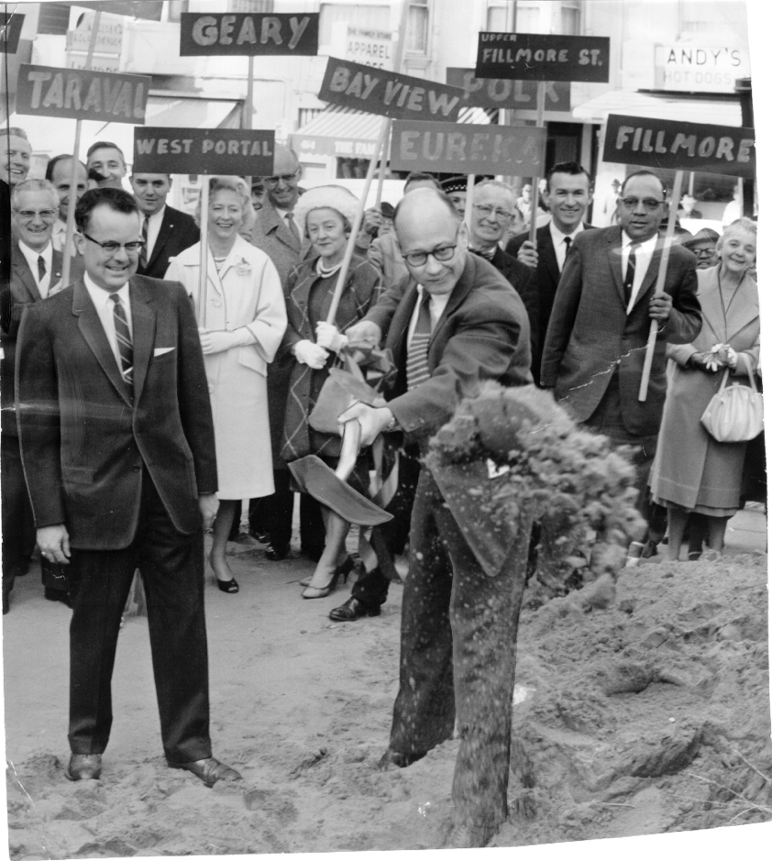
What Are These People Celebrating? And Why Are They So Happy?
The answer is at the end of newsletter.
Credit: SAN FRANCISCO HISTORY CENTER, SAN FRANCISCO PUBLIC LIBRARY. AAB-3269
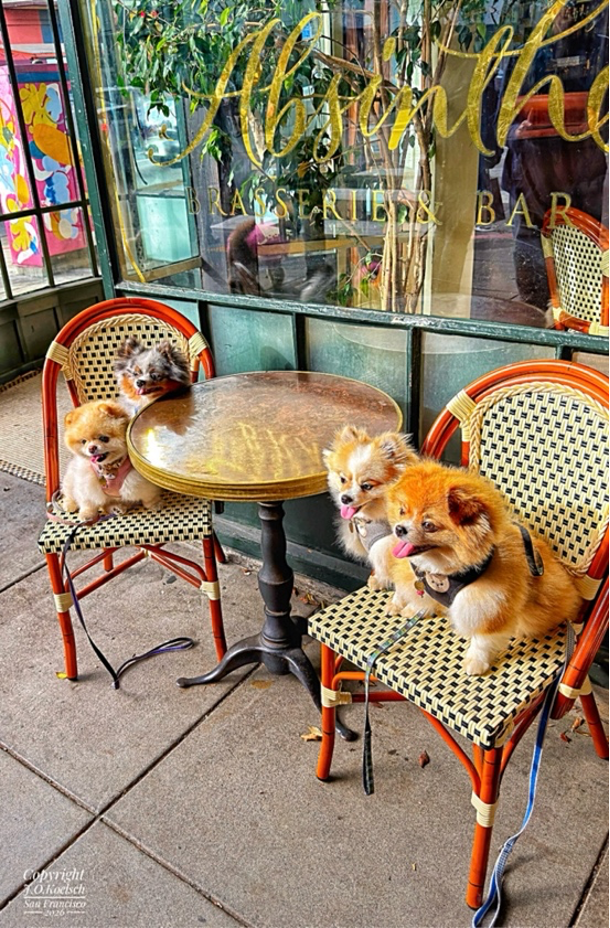
Pet Pics
Send a photo of your pet to info@corbettneighbors for upcoming newsletters. Don’t forget to give us your pet’s name.
Richie’s Picks: FEW BLUE SKIES by Carolina Ixt
HarperCollins/Quill Tree, February 2026, 384p., ISBN: 978-0-06-328791-4
Richie Partington, a Corbett Avenue resident, taught children’s library services classes in
the San Jose State MLIS program. Richie has served on numerous American Library Association award and selection committees, including the Caldecott Medal committee. Richie generously and willingly agreed to let us print this latest review.
“Just go out for a breath of air
And you’ll be ready for Medicare
The city streets are really quite a thrill
If the hoods don’t get you, the monoxide will.”
– Tom Lehrer, “Pollution” (1965)
“[W]hat I
have grown to learn through my own time in academia, in reading, and in research is that the racism in urban planning, the process of developing a city’s infrastructure, is never coincidental. The location of city dumps, the location of highways, and the location of warehouses are always strategically planned.”
— Author’s Note
(This book was inspired by the author’s learning that an Inland Empire community approved construction of a warehouse next to the local high
school.)
Issues of social, economic, and environmental justice permeate FEW BLUE SKIES, a contemporary tale for tweens and teens that is set in southern California’s Inland Empire. Two teens who have known each other forever–and share a sweet, innocent past together–team up on a research project tied to a lucrative scholarship contest. The topic of their research is personal for both of them. It relates to their dads’ respective respiratory illnesses that certainly seem to
stem from working in the community’s pollution-belching warehouse operations. It’s a story that illustrates injustices stemming from the siting of health-threatening industries in low income communities. It also shows how a prosperous corporation can readily work the system to the detriment of the people and community involved.
“Where most people had family photos pinned to the fridge, my ma had newspaper clippings of homes for rent back in her hometown. They all looked the
same: jaws of gates, stucco walls, terra-cotta tiles, an hour from here, away from all the warehouses, away from all the smog.
I could imagine her at work, sitting in a corner booth, poring over them in her break–a pair of scissors in her hand as she cut fantasy from paper.
‘How can we stay here?’ my ma asks, watching as my papa crosses into the kitchen. I hand him his water and he ushers us to all sit at the kitchen table. My ma sets her elbows against the surface,
presses her fingers tight against her temples. ‘She’s putting them everywhere.’
She tilts her head toward the living room, where the news is still on, where the mayor is still smiling. The volume is low, and I want so badly to get up and turn it off. To not know.
But not knowing feels worse than knowing.
I glimpse at the mayor who has divided the city, the community, my family, in half. She began her term twelve years ago and has yet to be voted out, funneling her quiet Selva
donations to bolster her reelection campaigns every cycle.
But what my ma is saying isn’t true. The mayor wasn’t putting them everywhere.
On the north side, where Mayor Warner lived, there were no warehouses. There were parks, there were gardens, there were trees.
But on the south side, where most of the Latino and Black residents lived, we have warehouses.”
In FEW BLUE SKIES, the smog that is connected to the logistics industry and all those warehouses has
created a life-and-death situation for Paloma’s and Julio’s dads, along with others living and working on the south side of town. Together, the two teens employ disciplined science research techniques in order to develop empirical proof of the harm being done, as they seek to win the scholarship contest that could provide the funds Julio needs in order to attend UC Davis.
The story also does a stellar job of delving into the web of relationships between the two teens,
their friends, parents, and community members.
Filled with first love, political corruption, heartbreaking tragedy, a look at how online shopping is causing big changes in our world, some jaw-dropping surprises, and some heartbreaking choices, FEW BLUE SKIES is a powerful, relevant, and thoroughly-engaging read that will leave readers pondering how they might act and react in similar circumstances.
Answer to the Why, Who, and Where of the Above Photograph
Jack Morrison, Supervisor, is lifting the shovel at the groundbreaking for the new neighborhood parking lot, the Eureka Valley Parking Plaza, at 455 Castro, between
17th and 18th Street on March 14, 1964. (The parking lot was approved by the Board of Supervisors later, however, after some opposition from the Brotherhood of Teamsters Local 665, who regarded the parking lot as “extravagant and socialistic.”) Members of other San Francisco neighborhoods appear in the background and they will soon get parking areas for their own districts. The Eureka Valley Parking Plaza replaced flats at 455-7-9 Castro and is the drive-in
for its 22 parking spaces; now it’s 18 spots and 1 parking spot for disabled. Parking was $10 a hour.