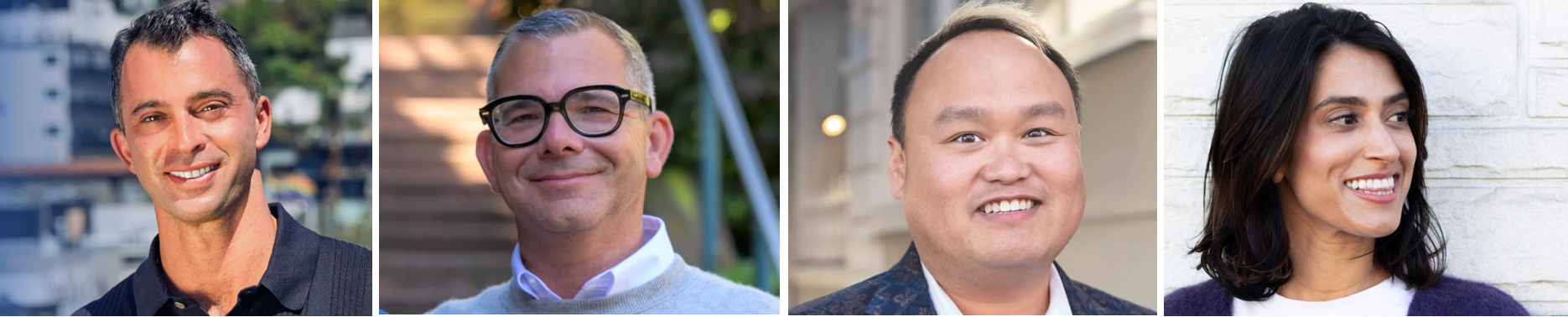
Over the last six months, the CHN Board welcomed the four candidates for District 8 Supervisor, Manny Yekutiel, Gary McCoy, Michael Nguyen, and Darshini Patel, to its meetings. The candidates answered five questions pertaining to D8 and their candidacies. Their answers to each question will be shared in each of the
next five newsletters, leading up to Election Day on November 3rd.
Their answers are in order of candidate appearance at our meetings and have been lightly edited for space:
Why are you running
for supervisor?
Manny Yekutiel: “I’m running now because we’re at a turning point in the city. We have more adults in the room in City Hall that want to solve our problems, and I want to be part of that work. I want to make the government easier to work with. In particular, I want to fill the vacant storefronts, make the city more affordable, and have fewer people on the streets suffering from mental illness and drug addiction, because it’s not compassionate. The spirit
of collaboration that’s occurring now is a spirit that I find in myself. I’m running now because of the moment that our city is in.”
Gary McCoy:
“I’m running for supervisor because I have a passion for public service. I spent all my 20s on the streets, mostly in the Castro. I went to treatment and my first role as a sober person was volunteering for Scott Weiner when he was first elected supervisor. There was so much going on, and it was very rewarding; I became a
legislative aide for him, which allowed me to come off disability and get housed more permanently. I also did an internship with Nancy Pelosi in 2013. My work led to her hiring me as a senior congressional aide in 2016. I had the honor to work on a lot of language in the second and third covid relief packages. I love public service.”
Michael Nguyen:
“I built community here and I found a home here – I’m the son of refuges – and I just thought the folks that were
running don’t come with bold enough solutions. For me, SF is a special place, and it needs to be protected. I’m pro-housing but I want to make sure that we don’t displace folks. I’m a drag queen, I’m an organizer, an activist. I know how to do the organization, legislation and fight for our communities. My main reason for running is the rent is too damn high. Affordability is at the top of my agenda.”
Darshini Patel:
“I’m running because I’m tired of seeing our
city make promises and voters vote in measures that don’t fully get finished. My career has been in making big systems function and work. That started during my time at the White House – where I worked on domestic policy under Obama – and we were focused on the government’s responsibility to get the people engaged. I then moved on to work on Obama’s reelection campaign. I was given a stack of papers and tasked with helping to win Virginia. Then, I worked with DoorDash, and started their small
business advocacy org within the company. At a profit-driven company, it was important to get all the teams onboard and include the small businesses in this strategy. It helped us be successful during Covid, delivering relief supplies to restaurants in need. These are examples of taking big systems and making them work for the person they’re supposed to work for. The problems we’re seeing is because the system isn’t working properly. I came back after running Get Out The Vote for Kamala Harris
in New Hampshire. I didn’t want to go back to tech after such a devastating loss, and as I was doing research to realize how best to focus on San Francisco, what I came to realize is that a lot of what people want is already in process; it just hasn’t come to fruition. We need to make these policies come to fruition and continue to engage the community.”
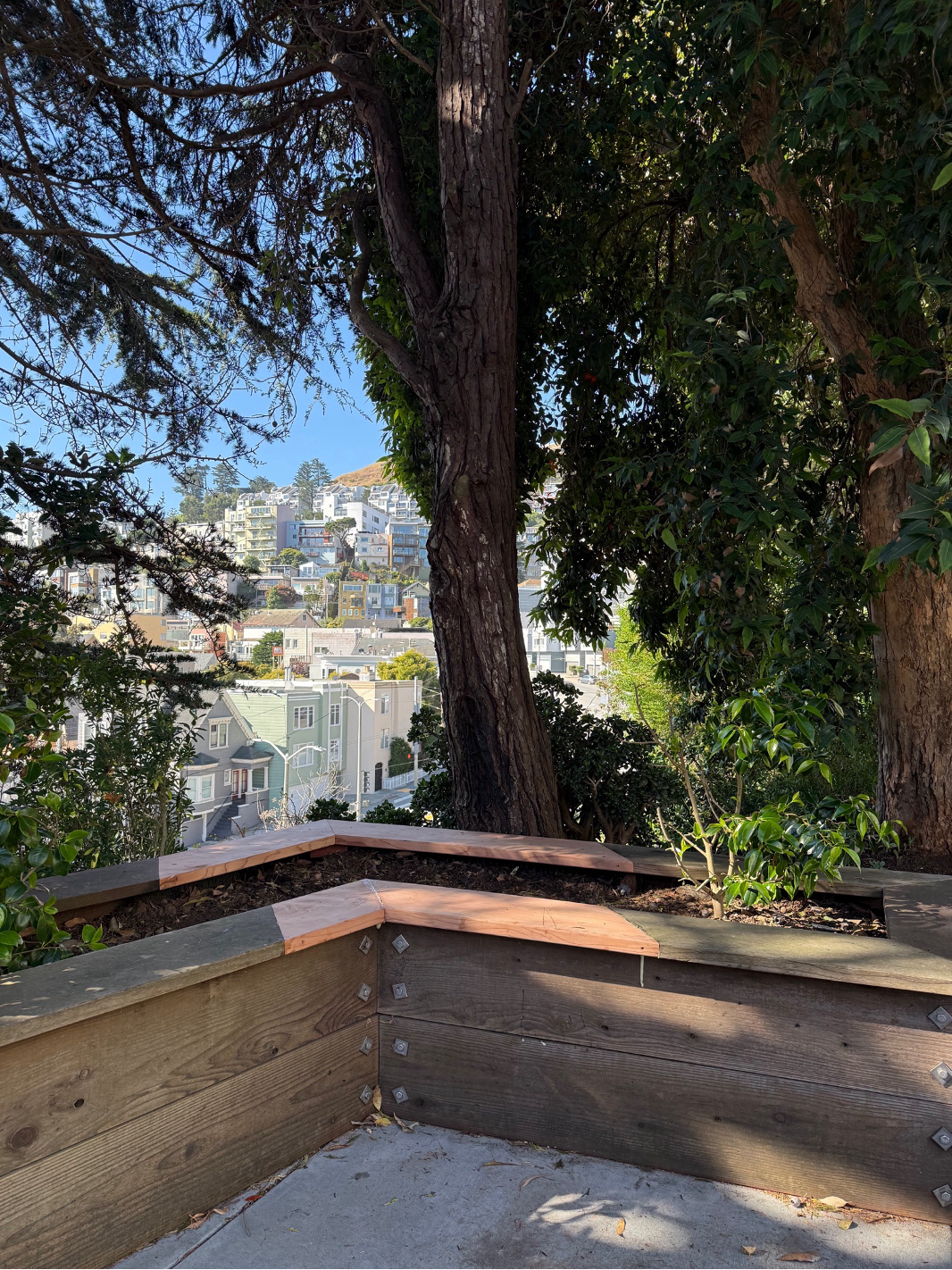
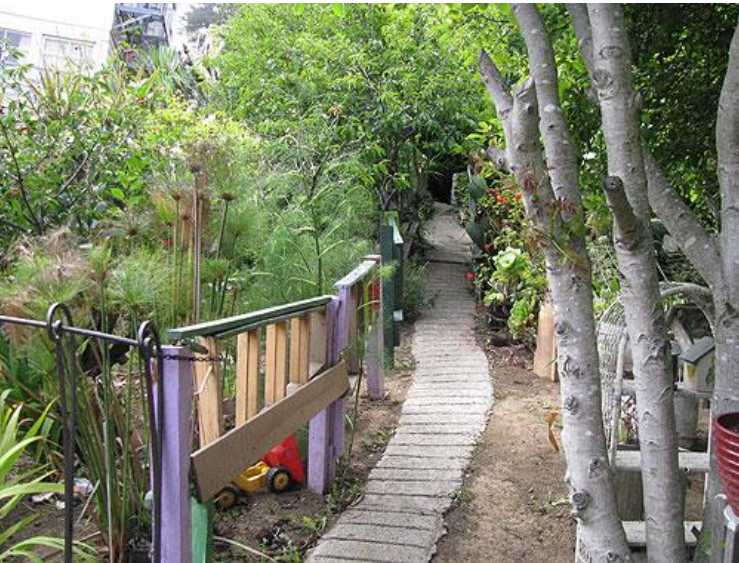
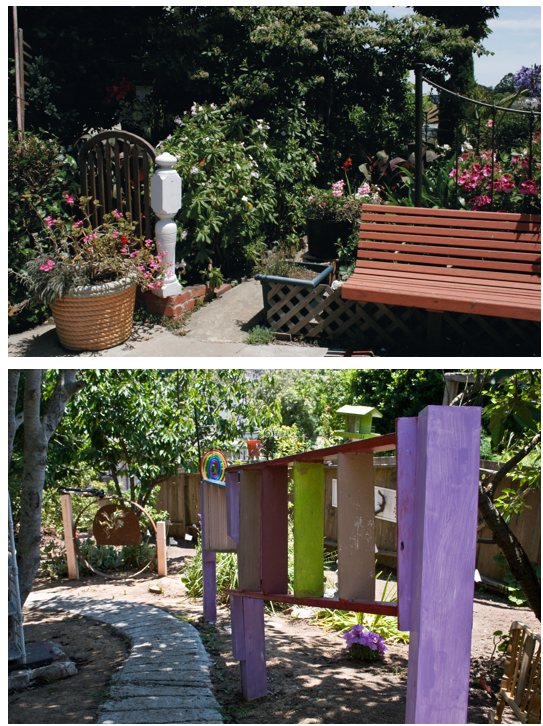
SLOPE Fire Damage Repaired
The damaged boards were replaced on May 30. The total
cost was $631.50 excluding plants. The redwood will darken over time to match. If you can help fund this, please do here. And thanks to those of you have already helped.
After
Welcome to Captain Sean Frost, Park Station
Captain Sean Frost has joined Park Station.
Address: 1899 Waller St, San Francisco, CA 94117 (between Stanyan Street & Kezar Drive).
Non-Emergency: (415) 553-0123
Station Line: (415) 242-3000
Tip Line: (415)
731-2865
Childhood Memories of Corbett Avenue and Twin Peaks in the 1950s and 1960s
by Al Kovalick, Jr.
Editor’s Note: Al Kovalick lived on Corbett Avenue for 20 years before heading off to college. He worked in Silicon Valley as an electrical engineer for 40+ years. He currently lives with his wife May in Santa Clara. We invited him to share his story of his childhood. He can be
reached at [email protected].
Growing up in San Francisco on Corbett Avenue during the 1950s and 60s was a wonderful experience. It was a huge playground for me—winding Corbett Avenue, Twin Peaks, Mt. Sutro and more. Life at home was calm with my father Al (of Al’s Park), my mother Virginia, my late sister, Janice, whom we called Squeak, and dog Jasper (lived 18 years). What follows is a collection of memories with many photos from my early years, up to about age 12.
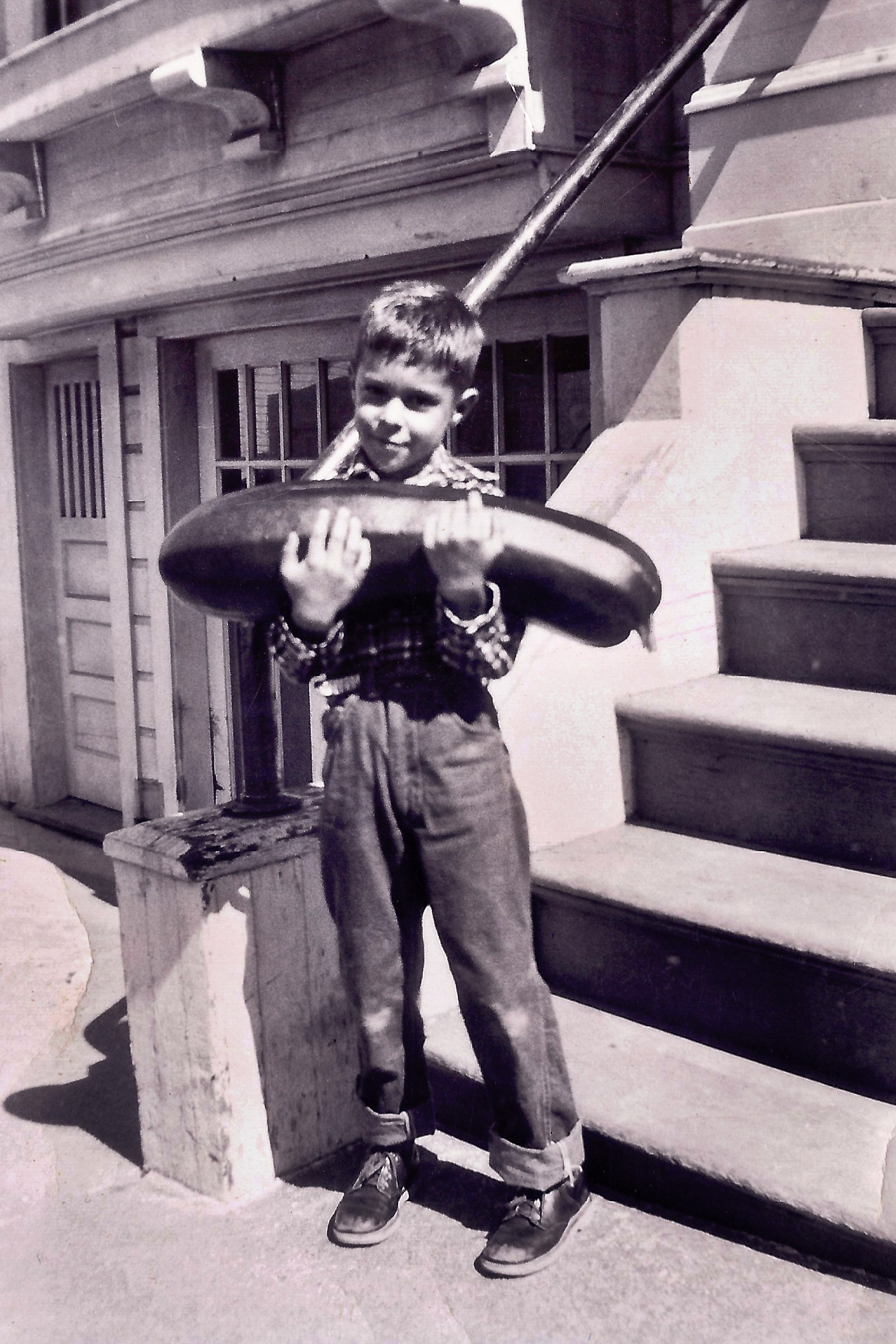
Until age 6 I lived at 383 Corbett. My mom’s parents owned the building (a duplex) and they lived at 381. There was a large rear garden and grandma loved to grow veggies. Here I am with one of her zucchinis in front of the 381/383 home, age 5.
Credit: Kovalick Family
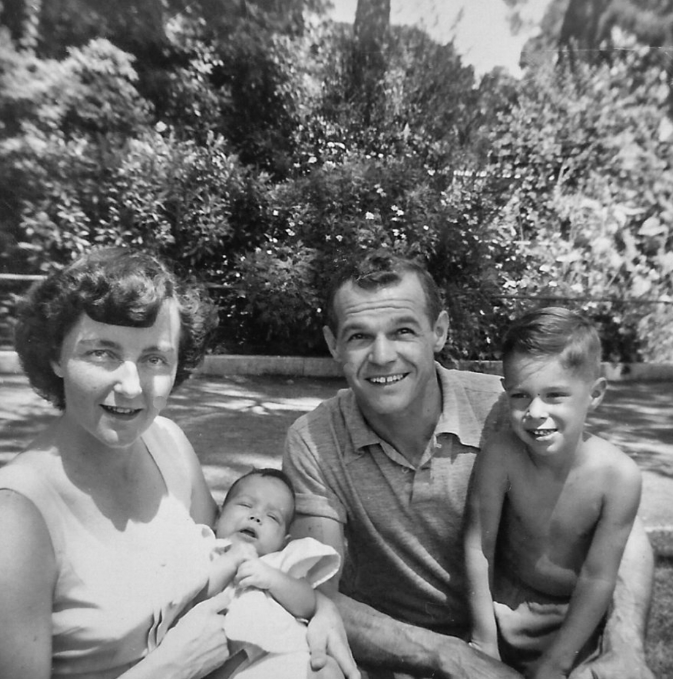
Having my grandparents living so close was great for my development. I visited them daily. Grandpa Jess was a home builder and plumbing inspector in San Francisco. He was a craftsman and built the wooden frame for an 8-line telephone system I built at 17 while attending Lowell High School. My dad worked as a plumber at UCSF on Parnassus for his livelihood. It was a bonus since he could walk to/from work if needed, and I could visit their powerhouse and learn about steam boilers. Mom was a homemaker. Below is a family picture when Squeak was a baby circa 1953.
Credit: Kovalick Family
Life on Corbett and Twin Peaks
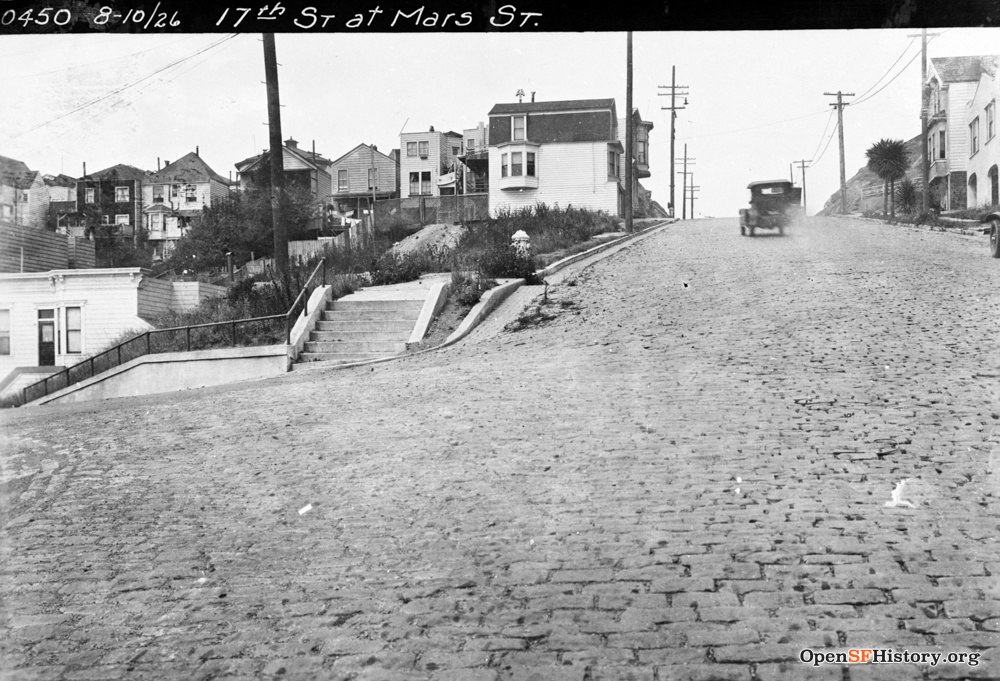
One of my early memories are the bricks on Corbett Avenue. Why? Circa 1955 the city laid asphalt over Corbett Avenue’s bricks and the process fascinated me.
Wow, heavy equipment at my front door. What could be better! Here’s a very early picture of the bricks on 17th Street similar to those on Corbett Avenue.
17th Street at Mars,
1926 SFOpenHistory.org wnp 36.03422
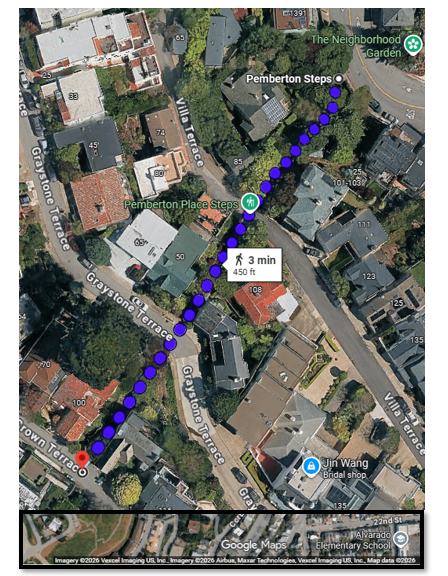
In the 1950’s parents could let their kids roam free in my neighborhood without too much worry. At age 7, I discovered the Pemberton Steps, climbing the eastern slope of Twin Peaks starting at Clayton near Corbett. I loved to run up and down and play hide-and-seek.
Pemberton Steps at Corbett. Google Maps, 2026
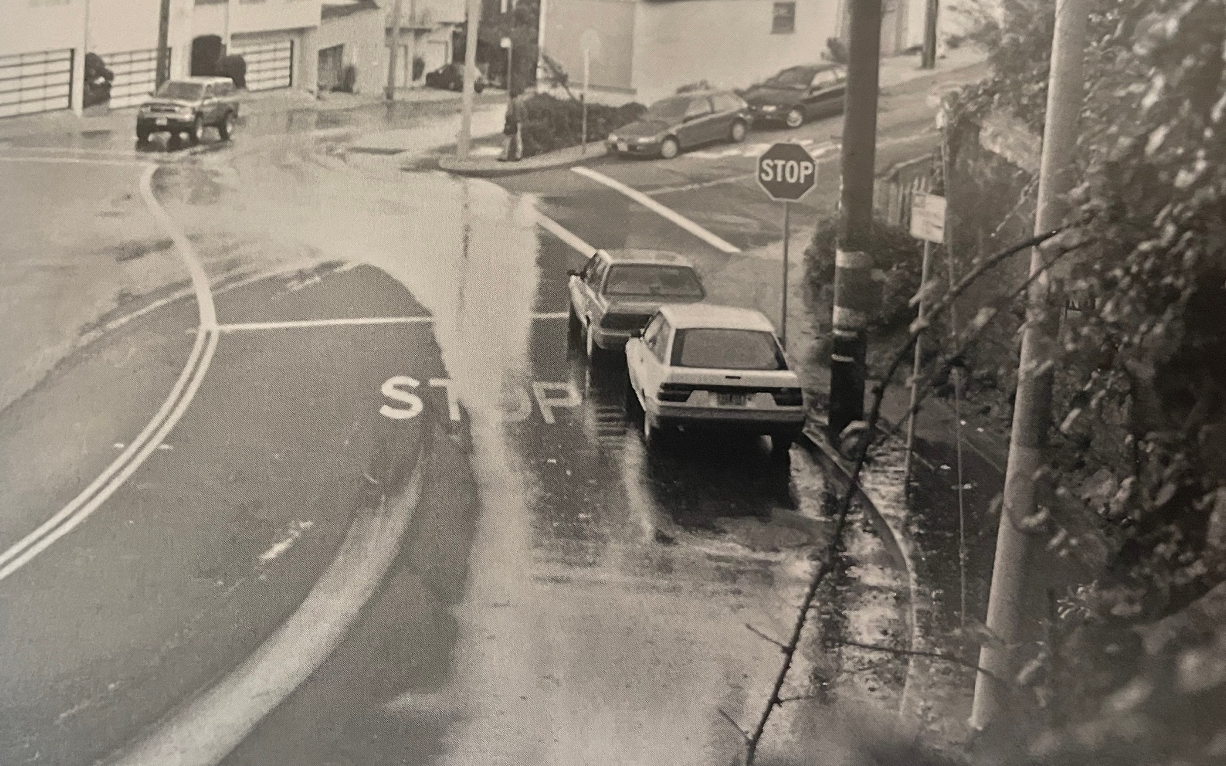
Near the entrance to the steps there were natural springs leaking out of the hillside. This was a persistent problem for many years. The sidewalk was often wet and slippery, especially in
the winter. I waited here many times for the 33 Ashbury bus.
The perpetual weeping hillside on Clayton near Corbett 1970s Credit: Lynn Oakley, San Francisco's Twin Peaks
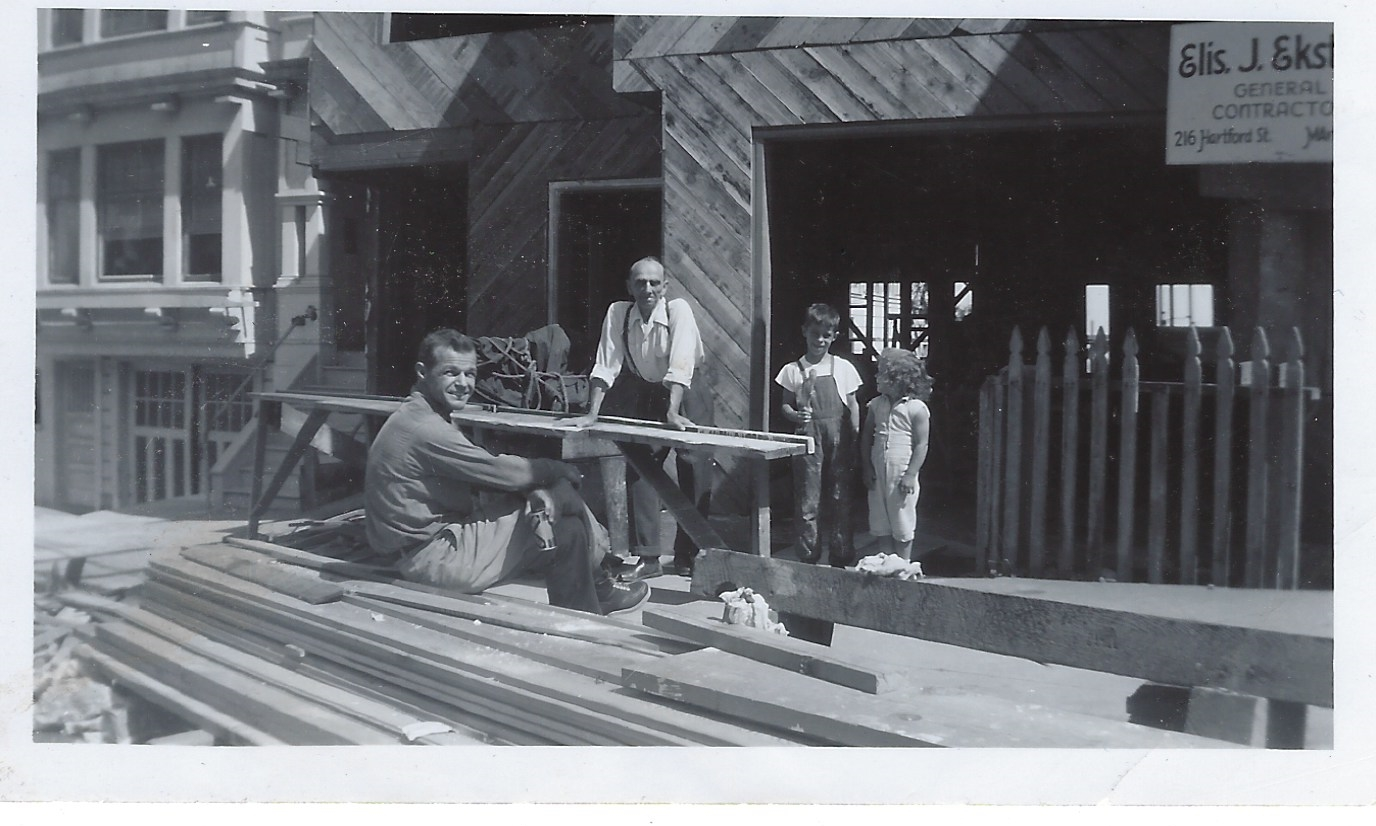
When I was about 6 my
parents purchased the vacant lot adjoining my grandfather’s house. My dad hired an architect for a new home design. Contractor Elis. J. Ekstrom built the house (385 Corbett). Here is a picture of my dad, Ekstrom, me and my sister Squeak about 1955. Ekstrom also built the home at 100 Corbett Ave (corner of Ord and Corbett).
Credit: Kovalick Family
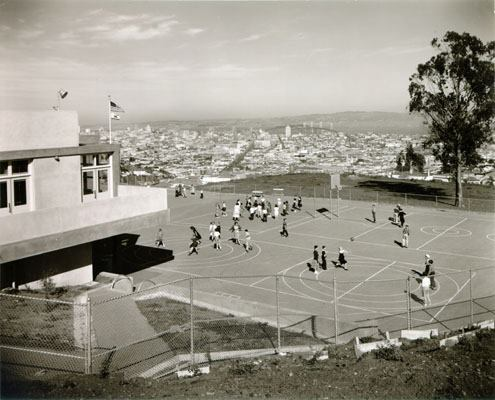
I went to Twin Peaks Elementary at Corbett and Romain from Kindergarten to 6th grade. This school (~1953 new) replaced the “old Twin Peaks” (1919) school on Corbett and Iron Alley. Today both school
buildings are called “Rooftop School” (with different campus names).
Twin Peaks Elementary 1953 San Francisco History Center, SF Public Library SFH 3, San Francisco Unified School District
Records
Some of my teachers (all woman) were Heinke, Byrd, Wesenberg, Bucher, Stettler, and Fischer. I enjoyed playing “Kickball.” The goal was to kick a ball that another person rolled toward you over the fence, near the large tree in the picture. Notice how few large buildings existed downtown.
We had Kickball teams and one semester I wa on the Pickles with teammate Joannah Kadish. Some other school friends were Alan Lee, Levon Nishkian,
Bruce Cambell, Jerry Jones, Charles Van Tassel and Pam Gray. Pam was a grandchild of the Mosby’s, owners of the Miller-Joost house in the 1950s (directly behind our home). Sometimes after school, we played hide-and-seek on Twin Peaks. The school was about 500-feet from Christmas Tree Point, still a popular lookout, and we often climbed there. Walking the figure-eight loop around the two peaks was always a fun time with great city views.
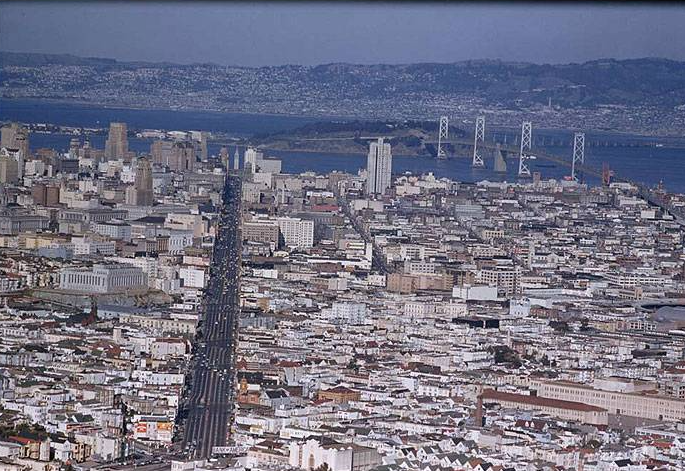
View from Twin Peaks, 1955FoundSF.org
Market Street Widening Project
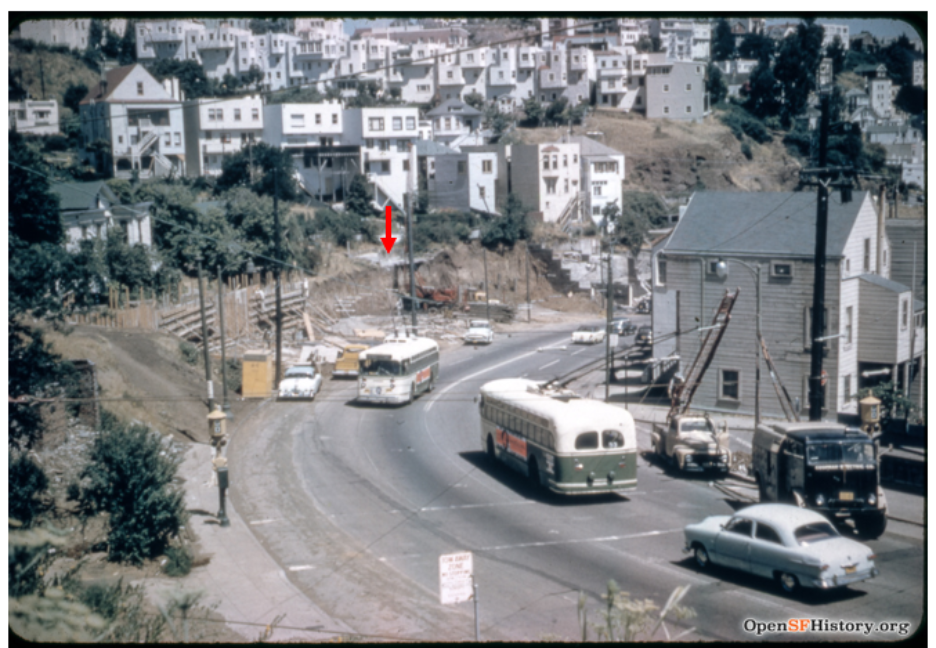
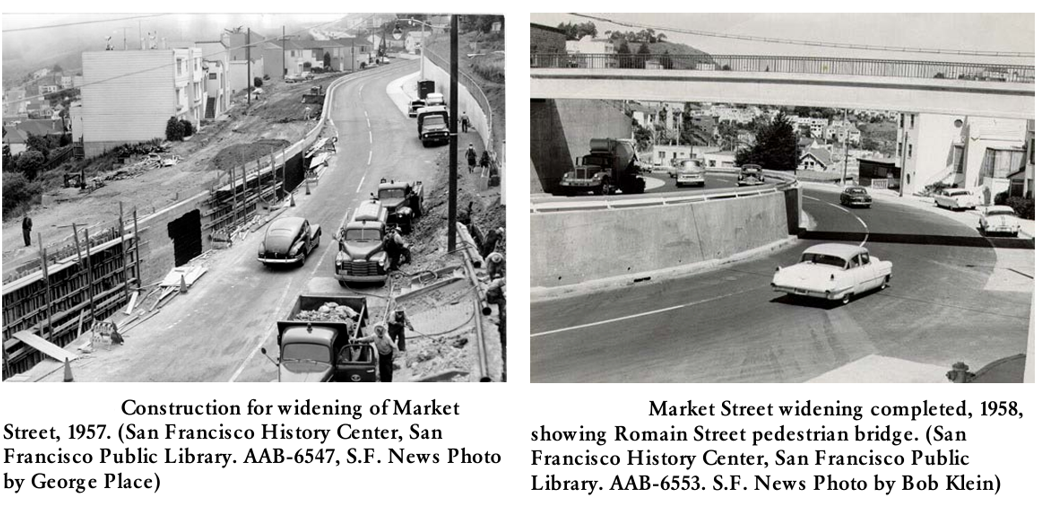
In 1957-9 (upper) Market St was made wider. What joy for this kid -- bulldozers, cranes, construction! The image
below is Market at Eagle Street with two 33 Ashbury buses in view. The Miller-Joost house (3224 Market) is at the far left. Larry Dresner’s home is the gray, four story, far left.
The widening was mostly on the west side of Market from Danvers to Burnett Avenue, about 1 mile. In the picture, a retaining wall is being constructed. Notice the ~30-foot “Right‑of‑Way acquisition” claimed for Market that was private land. There were many such acquisitions along Market for the
widening project.
Market at Eagle Street, 1957 (arrow added by author) OpenSFHistory.org wnp25.5089
During summer vacation I found plenty of time to watch the
workers. Sometimes during their lunchtime, I would beg to sit in the seat of some turned-off heavy equipment. What a thrill that was. In 1956 there was a home at the end of Mono St also called 19th Street (rear of Al’s Park, now) and it was scheduled for demolition to make way for a new retaining wall. The home’s location is indicated by the red arrow in the image above (only a foundation remains in picture). Before the professional demo started, friend and neighbor Larry
Dresner and I removed a few lead counterweights from the windows and used them as tools to break up most of the lathe and plaster walls in the house–oh, what fun. No one ever stopped us.
The home’s bare foundation survived for 60+ years until the property was purchased and a new built there in 2020.
Sutro Tower
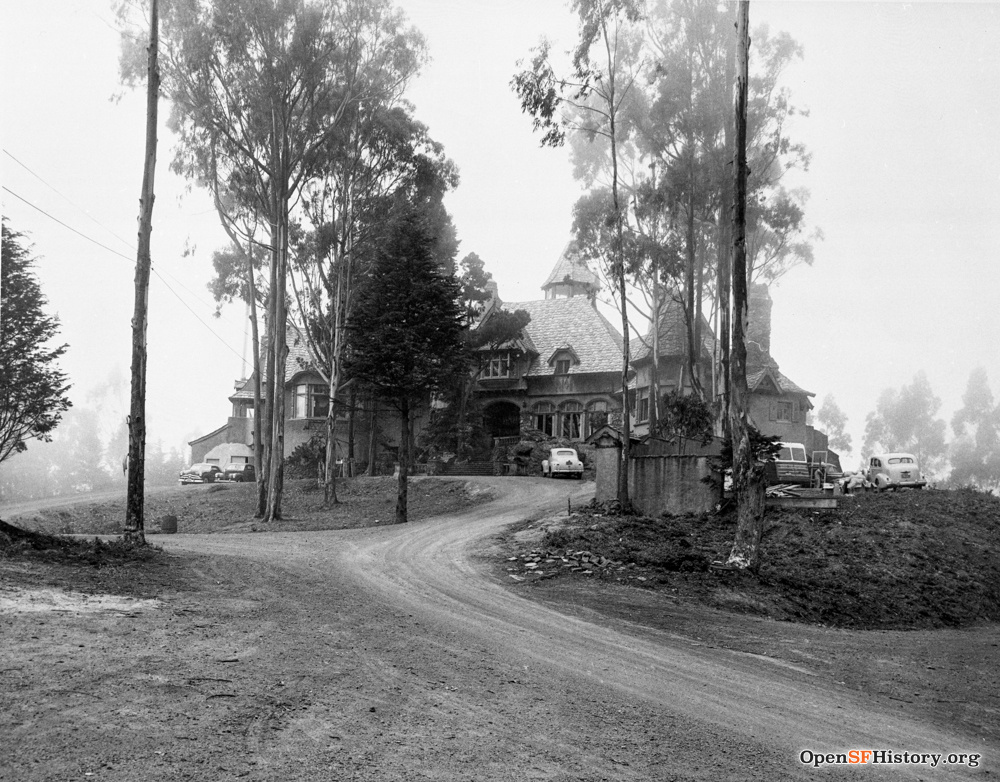
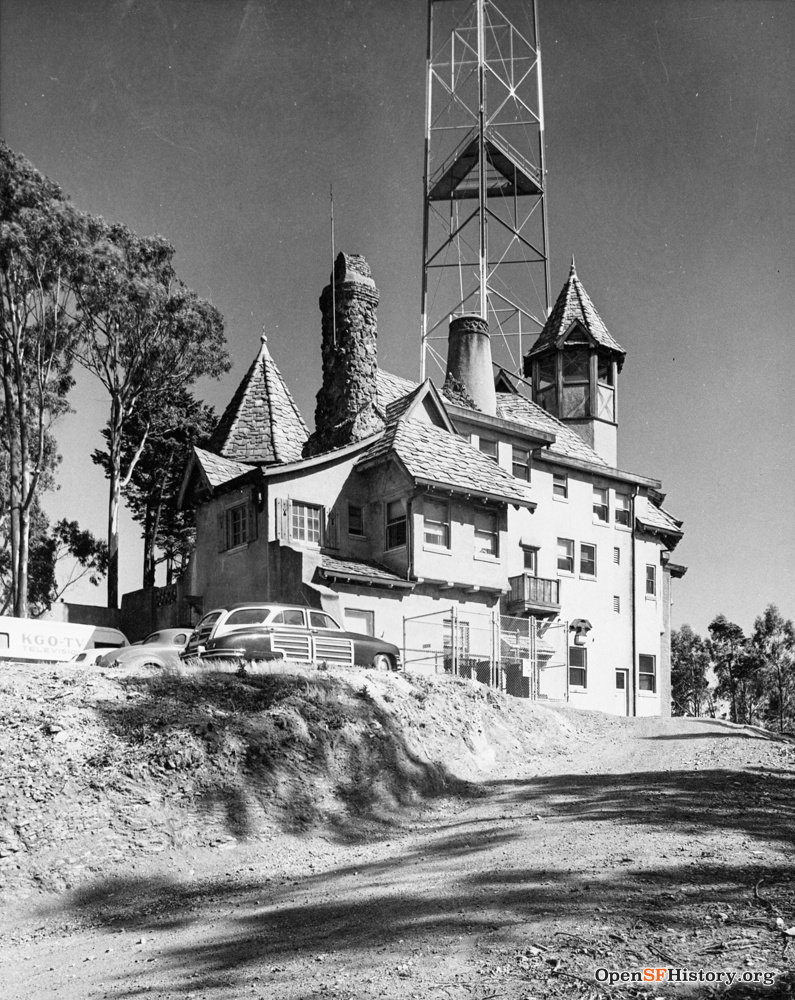
The Sutro TV Tower is a well-known SF landmark visible across the Bay Area. It's on Mt. Sutro, close to Twin Peaks and about 20 minute walk from home. In 1948, ABC bought the Sutro mansion, built in the 1930s by Adolph G. Sutro, for its KGO‑TV transmitter and studio. ABC added a 510-foot tower beside the mansion; the current
977-foot tower was constructed between 1971 and 1973.
Sutro Mansion Prior to Tower, 1950 OpenSFHistory.org, wnp 26.1404
Sutro Mansion with Tower, 1955 OpenSFHistory, wnp 26.1405
It was exciting to wander around the unguarded property. I could look inside the windows and see the transmitter, although I didn't recognize what it was
then. It was cool standing at the tower’s base and staring straight up. I can’t imagine a solo kid being allowed that freedom today.
Tank Hill
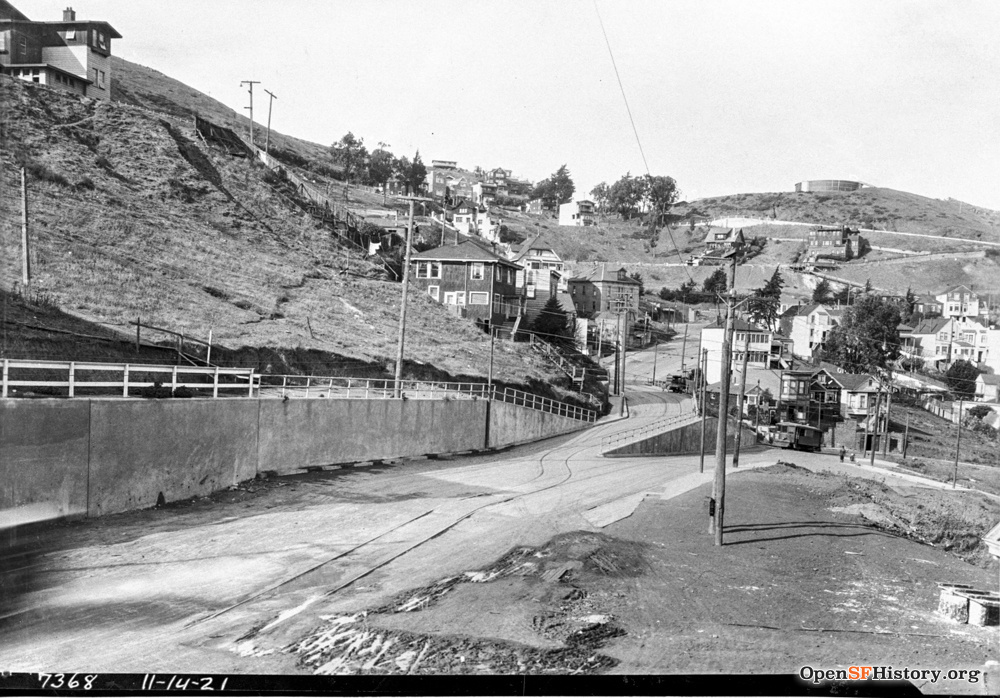
Tank Hill is located near Sutro Tower and was once home to the Clarendon Heights Water Tank, constructed in 1894. The image below shows the water tank in the distance viewed from Market and Clayton Streets in 1921. The tank looked the same in the 1950s until it was demolished in
1957.
Clayton and Market, 1921 OpenSFHistory.org WNP 36.02657
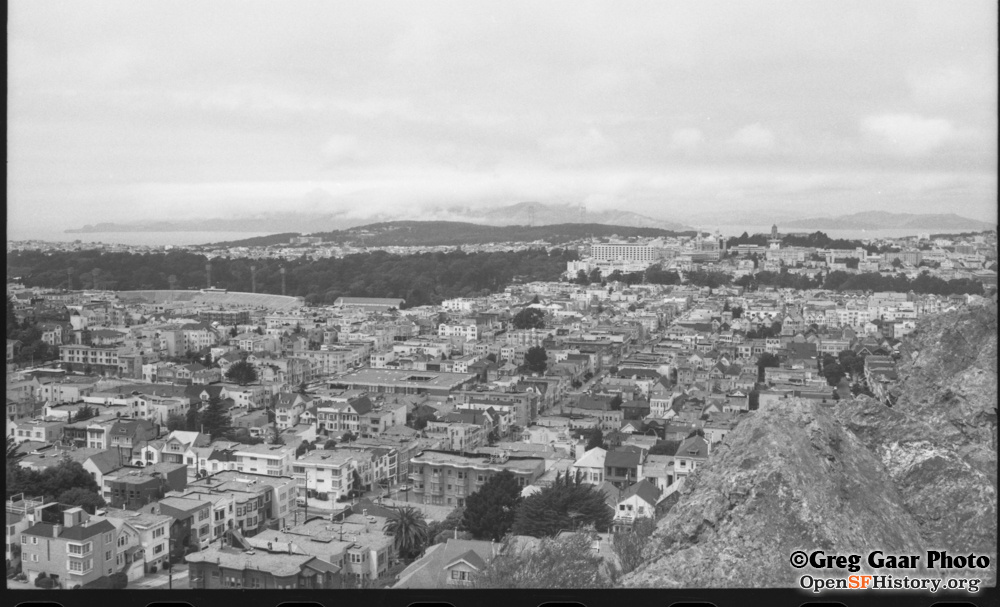
The Clarendon Heights Water Tank at top, giving the name “Tank Hill.” The hill has good views
of the Golden Gate Bridge and downtown San Francisco.
View from Tank Hill Towards Marin, 1947 OpenSFHistory.org wnp.72.239
Near the base of the Hill, was Twin Peaks Grocery
(corner of Twin Peaks Boulevard and Carmel Street). Andy Cherton was the owner, and my mom would often send me to buy items. I got many tooth cavities because licorice was only a few pennies per whip. Andy would often give me a leftover end piece of Columbus Salami to gnaw on. Funny thing, I am not a big meat eater as an adult, but I make an exception for salami (and licorice). Good childhood memories die hard. If I had 10 cents, I would sometimes buy a kite from Andy to fly on Tank
Hill. The wind was constant, as was the fog in the summer, and climbing up to the Tank was always a fun challenge. I ripped many kites in the wind, but this never stopped me from trying again.
Nike Missile Site
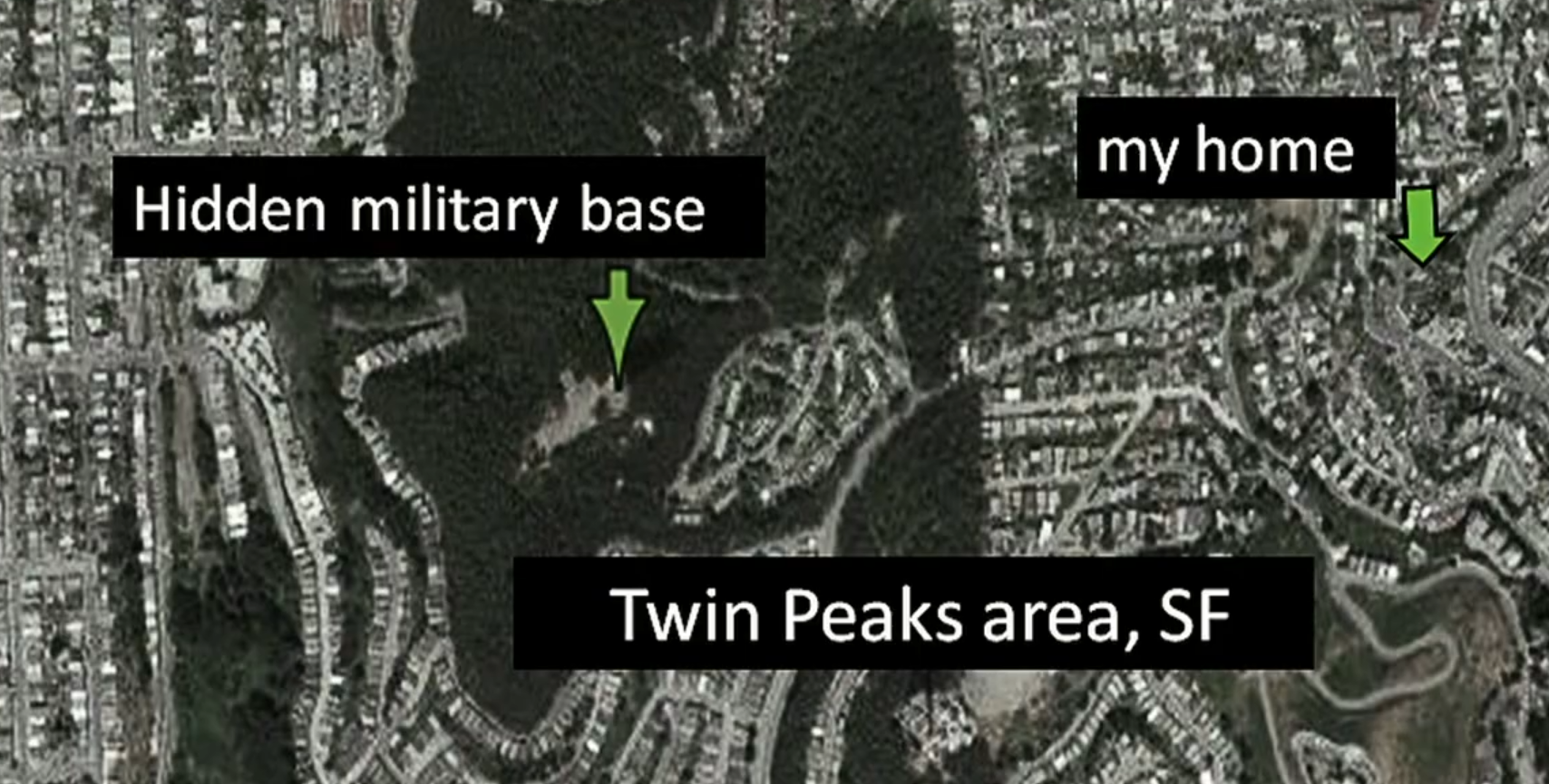
I will never forget my first encounter with the Nike Missile site on Mt. Sutro. I was about 10 years old and exploring the Sutro forest off Clarendon Avenue not far from the TV tower. I saw a fence with signs attached – “WARNING –
RESTRICTED AREA,” and “THIS AREA IS PATROLLED BY ARMED GUARDS” and others. This was my invitation to get closer. While approaching, an armed guard inside the compound hollered out “get lost kid.” I was scared for sure but excited to discover this amazing place in my backyard. See image below. Dense trees concealed the site from view. It was near the Married Students Housing complex associated with UCSF.
Behind the fences were several metal buildings and two big radars, one rotating. I loved it! “What could this be,” I wondered. I later discovered it was Nike-Ajax Missile Site
SF-89C, a Cold War-era air defense installation. It was designed to protect the Bay Area from the threat of Soviet bomber attacks. There were ~200 Nike‑Ajax sites in the US at that time.
SF-89 was operational from 1954 to 1963.
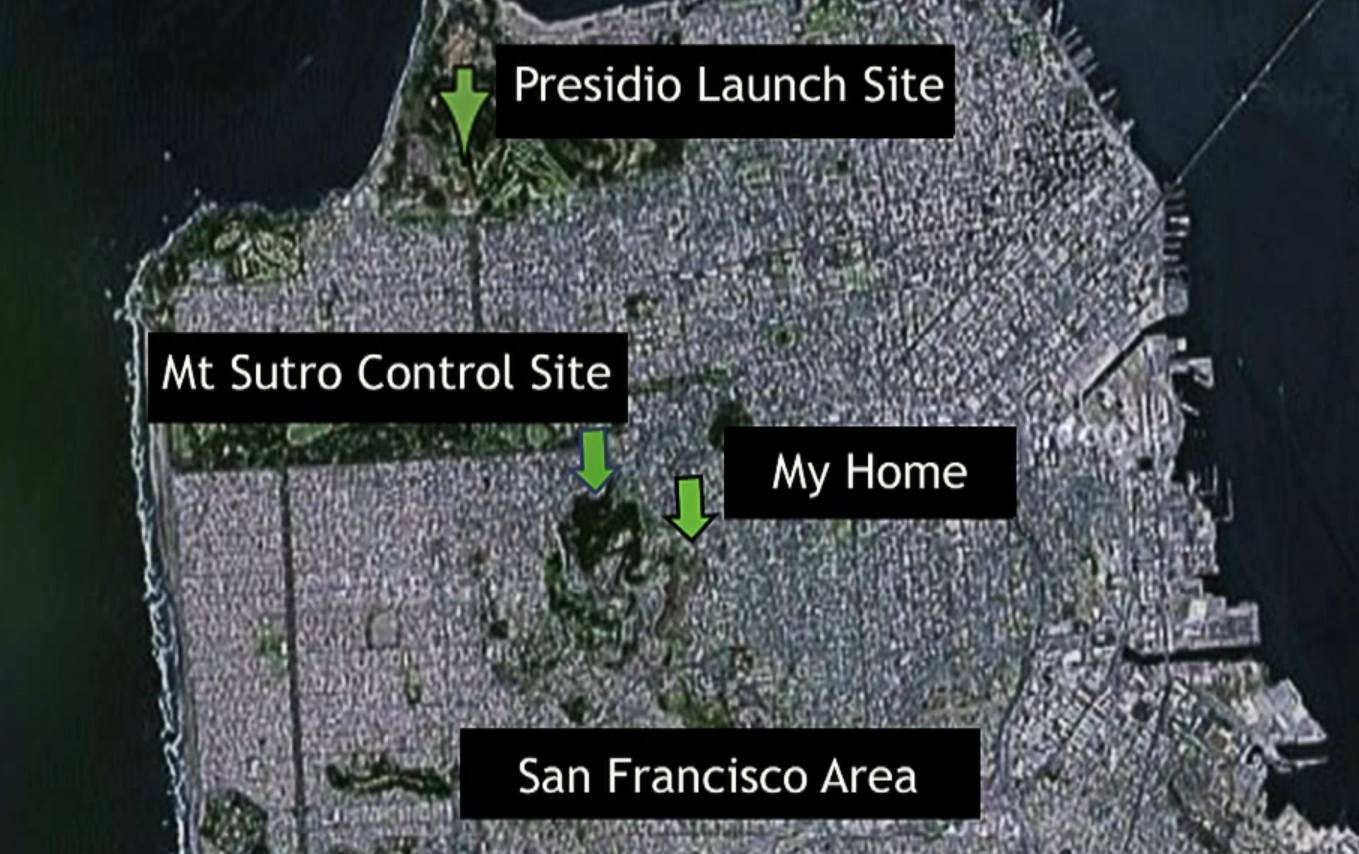
It was armed with 12 Nike-Ajax missiles located at the Presidio (SF-89L)
The control (C) site was 2.5 miles from the launch (L) site as seen in the image below.
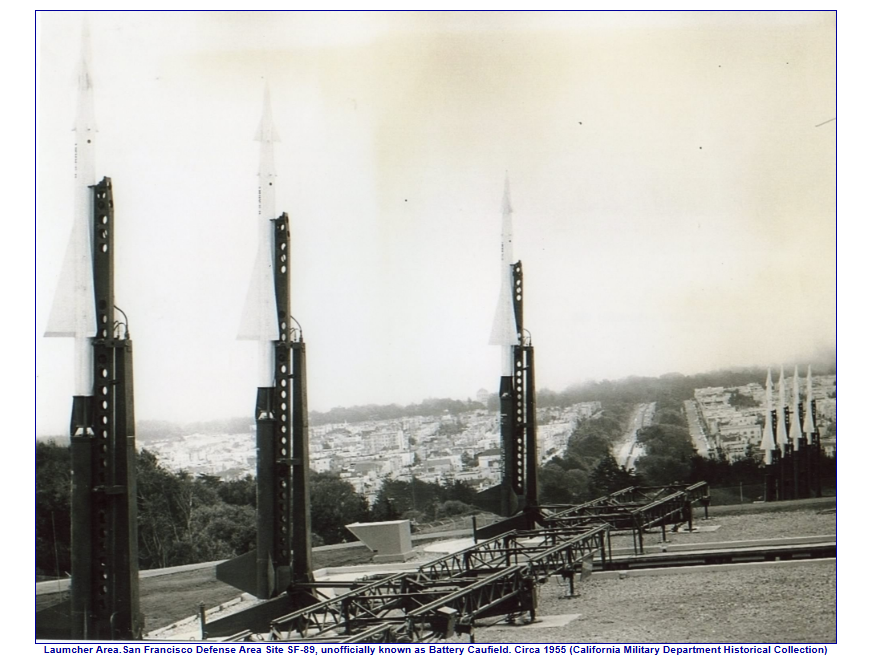
Not until 2010 did I finally unravel more details. The Launch site and Control sites are normally separated by two miles or more so a launched missile can be tracked more easily by control radar. Below is a picture of the Presidio launch site in 1955. In the
background the wide street is Park Presidio Boulevard. Today this area is part of a maintenance yard operated by the Presidio Trust. As an adult, I did visit the Launch site once and saw the underground missile storage space (closed off now).
Presidio Launch area, site SF-89L, circa 1955 (California Military Department Historical Collection)
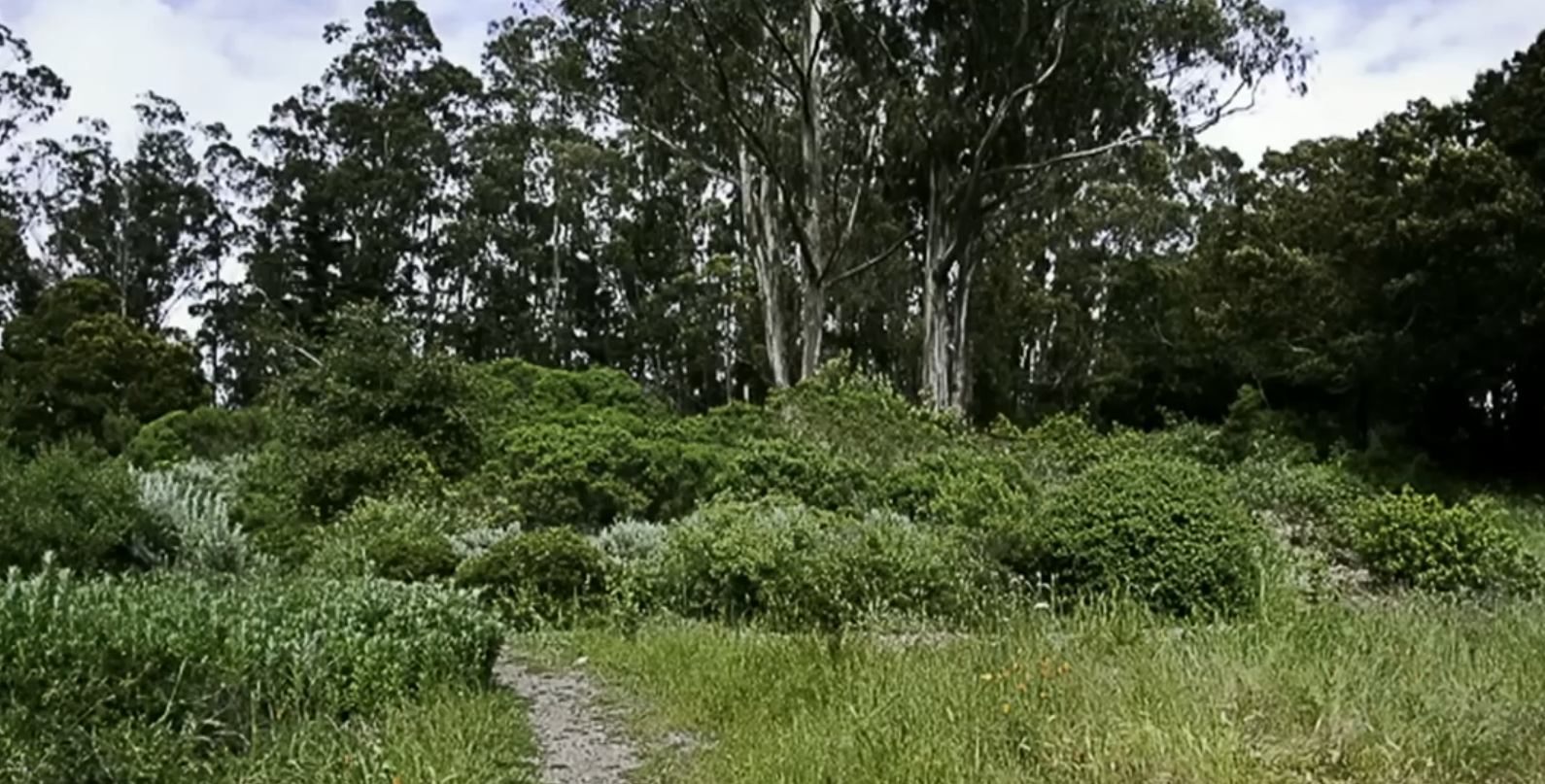
The Sutro Nike Control site (decommissioned 1963) is now peaceful Rotary Meadow, a park-like area maintained by UCSF and the Rotary Club of San Francisco. Visitors can park on Clarendon Avenue and walk to the Meadow.
Rotary Meadow, 2018 Credit: Al Kovalick, Jr.
In 2010 I made a video inspired by my childhood experiences with the Sutro SF-89C site. The short story presents a history of the Nike-Ajax system with emphasis on the existing “SF-88 working
museum” in the Marin Headlands. Scan the QR code below to view the history with interviews of some that worked at Bay Area Nike sites in the 1950s-60s.
https://www.youtube.com/watch?v=5c9RmjLLFhM
Al’s Park
For most of my life I witnessed my dad starting/maintaining Corbett neighborhood parks as a hobby. His first endeavor was the park on the corner of Corbett and Clayton. He began working on this in the mid-1960s. The park is still there, ably maintained by Chris Smith. For 40+ years dad sustained what became known as “Al’s Park” near 377 Corbett. He would work
on it, often daily – pruning this, planting those, and building that.
Al’s Park circa 2001 Credit: Al Kolavick, Jr.
Al’s Park, 2004 Credit: May Kovalick
Al loved Corbett life and I grew up loving it too. Although I now live in Santa Clara, a big part of my heart is still on
Corbett.
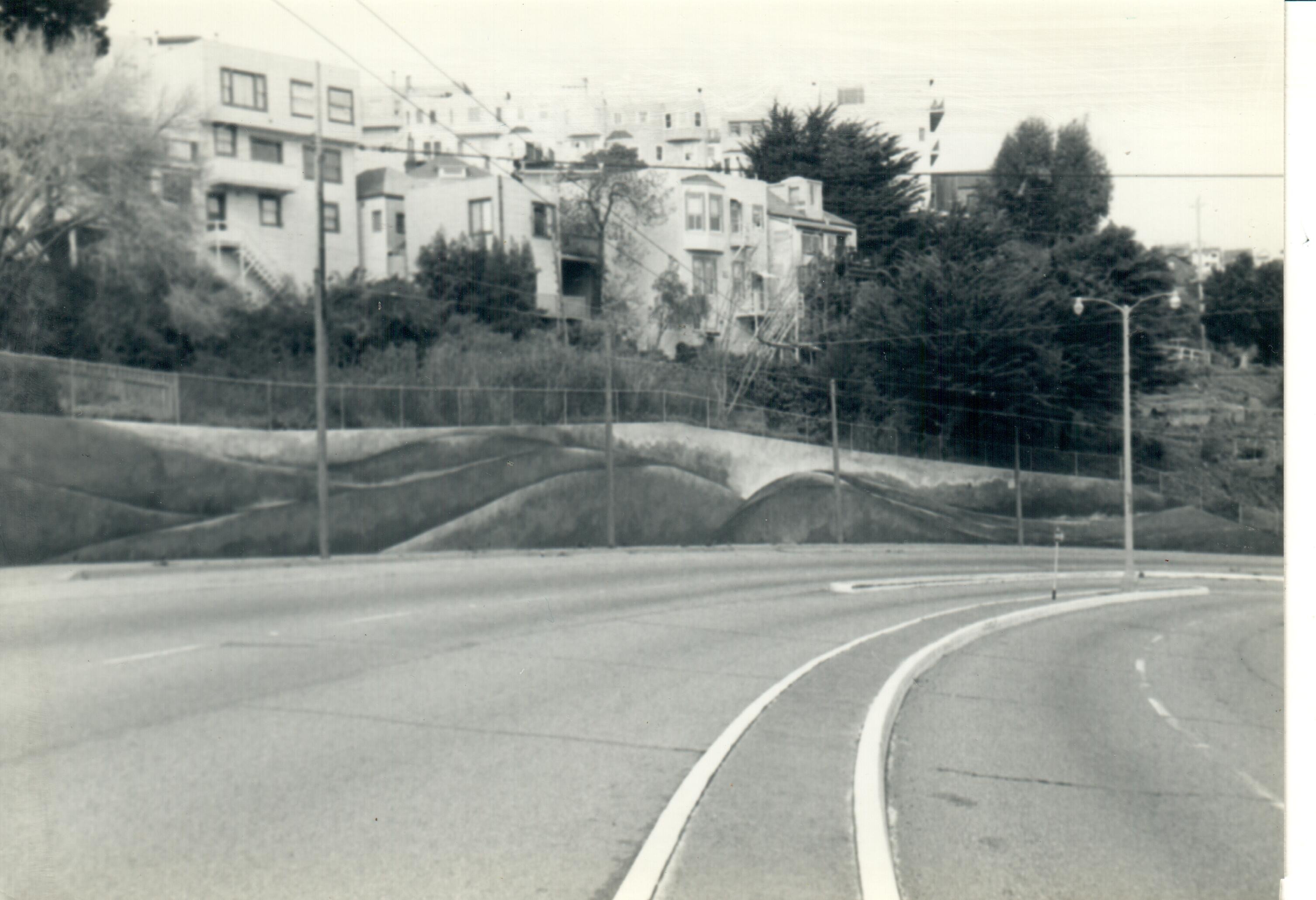
“The Chant of the Earth, the Voice of the Land” Mural on Market Street
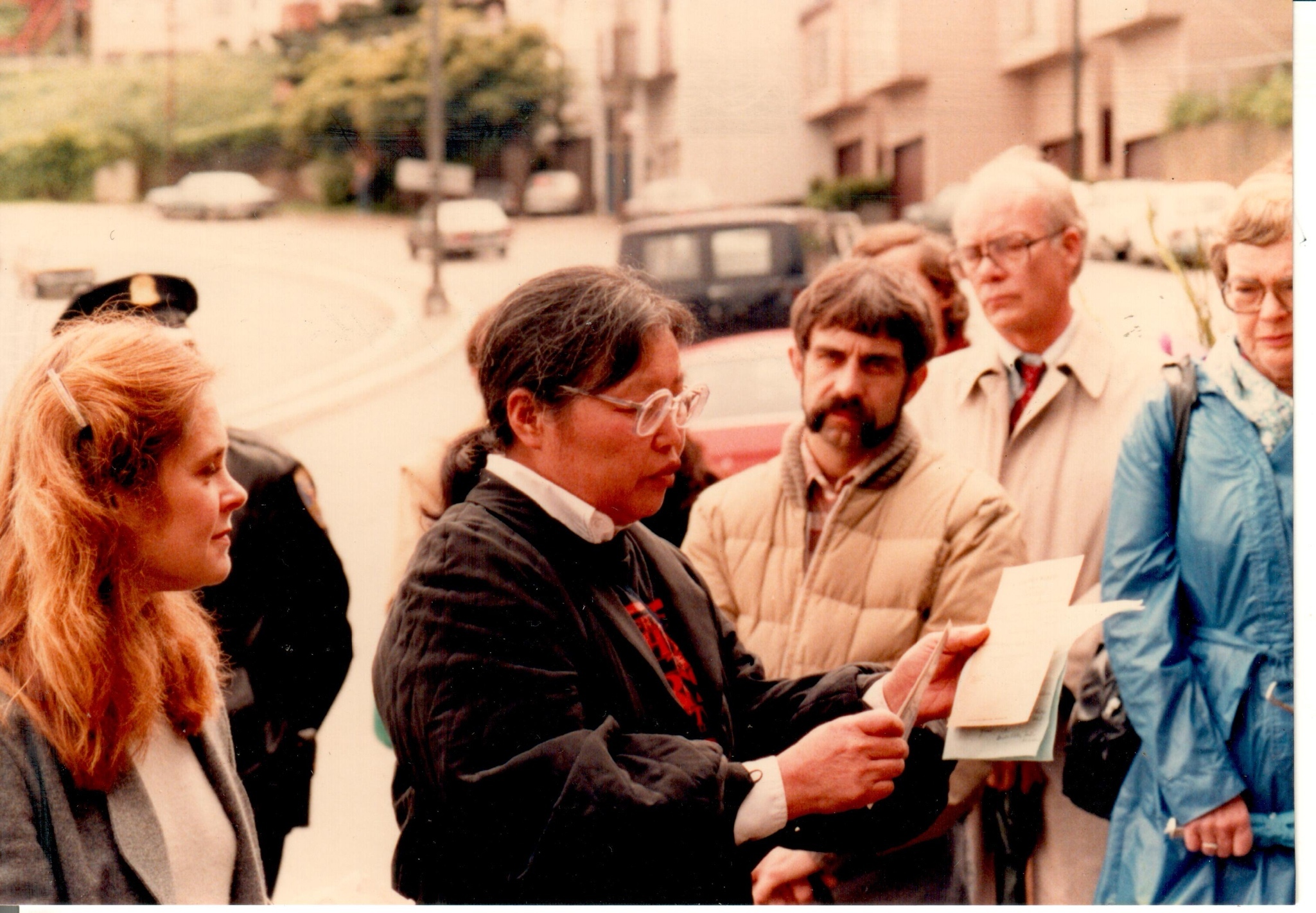
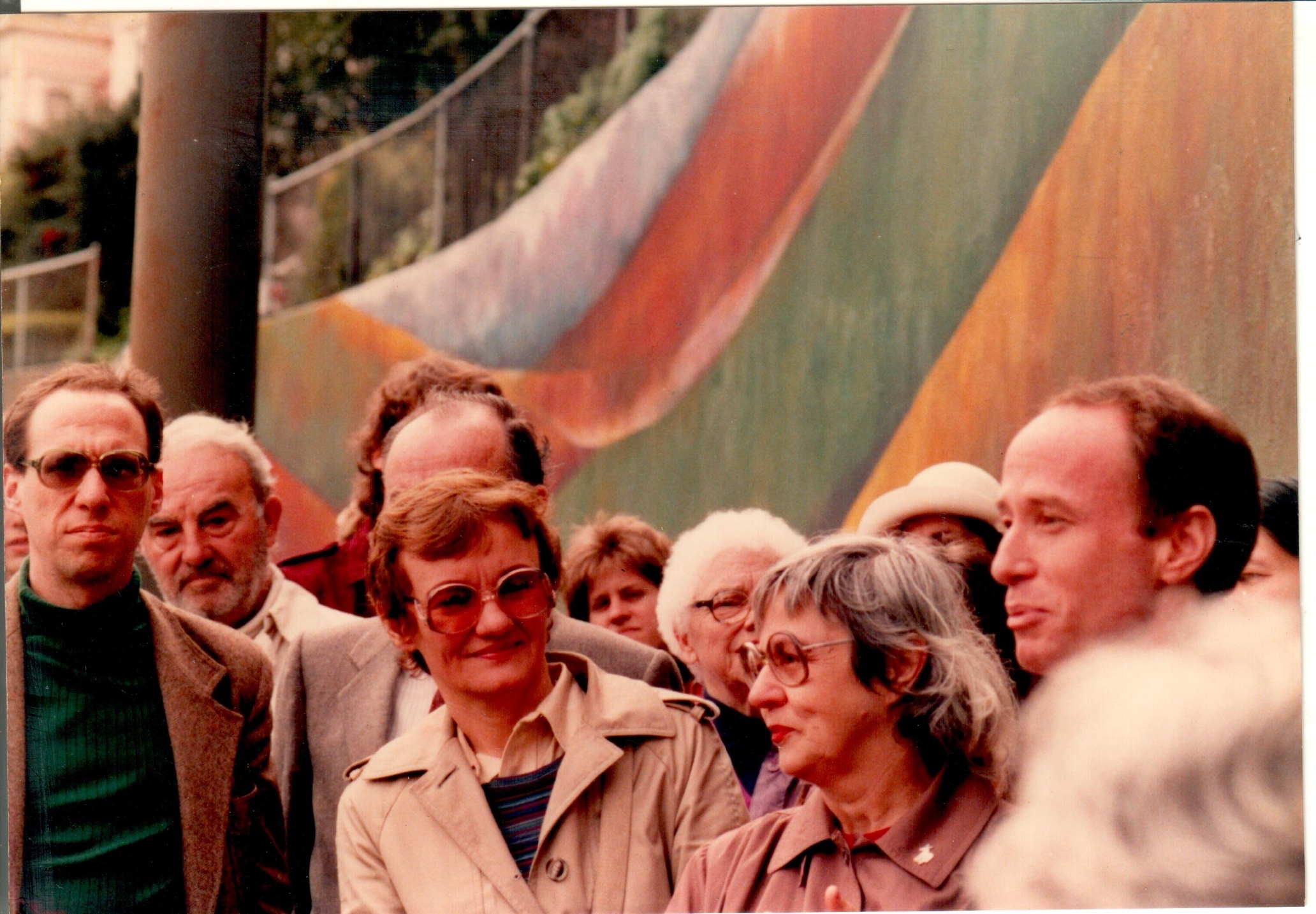
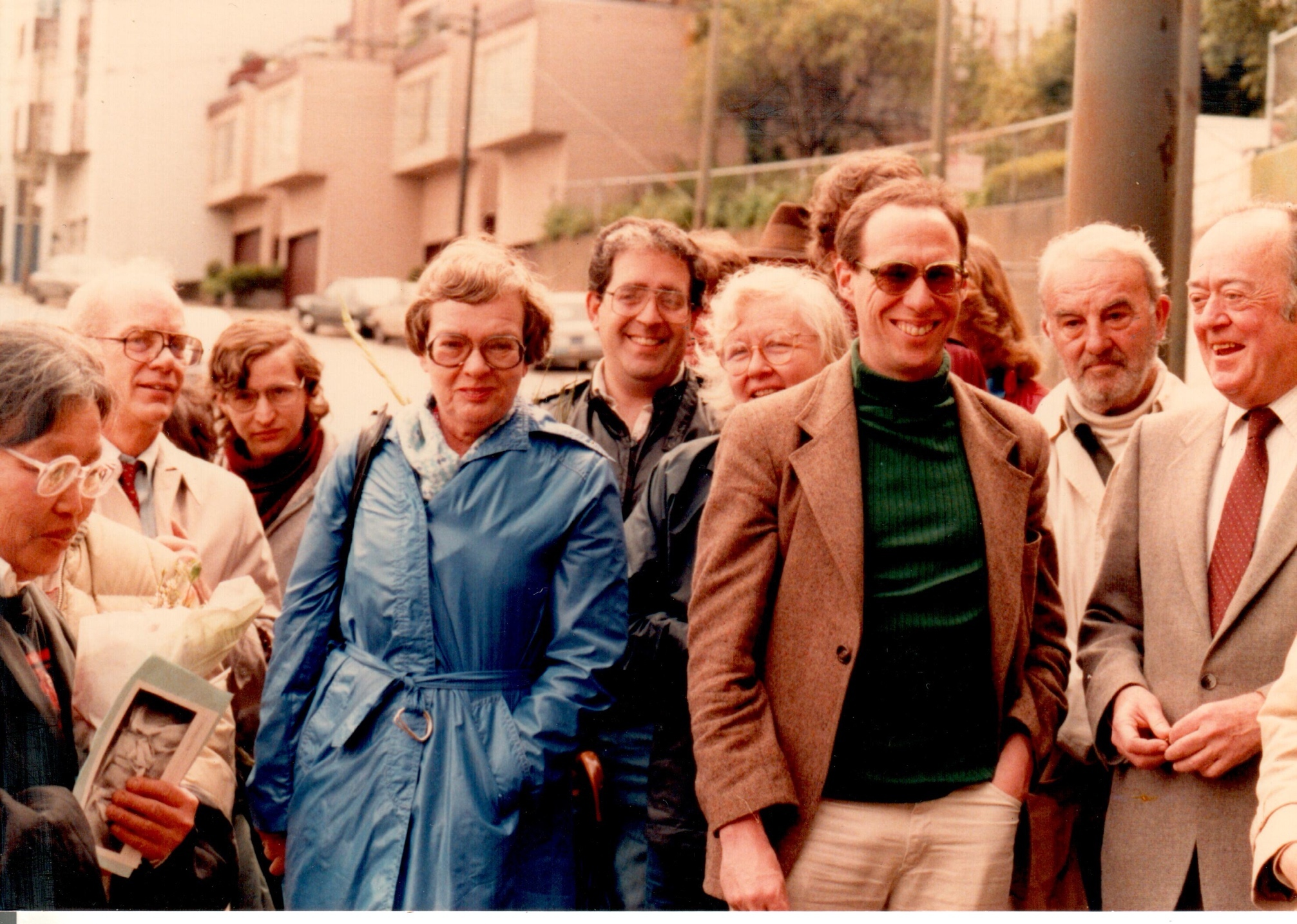
The mural by Betsie Miller-Kusz was completed (the first time) in 1981. In February 1983, local politicians and neighbors attended the dedication. You might recognize Ruth Asawa, artist; Senator Milton Marks, Sue Bierman of the Board of Supervisors, Planning Commission, and the Port Commission; Dorice Murphy. Betsie
Miller-Kusz recalls Dorice:
“…was a force of nature, a fierce advocate for all matters concerning Eureka Valley. She lived on Yukon St. and kept a sharp eye on all the City departments’ plans for Kite Hill. (It is still wild because she opposed various plans for developments there.) She knew everyone in City Hall, and her faithful husband Frank accompanied her to many hearings. I met her through my first mural at the Eureka Valley Rec Center, and she helped with all the
funding for the Upper Market mural as well as its first restoration in 1993. Dorice was a close friend of Ruth Asawa, and would call upon “Ruthie” for help with the Art Commission or other public agencies as needed. I think she was an officer in the Eureka Valley Promotion Association….As you might have guessed, I just loved Dorice. She was fearless and feisty, and as a young community artist in SF, I learned from her how important the neighborhoods were, and how it was possible to make a
great difference in your own. She passed away in 2007.
If you can identify others, let us know. The photographs are from the collection of Betsie Miller-Kusz.
1981
Richie’s Picks: THE LIONS’ RUN by Sara Pennypacker,
Macmillan/Balzer and Bray, February 2026, 288p., ISBN: 978-1-250-39281-7
“Such a long, long time to be gone
And a short time to be there.”
– Phil Lesh and Robert Hunter (1970)
“I ain’t a-marching anymore”
– Phil Ochs (1965)
“‘No more war. Do you think that’s actually possible? I mean no more war, not just this one over.’
Lucas waited. Alice was thinking about something.
‘My grandfather…,’ she
started after a minute. And then she paused again.
‘Your grandfather?’ Lucas prompted. ‘The one with the American friend in the Great War?’
She nodded and put down the blinders. ‘Once, when I was young, I was playing with my toy horses, pretending they were in a battle. That upset him. He put down his paper, took my hand, and walked me into our village center. He didn’t say a single word the whole way. He led me into the pub and pointed up to the ceiling. There, I saw silver coins
nailed to the beams.’
‘What were they doing there?’
‘That’s what I asked him.’ Alice came over and sat beside Lucas on the hay bale. She stroked Felix’s forehead softly. ‘He told me that in the Great War, all the young men in our village were called up to serve. The night before they were to leave, they went to this pub together. At the end of the night, they all nailed silver florins to the beams, vowing that after the war, they’d meet back in the pub and take those coins down and
buy each other drinks, to…’ She took a breath. ‘To celebrate.’
Lucas was silent. Alice’s voice had cracked on the word celebrate.’
‘My grandfather was squeezing my hand so tightly. He’d gone to the pub with those boys. They’d invited him, even though he was the village squire, because he’d signed up to serve, too. He made me look at the ceiling again and said, ‘Look harder.’
‘This time I noticed some nail holes among the coins. My grandfather pointed to one. ‘Thomas
Thackery, the town farrier,’ he said. ‘He made it back, took his coin down.’ He pointed to the coin beside the nail hole. ‘Rupert, his brother, a blacksmith. He didn’t make it home.
‘My grandfather knew every nail hole, every coin. There were more coins than holes. I was crying by then, but my grandfather went on and on, boys who came back, boys who didn’t, all of them parts of our village. Including himself.’
Alice threw herself back onto the hay, looked up at the stable beams as if
she were seeing those silver coins. ‘That war my grandfather was in, the Great War, well it wasn’t so great. And they called it “The war to end wars,” but here we are again. Here we’ll always be.’
‘Maybe not. Maybe one day we’ll learn.’ Lucas couldn’t believe it was him saying those words. But he had just realized that hope was a job, and somebody had to do it, and today that somebody was him.”
Lucas Dubois is a tween orphan who has been raised since infanthood in the
abbey of a now-Nazi-occupied village in France. In a sense, the lack of family ties make him a bit of an outsider. But his chores include daily deliveries around the village, so he gets to see and hear a lot of what is going on.
If you have not previously heard or read about THE LIONS’ RUN, you are likely to in the coming months. It is a thrilling piece of WWII/Holocaust historical fiction for all ages. It serves as a powerful piece of anti-war literature. Set in 1944, it is a
must-have for all collections serving children and tweens. There are aspects of the story, relating to the Nazis, that will be new and enlightening/horrifying even to many adult readers.
But, for me, the reason why THE LIONS’ RUN is THE book of 2026, has nothing to do with its relationship to Trump’s current war-of-choice, although that is certainly a valuable bonus.
For me, the genius of this story involves the decision-making and action-taking exhibited
by the tween orphan. It involves the eternal question of, what is/what makes a hero? That is what we find at the core of this brilliantly-developed, unforgettable, coming-of-age tale,
In order to avoid spoiling any of the excitement, I need to dance around the specific decisions and actions Lucas takes. Trust me. This is one that’ll you can’t miss, one that’ll keep you reading past your bedtime. Know that you’ll want to savor every page of this gem, one that I
guarantee is going to win awards at the end of the year.
My point is that the story contains powerful lessons of morality for young readers, life lessons that are applicable to any reader’s current and future development and decision-making experiences. My hope is that the story encourages many readers to put themselves in Lucas’ place. Then, based upon the readers’ own teachings and experience, what would they do if they were in the main character’s shoes? What is their gut
reaction? How does it compare to what Lucas does?
It’s all still going round and round in my head: Could I have had the guts to…